

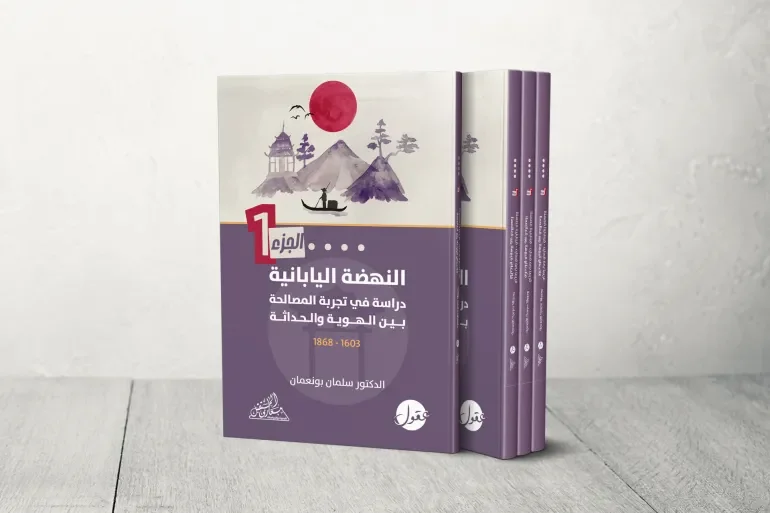
No Miracle in Tokyo.. A Book Returns Japan to the Laws of Urbanization
SadaNews - When he was a student in the early 1990s, the question pursued him: why did the Japanese succeed while the Arab and Islamic world failed? The echo of Prince Shakib Arslan's question – "Why have Muslims lagged behind while others progressed?" – resonated in his ears, and a lecture by Moroccan thinker Abu Zayd Al-Maqri Al-Idrisi in 1992, titled "The Islamic World and Horizons of Change: The Japanese Experience as a Model," opened a window that he thought might reveal some of what he was searching for.
A quarter of a century later, Salman Bounanman presents his answer to the reader: a two-part work consisting of about 700 pages, titled "The Japanese Renaissance - A Study in the Experience of Reconciliation Between Identity and Modernity," published this year by "Aqool Al-Thaqafa for Publishing and Distribution" in partnership with the "Future Knowledge Center for Research and Studies." Bounanman, a political science professor at Sidi Mohammed Ben Abdallah University in Fes and the head of the Future Knowledge Center, is not a stranger to the subject; he approached it in 2012 in his book "The Japanese Experience: A Study in the Foundations of the Renaissance Model."
However, what lies between the two books represents a transformation in vision, not just an expansion in the volume. The work was presented and signed at the university's hall during the activities of the International Fair for Publishing and Book in Rabat in early May, with the participation of engineer and international expert Nour El-Din Lshahab and a group of university professors.
The Illusion of Miracle
The central thesis of the book begins with demolishing a frequently repeated phrase: "the Japanese miracle." Bounanman believes that this phrase, in its common formulation, removes the experience from its historical context and cloaks it in an exceptional garment that exempt it from the laws of civilizational movement, rendering it a mysterious enigma that transcends its conditions. In contrast to this awe, he proposes that Japan be read as a human trajectory where successes and failures intertwine, and where the laws of urbanization apply just as they do elsewhere.
The Arabs were not far from this awe. Since the 19th century, Japan has been present in Arab reformist writings, from the mentions of traveler Muhammad Biram Al-Tunisi to Jamal al-Din al-Afghani and the "Al-Manar" school, reaching Shakib Arslan. The Algerian thinker Malik Ben Nabi also dedicated a distinguished presence to it as a civilizational model for contemplation.
However, this interest – despite its breadth – has largely remained a prisoner of emotional admiration, consuming the image of Japanese power after its defeat of China in the 1894-1895 war and then Russia in the 1904-1905 war, without dissecting the internal paths that produced that victory. The Arab discourse perceived the fruits of the Meiji (the imperial reform era that began in 1868), neglecting the soil that nurtured these fruits.
Three Centuries of Silence
The turning point in Bounanman's awareness came from the thesis of Moroccan historian Muhammad Afif, which he revisited with careful reading, flipping his perception upside down. Its summary is that what is called the "miracle" was the result of a long journey that matured over centuries of internal labor, away from any enchanting contact with Europe or imitation of ready-made models. The roots stretch back to the Tokugawa era, lasting from 1603 to 1868, where layers of experience in politics, administration, education, economy, and culture accumulated before their fruits were reaped in 1868.
From here, the familiar image of that era is turned upside down. Instead of being a stagnant, closed era waiting for a shock from the West to awaken, it becomes – in Bounanman's reading – a huge workshop for internal maturity, where institutions are formed, experiences accumulate, and a new civilizational awareness grows. Even the Japanese isolation is reinterpreted as a "smart isolation" that preserved the country's sovereignty without cutting it off from the world.
Civilizational Butterfly
To illustrate this slow and profound transformation, Bounanman borrowed from nature an image that arose in discussions with engineer Nour El-Din Lshahab: the model of the "civilizational butterfly." Japan, which emerged from the path as a completely different civilizational being, resembles a butterfly when it transitions from a silent egg to a diligent larva, then to a closed chrysalis, before finally flying in the open sky.
He is keen to clarify that this is a revealing interpretive metaphor, linked to a tradition that connects the Muqaddimah of Ibn Khaldun to the studies of British historian Arnold Toynbee regarding the rise and fall of civilizations, and to the philosophy of metaphor in the work of French philosopher Paul Ricoeur, which positions metaphor as a tool for knowledge rather than mere embellishment.
The model is supported by a conceptual distinction proposed in the book between "civilizational capability" and "civilizational attainment." The former refers to the latent catalyst for renaissance within the consciousness of the nation, that is, its psychological and intellectual energies that enable it to rise from its setbacks after every failure.
The latter is a formal achievement of material tools for progress when detached from the spirit that nourishes them. Between the two concepts is a significant paradox, as a nation may reach the height of material attainment and yet its civilizational capability might extinguish, leading it towards decline.
The rhythm of the book is built on this cadence. Its first chapters correspond to the phase of the egg, where civilizational potential is preserved by constructing the political system and managing external relations. Its middle chapters correspond to the lengthy larval stage, where material, cognitive, educational, and cultural accumulations consolidate over two centuries of patience. Finally, the last chapter ties the threads in its explanatory model, opening the door for the transition from chrysalis to flight, when Meiji Japan becomes a new civilizational being that retains a deep connection with its Tokugawa roots.
When the Hammer Becomes a Worship
The second part dedicates its deeper space to what Bounanman calls the symbolic, moral, and aesthetic structure of the renaissance, stemming from a thesis that institutions, markets, and schools do not move in isolation from a spiritual system that grants them meaning and taste. In this horizon, Shinto, Buddhism, and new Confucianism, along with the "Kokugaku" movement (an intellectual stream that sought to free Japanese consciousness from the hegemony of Chinese thought), intersect within a complex religious fabric that shaped the ethics of work, discipline, and belonging.
From this world emerges the details of the changing image of religion in Japan, where a Buddhist thinker transformed the hammer blow in the workshop into a worship that equals the meditation in the temple, while a popular ethics current addressed the merchant and craftsman in a language that sanctified daily work. Therefore, sanctity did not get confined to temples, but extended to crafts and workshops, producing a disciplined individual and a collective awareness of identity.
The Arab Mirror
Behind all of this lies an Arab question that does not leave the book. Bounanman does not study Japan for its own sake alone, but rather as a mirror for the Arab-Islamic predicament. He chose "reconciliation between identity and modernity" as an entry point, recalling Moroccan philosopher Taha Abdurrahman's distinction between the spirit of modernity and its Western applications, and invoking the expression of Lebanese-French writer Amin Maalouf about the "killing identity" that invested in wars and sectarianism until it became a trap for every comprehensive national project.
The horizon he aspires to is to liberate the Arab discourse from a stifling binary where one side is alienation before the other and the other side is closure on the self. For him, Japan stands as a witness to a third path where a nation borrowed the tools of the age without losing its spirit, and opened itself to others without severing its roots.
It remains that the book does not promise its reader a ready-made recipe for replication. The butterfly is not made in a laboratory, nor its stages can be shortened by a decision. Perhaps this is the most difficult aspect of the Japanese lesson as Bounanman sees it: that renaissance requires patience with the calm fire of history, not an explosion at one moment.
As for the question he carried as a student a quarter of a century ago, the reader departs having transformed it in hand, from a question about an obscure incapacity to a question about a dormant ability waiting for someone to awaken it.
Source: Al Jazeera
 Follow the latest Sada News via Google News
Goodbye to Cavities.. A New Gel That Rebuilds Tooth Enamel

UNESCO Officially Lists the Tunisian Village of "Sidi Bou Said" as a World Heritage Site

Morning Chaos of Choosing Clothes.. Is the "Capsule Wardrobe" the Solution?

Joshua defeats Brinjar by knockout and approaches a fight with Fury

After a Century of Unity.. Discovery of an Unknown Relative of a Rare Plant in Oman

Can you be healthy while obese?

Opening of the National Festival for Theater.. Esaad Younes dedicates her honor to Samir G...
