

Khartoum Rejects American Proposal to Equate Rapid Support Forces with Contact Points
SadaNews - Sudanese official sources revealed that the government has reservations about new proposals from the US President's advisor for Arab and African affairs, Mus'ad Boulos, regarding arrangements for a ceasefire lasting 90 days.
The sources, which requested anonymity, stated that Khartoum maintained its position in response to Boulos's previous document after the Security and Defense Council, chaired by Sovereignty Council President Abdel Fattah al-Burhan, acknowledged that the government conditioned the withdrawal of Rapid Support Forces from all locations where they are deployed in the Darfur, Kordofan, and Blue Nile regions in three phases, collecting them at specified points, while Washington proposed a limited withdrawal.
The official sources declined to discuss details of the new American points that Khartoum reserved judgment on, nor did they confirm or deny a recent meeting between Sudanese Foreign Minister Mohiuddin Salem Ahmed Ibrahim and Mus'ad Boulos after about a month since their previous meeting in Cairo on June 20.
However, an informed source clarified that Mohiuddin Salem arrived in Cairo last Sunday on an unannounced visit and received a new document from Mus'ad Boulos carrying amendments to his previous paper, which included steps for troop withdrawal and redeployment when necessary, prioritizing the first phase for the states of North Darfur and North Kordofan. The source refrained from disclosing the details of the new amendments.
Institutionalizing Division
The Sudanese digital platform "Al-Ean 24," close to the government, reported that Boulos's new proposals include field arrangements that lead to institutionalizing separate spheres of influence on the ground.
According to the platform, the new proposal stipulates that the Rapid Support Forces withdraw from a number of cities in exchange for repositioning themselves within specified geographical ranges dubbed "contact points," which is a mechanism that defines areas of troop deployment and control during the 90-day ceasefire period.
It clarified that the proposal allows the Rapid Support Forces to retain their positions in the Darfur region and large parts of Kordofan, along with a range of the Northern State extending alongside Darfur to the border triangle with Egypt and Libya, in exchange for their withdrawal from areas in the Blue Nile State.
It quoted official sources as saying that these arrangements do not merely represent a temporary cessation of hostilities but could effectively lead to solidifying a new map of military control, particularly as the proposal does not include a clear timeline for ending the repositioning or restoring state authority over those areas.
According to the same sources, the absence of a time limit and binding guarantees means institutionalizing permanent spheres of influence, which opens the door to a scenario of actual division of Sudan, similar to the multiple areas of control and influence in Libya.
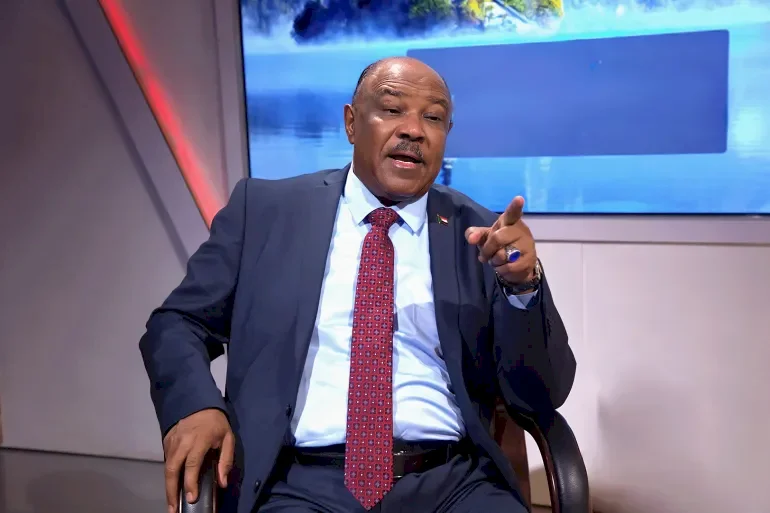
For his part, Foreign Minister Mohiuddin discussed in an interview with Sudan's official television the nature of communication with Mus'ad Boulos, clarifying that the envoy conveys messages to the Sudanese government, while the relevant institutions examine and respond to them.
He added that the dialogue between both sides is still ongoing, pointing out that Khartoum reaffirms in its responses that what the country is experiencing is, as it describes it, "an external attack supported by the Rapid Support militia alongside mercenaries," expressing hope that these communications yield positive results.
Political Pressures
Regarding sanctions, Salem stated that American sanctions on his country based on allegations of the army using chemical weapons, as well as recent British and European sanctions that restrict the import of gold from Sudan, will not only reflect on his country but will also affect the interests of the countries that imposed them within Sudan.
He added that the sanctions policy imposed on Khartoum has persisted for decades without achieving the results those countries sought, considering that it has become a means of political pressure on his country.
In his view, the imposition of these sanctions has coincided with any military advancement achieved by the Sudanese army, expressing hope that the United States and Britain would reconsider these unilateral measures.
Salem denied the validity of American accusations regarding the Sudanese armed forces using chemical weapons, affirming that the government requested the United States to send an investigation committee to verify these allegations but no response was received, nor was any investigation conducted prior to sanctions being imposed.
He added that the claims regarding the use of chemical weapons in areas of the capital Khartoum are incorrect, saying: "These areas we are living in now."
Strategic Relations
In another matter, the Sudanese Foreign Minister announced that his country and Saudi Arabia will sign an agreement next month to establish the Higher Council for Strategic Cooperation and Coordination.
Salem viewed this step as "a qualitative leap in the course of relations with the Kingdom of Saudi Arabia, a strategic partner of Sudan."
He said that Sudan looks forward to a strategic partnership with the Kingdom through this council, as it represents a pivotal institutional framework to unify visions and activate areas of cooperation, elevating bilateral relations to comprehensive strategic horizons.
Salem emphasized that "everything that targets Saudi Arabia and Arab countries also targets Sudan," stressing shared destiny and mutual interests.
He also praised the stances of countries that supported his country, mentioning Egypt, Turkey, Qatar, Oman, Eritrea, and other countries that stood by it.
Salem noted that support from some neighboring countries for the Rapid Support Forces is confirmed by international testimonies, affirming that Sudan will reevaluate its foreign relations based on the positions of countries during the war, pointing to what he described as external interventions from Ethiopia, Chad, Libya, and others in the course of the war.
The Foreign Minister indicated that South Sudan, as a state, does not have established interventions in supporting the Rapid Support Forces; however, he spoke of the participation of "mercenary groups and outlaws outside the jurisdiction of the southern government" in fighting against Sudanese forces.
Source: Al Jazeera
 Follow the latest Sada News via Google News
Raging Fires and a Hurricane.. Simultaneous Disasters Displace Hundreds of Thousands Acros...

Khartoum Rejects American Proposal to Equate Rapid Support Forces with Contact Points

30,000 North Korean Soldiers for War in Ukraine.. What’s the Story?

16 Killed in Mutual Attacks Between Russia and Ukraine

Dozens Dead and Injured in Collision of Passenger Buses on Deir ez-Zor - Damascus Road

Guterres Arrives in Syria on First Visit by a UN Secretary-General Since Before the War

UN General Assembly Extends Term of Human Rights Commissioner Turk for 4 Years
