

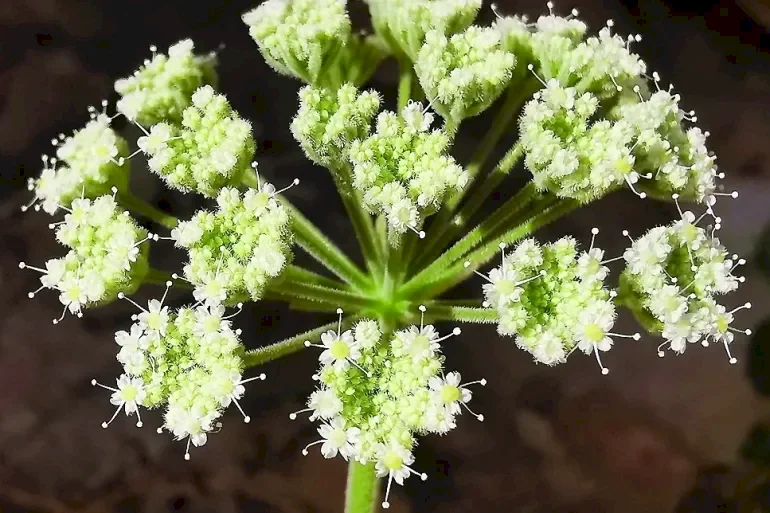
After a Century of Unity.. Discovery of an Unknown Relative of a Rare Plant in Oman
SadaNews - For many years, scientists believed that the plant genus "Adenosiadioum" contained only one species, the rare plant "Adenosiadioum arabicum," which was first described about a century ago. However, a chance encounter led a researcher from the Sultanate of Oman to discover a new relative that had remained unknown to this plant, naming it after the country to become "Adenosiadioum omanensis." This achievement was documented in a study published in the "Edinburgh Journal of Botany."
The story of this discovery began with an observation that caught the attention of Dr. Amina Al-Farsi, a plant taxonomist at Sultan Qaboos University, and the curator of the college's herbarium, while examining samples of "Adenosiadioum arabicum" preserved in Omani herbariums. She found that the plants from northern Oman differed in leaf and stem shape from those found in the southern parts of the country.
However, this observation was not enough to conclude that there were two types of plants misclassified as one, as mature fruits needed to be examined, being one of the key characteristics used in plant classification. This was the task that Dr. Amina vowed to carry out swiftly.
During a research mission in the Hajar Mountains of Oman, the researcher collected flowering plants and others bearing mature fruits. Upon close examination, it became clear that they had entirely different morphological characteristics than "Adenosiadioum arabicum," leading her to confirm that she was dealing with a new, previously undescribed species, which she subsequently named "Adenosiadioum omanensis."
What is special about "Adenosiadioum omanensis"?
"Adenosiadioum omanensis" is characterized by cylindrical fruits covered in long hairs, densely clustered flowers, and round leaves that can reach up to 70 cm in length. This distinguishes it from "Adenosiadioum arabicum," which has oval fruits covered in shorter hairs, more spaced flowers, and diamond-shaped leaves with a length of up to 50 cm.
Despite the differences in many elements, the fruits in the umbrella plants to which the genus "Adenosiadioum" belongs remain the most important criterion in plant classification, as scientists compare them to a "human fingerprint." Dr. Amina found that the fruit of "Adenosiadioum omanensis" clearly differed in shape and internal structure, confirming that she was facing an independent species and not just a morphological variation within the known species.
The researcher's estimates suggest that the new plant's spread might lead to its classification as "endangered" according to the International Union for Conservation of Nature standards, as there may be fewer than 10,000 plants across all its distribution areas. Some studied populations contain fewer than 100 plants, and some have less than 20.
Adaptive and Environmental Factors
Regarding the reasons for the differences between "Adenosiadioum omanensis" and its closest known relatives, Adenosiadioum arabicum, Amina states in interviews with Al Jazeera Net: "It could be that climate and habitat are the main drivers behind the evolution of the new species, as "Adenosiadioum omanensis" thrives in calcareous soil and arid conditions, whereas the southern species "Adenosiadioum arabicum" lives in sedimentary soils with tropical conditions."
Regarding the possibilities of its existence in areas other than the "Hajar Mountains," the researcher clarifies that "so far, this species is endemic to the Hajar Mountains of the Sultanate of Oman, and there may be some undiscovered populations in other locations along the slopes of the coastal mountains with similar topographic nature."
Dr. Amina emphasizes that overgrazing by animals and livestock poses the greatest threat to this plant, as it can affect its population size and survival in the wild.
She considers that her study is just the beginning of uncovering the secrets of this plant and determining whether it holds ecological, medical, or scientific importance, which will require further research to explore its chemical nature.
Dr. Amina concludes by asserting that the discovery carries a message she describes as "of utmost importance," namely, that the Arabian Peninsula is one of the most significant areas of plant biodiversity in the world, as the rugged mountains and deep valleys may hide more novelties and scientific discoveries."
Source: Al Jazeera
 Follow the latest Sada News via Google News
Goodbye to Cavities.. A New Gel That Rebuilds Tooth Enamel

UNESCO Officially Lists the Tunisian Village of "Sidi Bou Said" as a World Heritage Site

Morning Chaos of Choosing Clothes.. Is the "Capsule Wardrobe" the Solution?

Joshua defeats Brinjar by knockout and approaches a fight with Fury

After a Century of Unity.. Discovery of an Unknown Relative of a Rare Plant in Oman

Can you be healthy while obese?

Opening of the National Festival for Theater.. Esaad Younes dedicates her honor to Samir G...
