

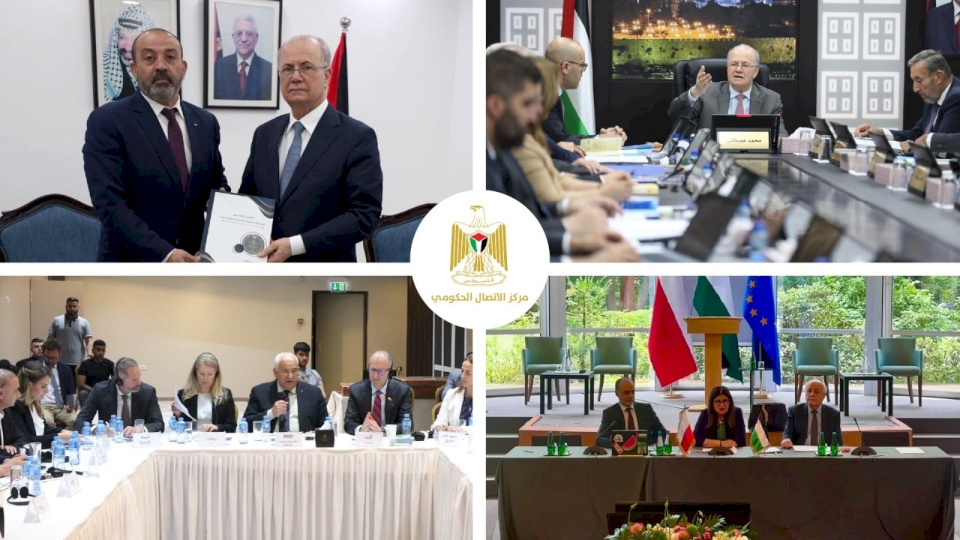
The Government Call Center Monitors Key Interventions Made by the Government Last Week
SadaNews - The Government Call Center issued a report highlighting the most important developmental and reform interventions implemented by the Palestinian government during the past week as follows:
The Cabinet renewed its call for urgent international action to stop the violent crimes committed by terrorist settler gangs against Palestinian citizens in various parts of the West Bank, and to hold those responsible accountable, amid a rise in assaults occurring under the protection of the occupying army, which have resulted in the death of several citizens and attacks on their properties in various provinces. The council warned of the dangers of continuing this escalation, emphasizing that these crimes require effective international intervention to provide protection for the Palestinian people and put an end to ongoing violations.
The Ministry of Agriculture continued to implement interventions to support the agricultural sector, most notably signing an agreement to supply equipment worth 126,000 shekels to complete the operation of Yatta Municipality's slaughterhouse within a project valued at 8 million shekels, funded by the European Union. Furthermore, it inaugurated the Agriculture and Veterinary Department in Sa'ir and distributed agricultural equipment and grants, alongside discussing the sector's needs with the Al-Dhahiriya municipality. The national vaccination and marking campaign surpassed 112,000 operations after implementing 4,400 new operations in the South Hebron Hills and the northern Jordan Valley. An urgent intervention was carried out to support the Bedouin communities north of Taybeh - Ramallah by distributing 20 bales of hay weighing 450 kg each to affected livestock breeders.
In the context of supporting farmers and rural women, the ministry conducted a marketing tour for 19 female farmers from Tubas and the Jordan Valley as part of the "EVAP3" project in partnership with "JICA." They also conducted activities for the olive field school in Sa'ir, attended by 15 female farmers as part of the "Mubadirati" project in partnership with the United Nations Development Program (UNDP), in addition to a reciprocal visit for 20 female farmers from Al-Minya and Marah Rabah in partnership with "FAO" within a project funded by the European Union.
Moreover, the ministry began recording honey production and testing its samples in Hebron, and initiated licensing nurseries for the agricultural season 2026/2027 from Bethlehem, rehabilitated the Al-Aroub Forest Nursery, and discussed with "JICA" the rehabilitation of nurseries in the Gaza Strip. It also discussed with representatives from the poultry sector, the farmers' union, and the agricultural union the development of the sector, and organized, in collaboration with the Palestinian Standards and Metrology Institute and the Green Olive Mountain Company, a workshop on quality management targeting 20 olive oil mill owners in Nablus and 30 in Tulkarem.
The Ministry of Public Works and Housing continued its interventions in the Gaza Strip and the West Bank, completing matching works for 317 housing units out of 352 in Gaza and the northern governorates. It replaced 117 tents in the Sultan shelter in Safatawi, with the installation of 4 multipurpose tents and 89 bathrooms, and followed up on addressing technical observations.
The implementation of the Ahmed Amir shelter, which includes 166 units with a capacity of 250 families, is ongoing. Thus far, 142 units have been delivered, and 22 water tanks have been supplied, with basic facilities completed, including a restroom for each unit. Damage assessments in 35,354 residential buildings and 171,387 housing units across various governorates of the Gaza Strip have also been completed. In the West Bank, a tender was issued for the rehabilitation of the Rafat - Am Al-Sharayet road in the Jerusalem governorate, and the design for the rehabilitation project of the Abwein - Rawabi - Attara road in Ramallah and Al-Bireh was completed, along with preparing tender documents for several road projects and conducting field surveys for the needs of local authorities.
The technical proposals for the wastewater treatment plant tender west of Jenin were opened, and the tender for rehabilitating the southern entrance to Jericho was reissued, in addition to the tender for the engineering supervision of the rehabilitation project for the Zubdah - Dahr Al-Abed road in Jenin governorate.
The Ministry of Education and Higher Education announced the results of the first round of the Tawjihi exam and continued its efforts to develop education through the dissemination of open educational resources (OER) for students in grades one to four starting this September. It also launched training sessions for 61 supervisors to train 1350 teachers.
The minister laid the foundation stone for the mixed vocational secondary school in Tubas, the largest vocational school in Palestine. The ministry also announced the availability of scholarships in Tunisia for master's and doctoral programs for the 2026-2027 academic year and organized a virtual meeting for Palestinian universities within the "Rome Forum" initiative to discuss priorities for the development of higher education and enhancing cooperation.
The ministry celebrated with Khadori University the graduation of the first batch from the professional diploma program in higher education pedagogy within the "Flip 3EEE" project funded by "Erasmus+" and launched the third phase of the Young Leaders Project in primary health, first aid, and psychological support in partnership with the United Nations Population Fund (UNFPA). The Ministry of Labor/the Palestinian Employment Fund provided 590 temporary employment opportunities in the Gaza Strip for the "Pathways to Economic Resilience" project in partnership with the UNDP and funded by Norway, to support essential services and infrastructure, focusing on youth, women, and the most vulnerable groups.
The ministry, in partnership with the Belgian Development Agency, launched the "STEP" guide for free in Arabic and English, following the success of the Palestinian model in linking training to work, where more than 70% of beneficiaries retained their jobs after six months. The ministry continued its interventions in Gaza, which included collecting and transporting 5,493.4 m³ of solid waste over a week, following up on paying the salaries of workers within the Recovery Initiative, and completing the financial closure of the comprehensive transitional community project.
The Labor Inspection and Work Protection Administration conducted 71 inspection visits to 68 establishments employing 435 workers, taking 56 actions against violators, while the Occupational Safety and Health sector conducted 24 visits, covering 183 workers, with 80% of establishments adhering to preventive equipment and 58% complying with safety conditions, recording 17 work-related injuries and investigating 9 of them.
The Minister of National Economy discussed with the Canadian ambassador to Palestine ways to develop economic relations, announcing Canada's desire to establish a joint Palestinian-Canadian chamber of commerce. Additionally, it announced the opening of applications for the import of goods under lists (A1) and (A2), extended an agreement with India to complete the setup of the heritage center to empower women and youth in the town of Sarda north of Ramallah, along with providing a patent certificate to innovator Sally Kamal Saleh Hussein for an innovation that utilizes Geographic Information Systems (GIS) in planning and development.
In terms of services and oversight, consumer protection teams conducted 80 inspection tours covering 523 commercial establishments, seizing 6 tons of non-compliant materials, destroying 27.5 tons of unusable materials, handling 44 complaints, issuing 25 warnings, and referring 3 violators to prosecution. In addition, 84 new companies were registered, 770 corporate transactions were completed, and 140 services to facilitate trade were provided, including import licenses, certificates of origin, and others, alongside completing 96 transactions in the commercial register, and 121 services in the field of intellectual property, including the registration of 13 trademarks. The Water Authority approved a 2026-2030 action plan for developing sanitation services in the Jerusalem district water utility area. It began rehabilitating the FAR’AH camp well worth $120,000 funded by UNICEF, additionally restarting the Jericho well and resuming water flow to the Aqbat Jabr camp.
It continued to follow up on the water project in the western area of Ramallah and Al-Bireh, agreeing on establishing a wastewater treatment plant for the governorate, alongside completing projects to rehabilitate the Sheikh Ajlin treatment plant ($2 million) and the Sheikh Radwan pumping station and pond ($500,000) in the Gaza Strip, and followed up on constructing two desalination plants in the Al-Shanti and Mushtal areas in Gaza City to serve about 4,400 citizens, in addition to maintaining 10 main wells in the Gaza Strip with a capacity of 800 m³/hour, drilling two new wells in Gaza and Khan Younis with a capacity of 100 m³/hour, and starting the construction of the central Al-Qala well in Khan Younis with a capacity of 80 m³/hour.
The Ministry of Industry issued 4 licenses for establishing new industrial facilities and 3 operating licenses for the first time, with investments amounting to 519,000 Jordanian Dinars, creating 16 job opportunities. It also renewed 17 industrial and quarry licenses, conducted 38 inspection rounds, reviewed 3 quality files, completed 2 transactions for accrediting local value-added costs, handled 2 complaints, and withdrew 16 laboratory samples.
The Ministry of Tourism and Antiquities announced the approval of the registration of 12 new Palestinian sites on the preliminary list of World Heritage, bringing the total number of Palestinian sites listed to 23, along with adopting international decisions to protect Palestinian World Heritage sites.
The ministry also undertook an initiative in Sebastia to support its nomination for the World Heritage list, involving participation from Muslim, Christian, and Samaritan religious leaders. It supervised elections for the Palestinian Restaurants and Hotels and Tourism Services body in Gaza, while continuing efforts to document and restore archaeological sites in Hebron, conducting an educational tour in Hisham’s Palace in Jericho, and organizing the "Palestine on Bicycle" initiative in Salfit to introduce archaeological and historical sites.
The Minister of Interior led a ministerial delegation to Tubas and the northern Jordan Valley to assess its needs and monitor the implementation of government projects to support citizens’ resilience, presiding also over a strategic security working group meeting with international partners to discuss security sector challenges. Police apprehended 1,089 suspects, executed 3,048 judicial orders, dealt with 64 drug cases, and 271 criminal incidents.
Meanwhile, the Civil Defense carried out 304 firefighting missions and 99 rescue missions, issued 232 permits, inspected 312 elevators, and undertook 900 rounds for public safety, while the customs authority followed up on 59 tax and customs evasion cases and monitored markets, destroying 7 tons of contraband goods.
The Ministry of Local Governance continued to support local authorities and enhance community development, receiving educational centers in Beit Furik, Al-Yamoun, and Al-Karmel from the German Association for Adult Education, signing two memorandums of understanding to ensure the sustainability of these centers, expanding their services, and establishing lifelong learning programs.
The minister and the deputy minister also reviewed the developmental project needs in several local authorities, including Beitunia, Al-Dhahiriya, Bani Naim, Beit Kahil, Beit Fajjar, Al-Mutala’, Al-Mughayer, Taqu’a, Bir Nabala, Beit Surik, Rafat, Khirbet Um Al-Lahm, and Al-Karmel.
Similarly, the minister inspected the town of Singel to assess its conditions and needs amid the occupation's closure of its main entrances, following up on its needs and the municipality's efforts to support needy families.
The Minister of Women’s Affairs carried out a work tour in Jenin governorate, which included meetings with official, women’s, and grassroots organizations, inaugurating training to prepare work plans and feasibility studies within the Economic Initiative program, listening to the needs of women displaced from the Jenin camp, concluding with a visit to the Zababdeh Municipality.
She also discussed with international partners the launch of the “Territorial” project to support women-led economic initiatives in Jericho and the northern Jordan Valley, chaired a meeting of the national committee to combat violence to follow up on the development of the protection and prevention system, the national referral system, and the national observatory for monitoring violence, executing the third national action plan for Resolution 1325 and enhancing confrontation against violence and cyber extortion.
The Ministry of Culture organized the international ministerial conference on Palestinian culture in Madrid, with the participation of ministers, officials, and representatives of international and regional organizations. The Minister of Culture held meetings with his counterparts in Indonesia, Tunisia, and Bahrain to discuss cultural cooperation and support for Palestinian culture.
The ministry also revived the centenary of poet Ma’in Bseiso in Ramallah, announced the opening of submissions for selecting the Palestinian film nominated for the Oscars, and executed a series of cultural, artistic, and heritage events in the governorates, including creative camps for children, workshops in handcrafts, painting, Arabic calligraphy, pottery, theatrical and cinematic performances, seminars on youth and heritage protection, literary and poetic meetings aimed at enhancing creativity and preserving the Palestinian cultural heritage.
The General Authority for Civil Affairs continued its humanitarian interventions in the West Bank governorates to enhance citizen resilience and support institutions, having facilitated since then the empowerment of citizens & farmers and agricultural machinery to access their lands in Dura and areas of friction in Hebron, contributed to the release of detainees, and assured the movement of citizens and institutions in the old city. In Jenin, coordination was conducted for maintenance of electricity, water, and internet networks, and in Salfit, it ended the presence of settler groups and ensured the release of some citizens.
It also intervened in Nablus to assure the repair of electricity networks and the food supply and opened roads and gates, and in Tubas, it followed up on arrangements for a government delegation's visit to the Athuf area, while in Jerusalem, worked to facilitate the movement of citizens and employees, and reopen vehicle paths and closed crossings.
The Ministry of Social Development implemented a wide range of social and humanitarian interventions in the West Bank and Gaza Strip, aiming to enhance the social protection system and support the most vulnerable groups, having provided food and non-food aid to 640 families in the West Bank worth 137,252 shekels, and carried out 77,344 food and non-food interventions in the Gaza Strip, in addition to distributing 840 cubic meters of potable water.
The ministry also executed 82 interventions for women's protection in the West Bank and 6,260 interventions in Gaza, alongside 145 interventions in childhood cases and 101 in juvenile cases in the West Bank, and 112 interventions for child protection in Gaza. A total of 120 orphans in the West Bank benefited from the ministry's services, while the number of interventions provided to orphans in Gaza reached 1,456 interventions.
The interventions also included 48 services for persons with disabilities and 30 for the elderly, 134 health insurance services, 43 interventions in the daycare file, and 24 interventions for economic empowerment in the West Bank, in addition to implementing 36 initiatives supporting charitable associations and community and volunteer work, contributing to strengthening the resilience of vulnerable groups and expanding the social protection umbrella.
The Ministry of Transportation and Communications participated in "Fun and Learning Day" organized by the Taybeh Municipality in cooperation with the Korean Alumni Association in Palestine and funded by the Korea International Cooperation Agency.
The ministry also honored its teams in Jenin in appreciation of their role in the success of the Tawjihi Exams 2026. Field monitoring and inspection teams, in cooperation with relevant authorities and traffic police, continued to address citizens' complaints in Jenin and Nablus governorates, ensuring that vehicles were fit for road use to maintain the safety of road users.
The deputy minister discussed with the governor of Nablus the development of transportation services and enhancing system efficiency in the governorate, as well as studying engineering plans to establish new roads. The ministry received 28 complaints, 24 of which were accepted, while 21 complaints were closed and resolved.
The Minister of Foreign Affairs and Expatriates discussed with the Polish Deputy Foreign Minister Poland's supportive position toward efforts to achieve a just and lasting peace based on international law and the two-state solution, while holding political consultations with the Swiss side that addressed the developments in the occupied Palestinian territories, including the crimes of occupation in Gaza, the West Bank, and Jerusalem, the Palestinian reform plan, the reconstruction of Gaza, and the financial challenges facing the Palestinian government. She also participated in a ministerial tour in Tubas to follow up on the governorate's needs and strengthen citizens' resilience.
The technical committee for the "Shamsi" project conducted field tours for several local authorities to assess their readiness for renewable energy projects and energy storage systems, examining proposed locations and their technical suitability to prepare for launching the first-phase tenders. The Energy Authority continued to implement projects to enhance energy infrastructure, which included installing 22 solar energy systems for families, supplying health facilities and schools with renewable energy systems, executing medium-pressure lines, preparing studies for a dual-circuit 66 kV electricity transmission line linking Jenin, Tubas, and Nablus, and establishing battery storage systems to enhance stability and reliability of the electricity network.
The Central Bureau of Statistics, in cooperation with the Ministry of Education, launched the "Bousla" platform as a national interactive guide that helps high school students choose university specializations based on accurate data and statistics. It also announced a 1.57% rise in the general wholesale price index during the second quarter of 2026, driven by a 6.18% increase in imported goods prices, compared to an 8.29% decrease in locally produced and consumed prices.
The results of foreign trade in May 2026 showed a 15% increase in the trade deficit for monitored goods compared to the same month in 2025, with exports rising by 25% to reach $193.3 million, while imports increased by 18% to reach $719.7 million.
The Minister of Jerusalem Affairs participated in the 2026 International Conference on Jerusalem organized by the Organization of Islamic Cooperation and the United Nations Committee on the Exercise of the Inalienable Rights of the Palestinian People in Cairo.
He also discussed with the Secretary-General of the Arab League, Nabil Fahmy, the current situation in occupied Jerusalem and ways to enhance Arab support for the steadfastness of Jerusalemites, affirming the importance of unified Arab efforts to protect the city, while the Arab League reaffirmed its supportive position for Palestinian rights and its rejection of measures to Judaize Jerusalem.
The Official Gazette organized a specialized training program for legal personnel in government institutions on the foundations of offering legal opinions on proposed legislation, and issued a research paper titled "Legal Security and the Problem of Constitutional Legitimacy of Legislation in the Gaza Strip Under the Transitional Management Phase."
During its participation in a workshop on open and effective public governance, the office reviewed the Palestinian experience in developing the legislative system, drafting legislation, enhancing public consultations, and providing digital tools for easier access.
The Environmental Quality Authority conducted 41 inspection and monitoring rounds of various establishments, followed up on 11 environmental complaints, and mandated one violator in Tulkarem to remove solid waste and rehabilitate the site. Moreover, it returned 4 Israeli trucks loaded with waste and refuse to their source in the 1948 Territories after seizing them in Salfit and Qalqilya.
On the institutional side, the Environmental Quality Authority held a meeting to develop governance and operational mechanisms for the Environmental Approvals Committee, organized workshops and activities on recycling paper waste and environmental realities and security, targeting summer camps, security forces members, and various community groups.
 Follow the latest Sada News via Google News
West Bank Under Targeting: Netanyahu Directs Intensification of Raids and Comprehensive Ar...

Presidency: Israeli escalation in the West Bank and Gaza will keep the region in a state o...

After Barrier Closures.. Two Women Forced to Give Birth Inside Vehicles Near Nablus

The Government Call Center Monitors Key Interventions Made by the Government Last Week

Settlers Establish a New Settlement Outpost on the Lands of Deir Istiya North of Salfit

Two Martyrs and Injuries from Occupation Fire in Various Areas of the Gaza Strip

Pentagon Accused of Concealing U.S. Military Losses in War
