

The American Laser Enters the Battle Against Iranian Drones
SadaNews - High-energy lasers are increasingly viewed as the most cost-effective method for defending against drones and missiles launched by Iran at oil refineries and U.S. bases across the Middle East.
A relatively inexpensive laser beam can cost about $3.50 per shot according to some estimates, compared to systems like the Patriot missile interceptor, which can exceed $3 million per launch to neutralize a drone.
U.S. President Donald Trump told reporters this week that lasers will soon be able to perform the role currently fulfilled by Patriot missile interceptors "at a much lower cost." He added, "The laser technology we have now is amazing, and it will be in service soon."
The idea of using lasers in this manner is not new. U.S. military leaders have spent decades attempting to develop this technology in pursuit of the dream of having a weapon capable of hitting targets at the speed of light that never runs out of ammunition.
Other countries, including Israel and China, have deployed their own high-power laser systems. However, the U.S. military faces significant challenges in its attempts to develop and deploy these systems widely. Experts in the field say it may take years before American soldiers can use lasers in this way.
How does the system work?
High-energy laser devices focus light beams on vulnerable points of drones, damaging their components as if they were a welding torch operating from a distance, according to David Staudt, the executive director of the Directed Energy Professionals Society, who helped develop a device to counter improvised explosive devices in Iraq.
Just as a magnifying glass is used to focus sunlight to start a fire, the laser beam must be directed at the drone for several seconds (three seconds or more in cloudy conditions); this raises questions about its effectiveness in bad weather or when facing swarms of drones.
Jared Keller, author of the specialized publication "Laser Wars" regarding military technology, said: "This is not a science fiction world where the target disassembles instantly." He added: "The laser is not magic, but it is subject to the laws of physics wherever it is used."
How effective are laser systems?
High-energy lasers are powerful weapons under the right conditions, but they are not a magic solution. Humidity can bend light beams in unpredictable ways, and fog can prevent the beam from reaching its target. Sea spray and sand can damage sensitive optical components, making the use or rapid repair of these weapons in the field complicated.
Four 50-kilowatt laser systems were deployed to defend U.S. bases in Iraq from drone attacks in 2024, but soldiers found their use exhausting and ineffective, according to a report from the New American Security Center, a research institute based in Washington.
Scott Kenny, CEO and co-founder of "N-Light" in Washington state, which produces laser systems for military and industrial uses, said that laser technology has made significant progress but its capabilities should not be overstated.
He added, "They are being used already, and their application will increase more and more, but the laser is not the solution in all environments and at all times."
Kenny explained that a 100-kilowatt laser has the equivalent of half the power of a regular car engine, but when concentrated into a narrow beam, it becomes powerful enough to damage an aircraft's engine.
Moreover, using lasers as a weapon can disrupt civil life. An airport in El Paso, Texas, was recently closed due to a laser incident. Shining a laser beam at an aircraft can temporarily blind the pilot and endanger passengers. The U.S. Federal Aviation Administration recorded about 11,000 laser incidents last year.
Are other countries using lasers?
Israel is testing laser systems. The "Iron Beam" system produced by Rafael Advanced Defense Systems is considered a significant technical achievement. However, Israeli officials stated that the latest version of the system, a 100-kilowatt laser delivered in December, is not ready for use in the current war.
In December as well, an Australian defense firm signed a deal to supply South Korea with a 100-kilowatt laser. Ukrainians have also attracted international interest with the "Sunbeam" system, which is small enough to fit in the back of a car.
China unveiled its own 180-kilowatt laser called "Li Wei-1" mounted on a ship in September.
What is the cost?
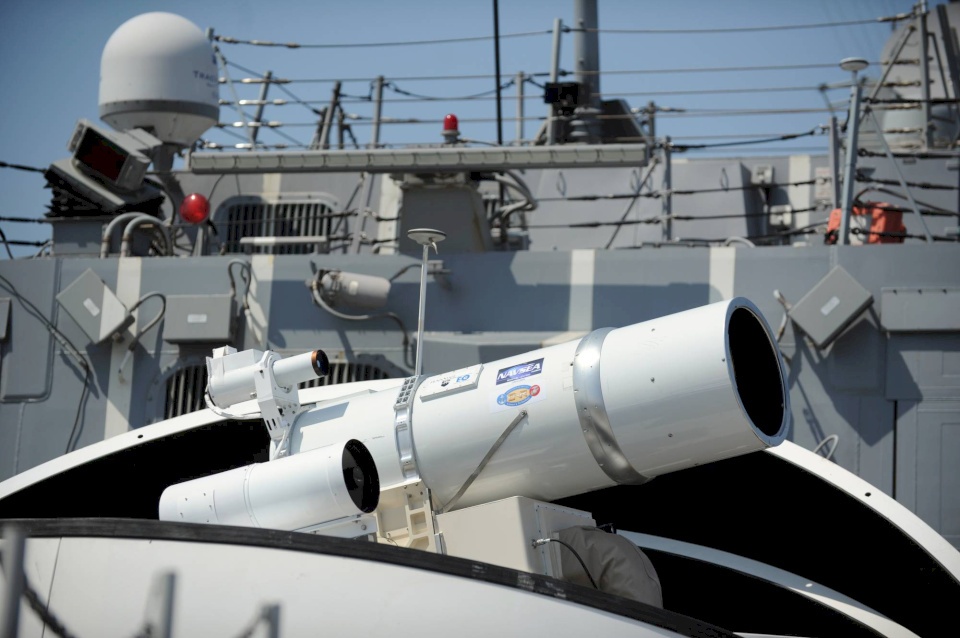
While the cost of firing the laser itself is low, the systems containing it can be expensive. Lockheed Martin received a $150 million contract in 2018 to build two prototypes.
The result was a naval laser system with a power of 60 kilowatts known as "the high-energy laser with an optical dazzler and surveillance system."
This system has been deployed on the U.S. destroyer USS Preble in Japan.
The U.S. Navy is still assessing how well the system's sensitive optical components can withstand prolonged exposure to saltwater and humidity.
Some media reports mistakenly identified a laser mounted on a ship in the Gulf as this system, when in fact it was another system known as "Odin," which is a less powerful weapon that blinds drones with dazzling lights but does not destroy them.
The high costs of the previous system prompted the U.S. Under Secretary of Defense for Research and Engineering to encourage small businesses to compete for laser contracts last year.
Directed energy, including lasers and high-power microwaves, was classified as one of six key priorities for the U.S. Department of Defense.
Under a $35 million contract, N-Light delivered a laser capable of producing 70 kilowatts of power to the U.S. Army.
Manufacturing Challenges
Production at scale may pose additional challenges. High-energy lasers amplify light by adding impurities to glass using rare earth metals like ytterbium, a metal that China largely controls production of. High-performance lasers also use semiconductors made from gallium, another rare metal that is primarily produced in China.
A report from the National Defense Industrial Association noted that manufacturers can only produce limited numbers of systems with long delivery times.
The report added that attempts to ramp up production will soon face obstacles related to manufacturing optical components such as diffraction gratings, mirrors, lenses, beam directors, and batteries.
 Follow the latest Sada News via Google News
High-level sources reveal to SadaNews: Washington seeks to hold a Gaza Reconstruction Conf...

Will the election of Khalil al-Hayya change Hamas's approach and path?!

Iraqji Reveals Details of the Attack on the Iranian Supreme Leader's Headquarters

صراع على إرث خامنئي وسط غياب مجتبى.. والمتشددون يتهمون قادة إيران بـ«الانقلاب»

The European Union Reiterates Its Call for Israel to Refrain from Expanding Settlements in...

"Mamdani Berlin".. The German Left Bets on a Politician of Turkish Descent to Lead the Cap...

Hebrew Channel: Kushner Pushing to Enhance Communication Between the United States and the...
