

Magnetic Fields Around 7 Distant Worlds Open a New Window in the Search for Life
SadaNews - An international team of astronomers has made an unprecedented achievement by measuring the magnetic fields of seven exoplanets located outside the solar system for the first time. This discovery is a significant step towards understanding the conditions that allow some planets to maintain their atmospheres and potentially support life in the future.
The importance of magnetic fields lies in their role as a protective shield that safeguards planets from high-energy stellar radiation and particles. Earth's magnetic field has helped protect its atmosphere and waters for billions of years, while Mars has lost a significant portion of its atmosphere following the decline of its magnetic field.
The results of the study were published in the journal Nature Astronomy, where researchers made this discovery while studying the wind speed of a group of hot giant planets, even though researching magnetic fields was not their primary objective.
Slow Winds Reveal the Magnetic Secret
The researchers focused on seven planets classified as "Ultra-Hot Jupiters", which are gas giant planets orbiting extremely close to their stars. As a result, they have become tidally locked, with one side constantly facing the star while the other remains plunged in perpetual darkness.
The temperatures of these planets reach around 2300 degrees Celsius or more, leading to the formation of immense winds ranging from 7200 to 25,000 kilometers per hour. In comparison, wind speeds on Jupiter do not exceed about 1500 kilometers per hour.
Scientists relied on the ESPRESSO spectrograph at the European Extremely Large Telescope in Chile, and the MAROON-X spectrograph at the Gemini North Telescope in Hawaii. These instruments analyze the light coming from the planets across different wavelengths, allowing researchers to study the composition of their atmospheres and track the movement of elements within them, particularly iron.
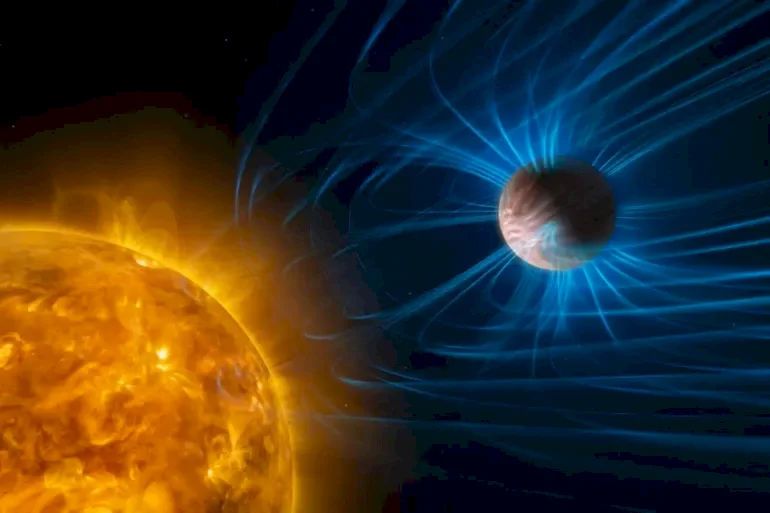
An artistic rendering shows a hot exoplanet being buffeted by immense winds, influenced by its magnetic field, which slows the winds and reshapes their paths (Gemini International Observatory)
While analyzing the data, the scientists encountered a surprise that disrupted their theoretical expectations. Instead of wind speeds increasing with rising temperatures, as simple physical laws would suggest, they found that hotter planets have slower winds.
Researcher Julia Seidel described this phenomenon in an official press statement as "completely counterintuitive to scientific intuition," as additional energy is supposed to make winds more violent. Researcher Viviane Parmentier pointed out that there is an invisible factor that restrains these winds.
After ruling out other explanations, the team concluded that the magnetic fields are the most likely reason for this effect, as these fields influence the charged particles within the planet's atmosphere, acting as a kind of "brake" that slows wind movement and regulates energy flow between both sides of the planet.
A New Step Towards the Search for Habitable Worlds
The study showed that the strength of these magnetic fields is a few gauss (a unit of measurement for magnetic field strength), which is much lower than some theoretical predictions that suggested the existence of fields hundreds of times stronger. Nevertheless, their values remain similar to those found in some giant planets in our solar system.
Although the seven studied planets are uninhabitable due to their extreme heat and gas giant composition, the significance of the discovery extends beyond these worlds themselves. The presence of a magnetic field is one of the essential elements that could help rocky planets retain water and protect their atmospheres from erosion by stellar winds.
Scientists believe that this new technique could become a key tool in the coming decades, especially with the advent of a new generation of giant telescopes. By measuring the magnetic fields of distant planets, researchers will be able to assess their potential for habitability more accurately, bringing humanity one step closer to answering one of the oldest scientific questions: Are we alone in the universe?
Source: Al Jazeera
 Follow the latest Sada News via Google News
After Deschamps' Departure... Zinedine Zidane Tops the Candidates to Lead France

Mbappe Surpasses Messi and Becomes the All-Time Top Scorer in the World Cup

England Defeats France and Achieves Largest World Cup Achievement Since 1966

Messi Refused to Play for Spain and Missed 3 World Cups

Publishers Sue Google for Allegedly Using Books to Train Artificial Intelligence

Google Expands Capabilities of Google Search Console to Support Social Media Accounts

The Mediterranean Table... An Ancient Diet Revealing Its New Secrets for Health and Longev...
