

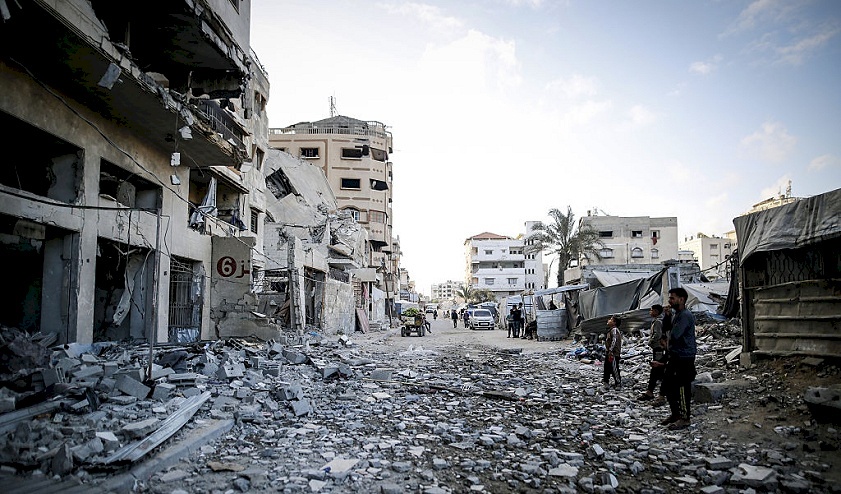
Environmental Catastrophe in Gaza: 33.2 Million Tons of Carbon Emissions
SadaNews: The Central Bureau of Statistics, in a joint statement with the Environmental Quality Authority, stated that carbon emissions resulting from the Israeli occupation's aggression on the Gaza Strip reached 33.2 million tons of CO2 equivalent, a huge figure equivalent to the total annual emissions of some countries.
The statement, issued on the occasion of World Environment Day on Thursday, explained that these emissions equal what about 7.6 million gasoline-powered cars produce in a whole year, and what forests covering 133,000 km² can absorb from carbon dioxide in one year.
The statement noted that this catastrophic cost is distributed between the direct military operations that caused the emission of about 1.9 million tons and the carbon costs before and after the aggression, related to debris removal and the reconstruction of damaged facilities and homes.
Sharp Increase in the Prices of Water Tankers in Gaza Exceeding 600%
The statement highlighted that the destruction of water networks in the Gaza Strip led to a sharp increase in water prices, especially that distributed by tankers, where the price of a cup of water rose to about 211 shekels in 2025, compared to 30 shekels in 2023, reflecting the exacerbation of the water crisis and the economic burden on citizens.
Widespread Destruction of Gaza's Sewage Infrastructure and Rising Public Health Threats
The Gaza Strip is also experiencing a near-total collapse of the sewage system due to damage to over 90% of the infrastructure and the destruction of all treatment plants, in addition to widespread destruction of networks (about 1,545 km) and 47 pumping stations. With the continued power and fuel cuts, services have stopped completely, leading to the flow of sewage in the streets and increased environmental and health risks and the spread of diseases.
Escalating Environmental Pollution in Gaza Amidst Intensifying Waste and Debris Crisis
The Gaza Strip is suffering from acute environmental deterioration due to the accumulation of about 710,000 tons of household waste and more than 60 million tons of debris resulting from the destruction of over 330,000 housing units, amidst a near-total collapse of the waste collection system and the destruction of 90% of municipal equipment, which has led to increased pollution, diseases, and worsening of the environmental crisis and complicating recovery efforts.
Destruction of 86% of Agricultural Land in the Gaza Strip
A recent report from the United Nations Satellite Centre (UNOSAT) indicated that by the end of June 2025, the Israeli aggression caused widespread destruction to the agricultural sector in Gaza, with about 86% of agricultural land destroyed due to shelling, bulldozing, and military machinery movements. Higher levels of destruction were recorded in some areas, where the destruction rate in northern Gaza reached 94%. This rapid and ongoing collapse of the agricultural sector poses a direct and severe threat to the food security of over two million people in the Strip.
Escalating Israeli Environmental Violations Threatening Ecosystems in the West Bank
The statement indicated that 2025 witnessed a noticeable increase in Israeli environmental violations in the West Bank, with 685 violations recorded compared to 535 violations in 2024, and by the end of April 2026 (310) violations were recorded. This reflects an increase in encroachments on the Palestinian environment. These violations varied between bulldozing agricultural land, destroying trees, discharging sewage, and dumping waste, in addition to damage to infrastructure, which has led to increasing deterioration in ecosystems and threatens the sustainability of natural resources.
It continued: The State of Palestine continues its commitment to the United Nations Framework Convention on Climate Change and the Paris Agreement by enhancing the preparation and implementation of national reports, foremost among them the Nationally Determined Contributions (NDCs) report, as a key tool for guiding climate action, enhancing adaptation, supporting national policies, and attracting green investments.
It added: Despite the escalating environmental and climatic challenges, Palestine's contribution to global greenhouse gas emissions remains extremely limited, estimated at less than 0.01% of total global emissions, a nearly negligible percentage compared to major industrial countries. Nevertheless, Palestine is among the most vulnerable regions affected by the consequences of climate change, reflecting a state of "climatic injustice," as Palestine bears the effects of a global climate crisis despite its very minimal contribution to causing it.
The joint statement concluded that the Environmental Quality Authority signed contracts to support environmental and agricultural initiatives for several institutions, aimed at enhancing resilience and sustainable development, protecting biodiversity, adapting to climate change, and empowering local communities.
The statement clarified that nine institutions were supported within these initiatives, as part of enhancing environmental work at the local level. The number of environmental clubs in West Bank schools also increased to 851 clubs during the 2025/2026 school year, compared to 591 previous clubs, with an increase of 260 clubs, or 44%, reflecting the growing environmental awareness among students.
It noted that the electrical capacity of solar cells in Palestine rose to 400 megawatts by the end of 2025, compared to 300 megawatts in 2023, constituting about 8% of total electricity, as part of the move towards enhancing clean energy and energy security.
In this context, a joint project between the water and energy sectors was funded for $620,000, aiming to prepare feasibility studies and develop a roadmap for investing in solar energy systems for priority water sector facilities.
The statement also referred to the continued work within the twinning project in cooperation with a Lithuanian-Austrian coalition, which includes preparing a draft new environmental law titled "Environmental Law within the Framework of Sustainable Development," to enhance the environmental system according to international standards, in addition to developing a guide to integrate the environmental and climate change dimension into various sectors, including agriculture, local governance, and water.
It highlighted the adoption of the Development and Lending Fund for Local Authorities as a national entity for direct access to financing from the Green Climate Fund in 2026, along with Palestine's recent accession to the Adaptation Fund, which is a specialized international financial mechanism aimed at enhancing resilience to climate change.
 Follow the latest Sada News via Google News
Washington Investigates Possible Russian Role in Iranian Attacks on Its Sites

Mossad Chief Visited Washington to Discuss Iran and Its Nuclear Program

Report: Washington Informed Israel It Is Preparing to Intensify Attacks on Iran and Use St...

Organization of Islamic Cooperation Condemns Nauru's Decision to Open an Embassy in Occupi...

Video:: Nablus: Settlers Evict Tubasi Family from Their Home in Jaloud and Take Over It

Netanyahu: I Intend to Form a Broad National Unity Government

Syrian Foreign Minister Meets with Yasser Abbas in Damascus
