

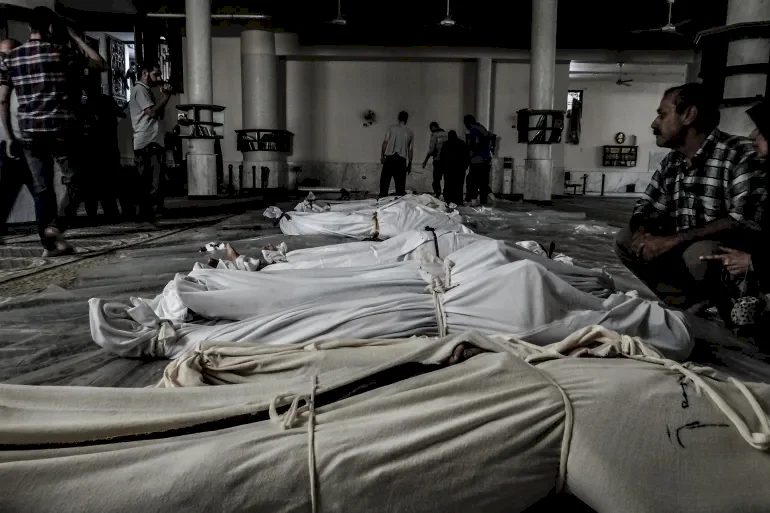
Thirteen Years After the Massacre.. Sarin Reopens the Wounds of Syrians
SadaNews - The images that emerged from Eastern Ghouta in the Damascus countryside in the summer of 2013 were not just fleeting war scenes; they became an open wound in Syrian memory and one of the most painful moments in the country's modern history.
The report recalls images of chemical attack victims; children lying motionless and entire families gasping for their last breaths amid ominous clouds of death, in a scene that shook the world's conscience and raised a question that Syrians have not stopped repeating since that day: How did chemical weapons get into the hands of the regime that is supposed to protect its people?
Almost 13 years after the Ghouta attack, this question has resurfaced strongly following the Syrian authorities' announcement on May 26, 2026, of the discovery of remnants of the chemical weapons program run by the ousted regime, including raw materials and munitions related to the production of sarin gas.
Syria's permanent representative to the Organization for the Prohibition of Chemical Weapons, Mohamed Kattoub, considered this discovery a significant achievement for the Syrian people and the world, as he described it as the first time such munitions have been found before being used in new crimes against Syrians.
However, behind this announcement lies a longer and more complicated story, that of a chemical program spanning decades, which began under the banner of military deterrence and ended up being accused of killing thousands of Syrians.
Origins of the Program
The origins date back to the early 1970s, when Damascus, in 1971, began establishing the Center for Scientific Research and Studies under the supervision of nuclear physicist Abdullah Wathiq Shahid, an advisor to former Syrian president Hafez al-Assad. At that stage, the state focused on developing its capabilities in the field of protection against chemical attacks in cooperation with the Soviet Union.
However, the most significant shift occurred in 1973, when Syria effectively began building its chemical program by acquiring equipment and materials related to this type of weapon from Egypt just before the October War. The public goal at that time was to possess a means of deterrence against Israel, but subsequent events took a tragic turn; these weapons were not used against an external enemy as promoted, but were later directed against the Syrian people themselves.
Throughout the 1980s, international suspicions about the extent of the Syrian program grew. While U.S. intelligence estimated in 1983 that Damascus did not possess the local capacity to produce chemical weapons, declassified documents later revealed that the Syrian authorities were vigorously pursuing the establishment of a self-sufficient program.
In 2014, the British government revealed that Syria had acquired hundreds of tons of precursor chemicals and technologies in the mid-1980s that helped it develop nerve gases, notably sarin, which would later become the name most associated with chemical massacres in the country.
As the years passed, the infrastructure of the program expanded rapidly. By the 1990s, U.S. officials mentioned the conversion of factories dedicated to agricultural materials into facilities for producing sarin, while subsequent U.S. and Israeli estimates indicated the existence of specialized facilities in Damascus, Homs, and Aleppo producing sarin, mustard gas, and VX gas, one of the deadliest known nerve agents.
Despite international restrictions imposed on supplying Damascus with sensitive chemicals, repeated accusations arose regarding the regime's reliance on black market networks to acquire its needs. Among the cases that attracted wide attention at that time was the accusation of retired Russian General Anatoly Kuntsevich of transferring hundreds of kilograms of precursor materials related to the Syrian chemical weapons program.
With the dawn of the new millennium, the Syrian chemical arsenal had turned into one of the largest secret military programs in the region. In 2009, the U.S. Central Intelligence Agency confirmed that the regime had the capability to carry out chemical attacks using aircraft, missiles, and artillery.
Obama and the Red Line
Just a few years later, specifically in July 2012, the first official acknowledgment from Damascus of possessing chemical weapons emerged, when the spokesperson for the Ministry of Foreign Affairs at the time, Jihad Makdissi, confirmed the existence of this arsenal, stressing that it would not be used against the Syrian people but rather to confront any external aggression.
However, the events that followed this acknowledgment took a completely different direction. Less than a month later, former U.S. President Barack Obama announced that the use of chemical weapons in Syria represented a "red line," warning that any use of them would change Washington's calculations regarding intervention.
Despite those warnings, human rights organizations and international bodies documented more than 300 chemical attacks within Syria since 2012. Images of the victims, especially children, became undeniable evidence of one of the harshest pages of the Syrian conflict, where death no longer came only from conventional bombardment, but from poisoned air seeping into homes, shelters, and bedrooms.
While the international community believed that the Syrian chemical weapons file was heading towards closure after agreements related to dismantling the arsenal, subsequent reports and investigations revealed that parts of the program remained hidden from the inspectors’ eyes. These reports indicated operations to conceal weapons and prohibited materials, as well as ongoing attempts to secretly acquire components involved in manufacturing nerve agents.
Today, after the discovery of new remnants of this program, many Syrians do not see this as just a military or technical discovery, but rather as a painful revival of memories that are still alive within them. Every document revealed and every warehouse discovered brings to mind the faces of children who suffocated in Ghouta and other areas, reminding the world that the story of chemical weapons in Syria is not just a tale of a prohibited arsenal, but a story of human lives sacrificed to one of the deadliest weapons in modern history.
Source: Al Jazeera
 Follow the latest Sada News via Google News
Saudi Arabia condemns the Houthi threats to navigation and pledges to protect its ships

Houthi Movement Announces Ban on Maritime Navigation Against Saudi Arabia

Earthquake of 5.5 Magnitude Hits Western Iran

To Enhance His Support for "Increasing Children"... Vance Announces the Birth of His Fourt...

Death of a Mosque Imam in Armed Attack in Southeastern Iran

Rubio Reveals Circumstances Surrounding the Death of an American Soldier in Iraq

Reliable Threat.. US Embassy in Jordan: Evacuation of International Airport and Port in Aq...
