

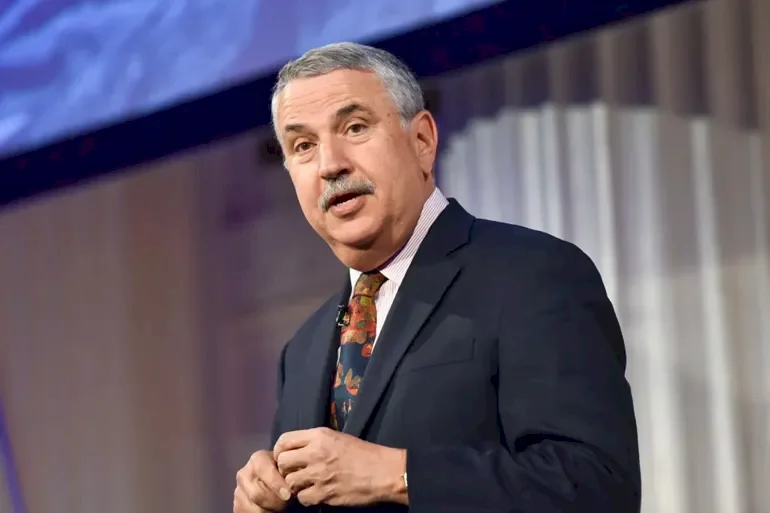
Friedman: Trump Failed as Commander-in-Chief and Acts Like a 'Thief Leader'
SadaNews - American writer Thomas Friedman believes that President Donald Trump has failed to perform the traditional role of commander-in-chief, considering that he behaves more like a "thief leader" than a "commander-in-chief".
Friedman asserts in the New York Times that while the United States is waging war on Iran and deploying tens of thousands of soldiers in the Middle East, the primary task for any president under such conditions is to maintain the unity of the home front.
However, the writer believes that Trump has made no effort to rally support from the Democratic Party or to unite Americans behind the war, but instead has been preoccupied with internal political struggles and controversial projects that serve his personal interests and those of his political allies.
Friedman states that "nothing demoralizes soldiers more than seeing their country tearing itself apart from the inside"; internal division also gives adversaries hope of extracting better terms to end conflicts.
Friedman devotes a large part of his article to criticizing the fund that the Trump administration sought to establish, valued at nearly $1.7 billion, to compensate individuals whom the administration claims were subjected to what it calls "judicial politicization" during the previous administration.
The writer considers that the project would practically reward Trump loyalists, including individuals linked to the events of the Capitol riot on January 6, 2021. He cites the stance of former Senate Republican leader Mitch McConnell, who described the idea as "completely stupid and morally wrong".
According to the article, the temporary halt of the project by a court decision represented a significant setback for the White House, although Trump later hinted at the possibility of retracting it. Friedman believes that the funds should have been directed to support the Ukrainian army fighting Russian forces, instead of compensating individuals he describes as "loyalists who stormed the halls of Congress".
The writer also criticizes another clause added to the agreement, which concerns preventing authorities from pursuing certain existing tax claims against Trump and his family and businesses in the future, considering that this raises serious questions about conflicts of interest and the use of power for personal gain.
Friedman does not stop at criticizing the fund; he also addresses what the Associated Press described as the "trading commander", noting that Trump executed thousands of stock purchases and sales during the initial months of his new term, including shares of companies directly affected by his presidential decisions.
The writer cites a statement by Richard Painter, a former White House advisor during the George W. Bush administration, who said such actions would be considered a crime if committed by a defense secretary, even if they were technically legal for the president.
Friedman believes that these practices reinforce the growing perception among Americans that the president is using state institutions to serve his private interests, whether through influencing the judicial system or through financial and political arrangements that benefit him and his close circle.
Deterring Trump’s America has become a strategic priority for allies as much as deterring Russia; NATO countries have begun to realize the dangers of over-reliance on the United States in technology, defense, and finance.
In the international part of his article, Friedman warns that Trump's policies are pushing traditional U.S. allies to reconsider the nature of their relations with Washington. According to the writer, European concern is no longer limited to Russia, but now includes the United States itself.
He points out that Washington's allies have watched with concern Trump's threats to annex Canada and make it the fifty-first American state, his talk about taking control of Greenland, in addition to imposing tariffs on U.S. partners and cutting military and financial aid to Ukraine.
Friedman quotes geopolitical expert Nader Mousavi Zadeh as saying that "deterring Trump’s America has become a strategic priority for allies as much as deterring Russia". Mousavi Zadeh believes that NATO countries have begun to recognize the dangers of over-reliance on the United States in technology, defense, and finance.
The writer notes that several European countries, including Germany, Sweden, France, Norway, the Netherlands, Finland, and Britain, have announced sending limited forces to Greenland in support of Denmark, a move seen as an unprecedented indication of dwindling trust in the American ally.
Friedman concludes that what he calls "the distortion of the American presidency" has repercussions that extend beyond domestic U.S. issues, threatening the international alliances network that contributed to victories in the two world wars and the Cold War.
He asserts that the continuation of this approach could cost the United States its global influence and the trust of its allies, exposing future generations to increasing risks, at a time when Washington needs more than ever to unite its internal front and maintain its international standing.
 Follow the latest Sada News via Google News
High-level sources reveal to SadaNews: Washington seeks to hold a Gaza Reconstruction Conf...

Iraqji Reveals Details of the Attack on the Iranian Supreme Leader's Headquarters

صراع على إرث خامنئي وسط غياب مجتبى.. والمتشددون يتهمون قادة إيران بـ«الانقلاب»

The European Union Reiterates Its Call for Israel to Refrain from Expanding Settlements in...

"Mamdani Berlin".. The German Left Bets on a Politician of Turkish Descent to Lead the Cap...

Hebrew Channel: Kushner Pushing to Enhance Communication Between the United States and the...

SadaNews Report: Israeli Elections with a Settlement Flavor!
