

Magnetic Fields Around 7 Distant Worlds Open a New Window in the Search for Life
SadaNews - An international team of astronomers has achieved an unprecedented milestone by measuring the magnetic fields of seven exoplanets located outside our solar system for the first time. This discovery is an important step towards understanding the conditions that allow some planets to maintain their atmospheres and possibly support life in the future.
The significance of magnetic fields lies in their function as protective shields that guard planets against high-energy radiation and stellar particles. Earth's magnetic field has helped protect its atmosphere and waters for billions of years, whereas Mars has lost a significant portion of its atmosphere after its magnetic field declined.
The results of the study were published in the journal Nature Astronomy, where researchers made this discovery while studying wind speeds in a group of hot giant planets, without magnetic field research being their primary objective.
Slow Winds Reveal the Magnetic Secret
The researchers focused on seven planets classified as "Ultra-Hot Jupiters," which are gas giants that orbit very close to their stars. As a result, they become tidally locked, with one side constantly facing the star while the other remains in perpetual darkness.
The temperatures of these planets can reach around 2300 degrees Celsius or more, leading to the formation of immense winds that range in speed from 7200 to 25,000 kilometers per hour. In comparison, wind speeds on Jupiter do not exceed about 1500 kilometers per hour.
The scientists relied on the ESPRESSO spectrograph at the European Southern Observatory in Chile and the MAROON-X spectrograph at the Gemini North Telescope in Hawaii. These instruments analyze the light coming from the planets across different wavelengths, allowing the study of atmospheric compositions and tracking the movement of elements within them, particularly iron.
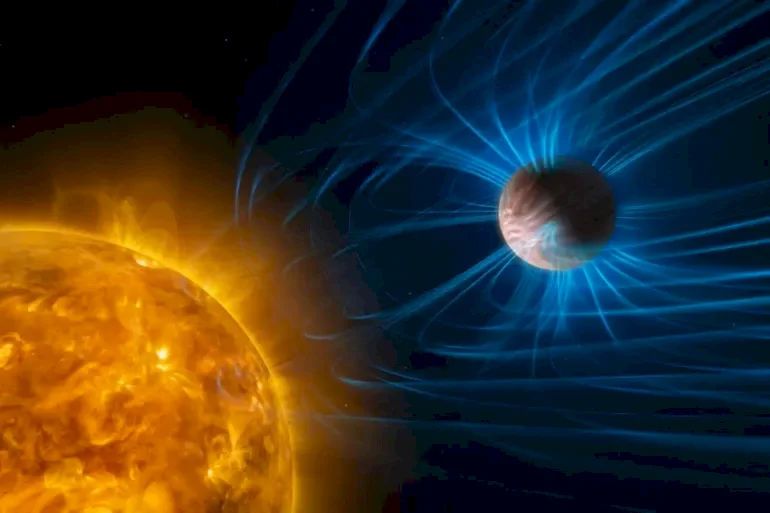
An artistic rendering shows a hot exoplanet being struck by colossal winds, affected by its magnetic field which slows and reshapes their paths (International Gemini Observatory).
While analyzing the data, scientists observed a surprise that baffled their theoretical expectations. Instead of wind speeds increasing with temperature rise, as simple physical laws would suggest, they found that the hotter planets had slower winds.
Researcher Julia Seidel described this in an official press release as "completely counterintuitive to scientific intuition," as the additional energy is supposed to make winds more violent. Meanwhile, researcher Vivien Parmentier noted that an invisible factor is restraining these winds.
After ruling out other explanations, the team concluded that magnetic fields are the most likely reason for this, as these fields influence charged particles within the planet's atmosphere, acting as a kind of "brake" that slows wind movement and regulates energy flow between the planet's two sides.
A New Step in the Search for Habitable Worlds
The study revealed that the strength of these magnetic fields is measured in only a few gauss (a physical unit indicating the strength of a magnetic field), which is much lower than some theoretical predictions that suggested significantly stronger fields, yet their values remain similar to those found at some giant planets within our solar system.
Although the seven studied planets are uninhabitable because they are extremely hot gas giants, the importance of this discovery extends beyond these worlds themselves. The presence of a magnetic field is one of the essential elements that could help rocky planets retain water and protect their atmospheres from erosion due to stellar winds.
Scientists believe that this new technique could become a major tool in the coming decades, especially with the advent of a new generation of giant telescopes. By measuring the magnetic fields of distant planets, researchers will be able to better assess their chances of being habitable, bringing humanity a step closer to answering one of science's oldest questions: Are we alone in the universe?
Source: Al Jazeera
 Follow the latest Sada News via Google News
Soaring Oil Prices Burn the Pockets of the Palestinian Citizen "The Poor"

Millions of Dollars in Losses.. "SadaNews" Reveals Shocking Figures for Traders from Pales...

The Problem of Shekel Overcrowding Worsens.. Fuel Station Owners Threatened with Closure o...

High-level sources reveal to SadaNews: Washington seeks to hold a Gaza Reconstruction Conf...

The Palestinian Economy at a Crossroads: 4 Files Awaiting Resolution

مركز كارتر يصدر تقريره النهائي بشأن الانتخابات البلدية في الأراضي الفلسطينية المحتلة التي...

Al-Hayya: Our Priority is to Completely End the War and Restore National Unity
