

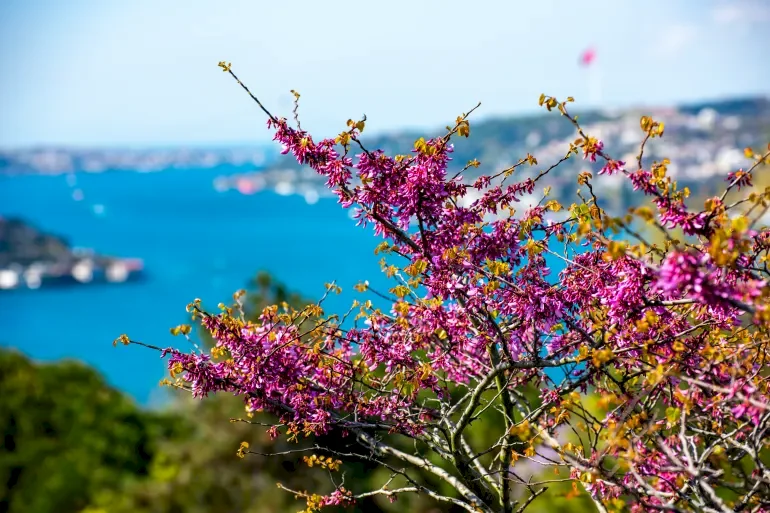
A Spring for the Weary Heart.. When the Judas Tree Colors Istanbul
SadaNews - In such a difficult phase as this one we are living through, where painful events besiege our country and the weight of wars shakes the world around us, a person finds themselves mentally and spiritually exhausted. We, as humans, are in a state of comprehensive fatigue; in moments when our minds are mixed and our hearts saddened, we need, more than ever, to catch our breath, to pause for a moment, and to regain the rhythm of our breathing. And this is precisely where the spring of Istanbul comes as a herald not only of seasonal change but also of what resembles resurrection and hope.
We are in the middle of April. The unique and elegant spring of Istanbul is knocking at our doors. On both sides of the Bosphorus, every corner - from the gardens of ancient wooden palaces (the Yali) on the banks of the strait, to public parks, popular orchards (millet bahçeleri), and flowerbeds in neighborhoods - has turned into spaces for celebration. The Judas trees (Cercis siliquastrum), the harbingers of spring and the inspiration of poets, have added a new beauty to the grandeur of Istanbul, especially the Bosphorus.
The Resurgence of the Soul, Not Just Nature
Spring in Istanbul is not just a waking of nature; it is also a time for the renewal of the spirit. When you stand under a Judas tree and look at the deep blue of the Bosphorus, you feel that all this mental exhaustion dissipates a little, giving way to a hidden peace. Nature reminds us that life, despite everything, continues, and that a spring follows every winter, and a light follows every darkness.
The Judas tree (Cercis siliquastrum) is a tree of high cultural and historical value, particularly associated with Istanbul and the Bosphorus line, and it is considered a harbinger of spring. What distinguishes it most is that it blooms before it leafs out. From mid-April to early May, its branches, and even its trunk, are filled with clusters of purple-crimson flowers. When the flowers fall, the tree then opens its shiny green leaves in the shape of hearts.
Between Myth and Name
In English, it is called "Judas Tree", derived from a Christian belief that the leaves of the tree on which Judas hanged himself - after betraying Jesus to the authorities - turned from white to purple. However, there is another narrative that attributes the name to a misinterpretation of the phrase "Arbre de Judée" (the Tree of Judea), referring to the mountainous region of "Judea" in France where this tree is found. Its native range extends from North America to the Mediterranean basin and Western Asia, and it is spread across Turkey in the Marmara and Aegean regions. Its crimson flowers start to appear with spring and end before the arrival of summer.
The "Season of the Judas Tree" in the Ottoman Era
In the fifteenth century, festivals were organized in the name of this tree, which held a highly significant place in Ottoman culture. It was referred to as "Arghavan Faslı" (the season of the Judas tree) and "Arghavan Bayramı" (the feast of the Judas tree). The famous Ottoman traveler Evliya Çelebi referred to it as "Arghavan Cemiyeti Faslı", and it is known that this tradition was initiated by the Prince of Sultan, and dervishes would flock from all four corners of Anatolia each year in early Nowruz to gather at the lodge of the tomb of Prince Sultan in Bursa.
A Color Exclusive to Emperors
Colors always hold a crucial place in human culture. While the color purple represented royalty in Rome and Byzantium, the color yellow symbolized deities in Indian culture. What cherry blossoms mean to Japan, the Judas tree means to Istanbul. We can define the Judas tree as "a tree exclusive to Istanbul". The season of the Judas tree in Istanbul extends from April 23 to May 19.
The purple color has, since ancient times, been a symbol of wealth, power, and nobility. In the Byzantine Empire, this color was so sacred that imperial decrees were written in it, and members of the ruling family wore fabrics in this color. In Byzantium, nobles and emperors monopolized the color of purple, as only the emperor had the right to wear the "purple cloak", and the general public was forbidden from wearing cloaks of this color. Moreover, the chemical production of this color was extremely difficult in those eras, and hence, it becomes understandable why rulers who viewed themselves above all others monopolized it.
Where to See the Judas Trees?
From mid-April onwards, you can witness this visual celebration from many points in the city. The recommended places especially for viewing Judas trees are:
The Bosphorus line: the Rumeli Hisarı - Ayvansaray track, and the coastal strip between Üsküdar and Beykoz. Small forests (kuru): Yıldız Park, Fethi Pasha Forest, Beykoz Forest (İbrahim Pasha), Otakçı Tepesi, and Mahirabat Forest. Public gardens: the spaces overlooking the Bosphorus, such as Fenar Bahçe and Bebek Park. A tree that preserves the soul of Istanbul.
The Judas tree is not just a plant, but a living piece of history, having settled in the memory of Istanbul and inspired literature, songs, and various arts. The Judas trees form what resembles a "historical background" on the slopes of the city, especially along the Bosphorus line.
Historian and architectural researcher Semavi Eyice, who has often expressed that Istanbul has lost its soul due to concrete sprawl, sees the presence of Judas trees as a cultural point that preserves the elegant old face of the city and that historical beauty it breathes. As for the late historian Professor Dr. Haluk Dursun, he defines Istanbul's spring as the "season of the Judas tree" (erguvan mevsimi). In his works such as "The Art of Living in Istanbul" (İstanbul'da Yaşama Sanatı) and similar studies, Dursun emphasizes that Istanbul consists of more than just monuments and buildings; these buildings need a backdrop, a "natural face" like the Judas tree.
In his writings, Dursun holds that looking at a Judas tree and following its season are conditions for being a "true Istanbulite" (İstanbul beyefendisi) or a "true Istanbul lady" (İstanbul hanımefendisi). He hinted that those who do not pay attention to the Judas tree cannot fully understand the spirit of this city. He asserts that wandering through the city is not just about visiting museums; knowing the time of the Judas tree and following its season also means possessing "spatial awareness".
The Judas trees are a bridge that "unites man with nature, the past with the present, and the city with the spirit". So let us enjoy the season of the Judas tree.
 Follow the latest Sada News via Google News
After Deschamps' Departure... Zinedine Zidane Tops the Candidates to Lead France

Mbappe Surpasses Messi and Becomes the All-Time Top Scorer in the World Cup

England Defeats France and Achieves Largest World Cup Achievement Since 1966

Messi Refused to Play for Spain and Missed 3 World Cups

Publishers Sue Google for Allegedly Using Books to Train Artificial Intelligence

Google Expands Capabilities of Google Search Console to Support Social Media Accounts

The Mediterranean Table... An Ancient Diet Revealing Its New Secrets for Health and Longev...
