

New Poll Shows Likud Decline and Smotrich's Party Surpassing the Threshold
SadaNews Translation - A poll published by Reshet Kan Hebrew Channel on Thursday evening showed a decline in the Likud party led by Benjamin Netanyahu, losing three seats compared to the last poll.
According to the poll, as per SadaNews translation, the Yesh Atid party led by Gadi Eisenkot gained one seat, yet the current government coalition remained the same even though the Religious Zionism party surpassed the electoral threshold for the first time.
The results indicate that the candidacy of the Arab parties in a joint list would weaken Netanyahu's bloc, while a coalition between Bennett and Eisenkot would strengthen the opposition bloc.
60% of surveyed voters expressed concern over the integrity of the upcoming elections.
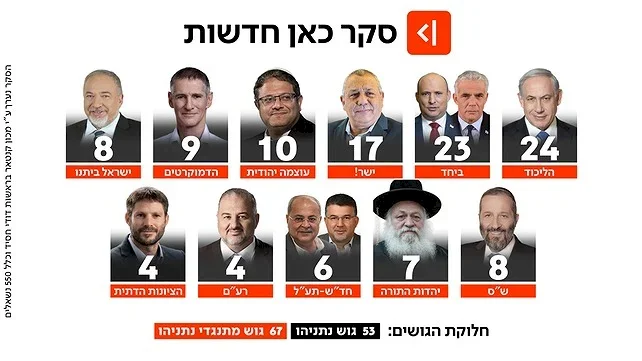
According to the poll, the Likud party would receive 24 seats instead of the 27 it obtained in the last poll, the bloc of Ma'an (Lapid and Bennett alliance) would have 23 seats, Yesh Atid led by Eisenkot would have 17 seats, Jewish Power led by Itamar Ben Gvir would secure 10 seats, the Democrats led by Yair Golan would get 9 seats, Yisrael Beiteinu headed by Avigdor Liberman would attain 8 seats, and so would the Shas party, while the United Torah Judaism party would win 7 seats, Hadash Ta'al would have 6 seats, Religious Zionism would get 4 seats, and the United Arab List would also have 4 seats.
This means that Netanyahu's coalition successfully garnered 53 seats, while the opposition coalition obtained 57 seats, and the Arab parties received 10 seats, indicating that neither coalition has achieved a majority of 61 seats thus far.
The poll also addressed a potential joint candidacy between Naftali Bennett and Gadi Eisenkot; in this case, the coalition would become the largest party with 38 seats, as in the last poll. This scenario would weaken the Likud party but would allow Smotrich's party to surpass the electoral threshold, enhancing the coalition bloc to 54 seats. Conversely, if the Arab parties united in a joint list, they would win 13 seats and weaken Netanyahu's bloc to 52 seats.
 Follow the latest Sada News via Google News
High-level sources reveal to SadaNews: Washington seeks to hold a Gaza Reconstruction Conf...

Iraqji Reveals Details of the Attack on the Iranian Supreme Leader's Headquarters

صراع على إرث خامنئي وسط غياب مجتبى.. والمتشددون يتهمون قادة إيران بـ«الانقلاب»

The European Union Reiterates Its Call for Israel to Refrain from Expanding Settlements in...

"Mamdani Berlin".. The German Left Bets on a Politician of Turkish Descent to Lead the Cap...

Hebrew Channel: Kushner Pushing to Enhance Communication Between the United States and the...

SadaNews Report: Israeli Elections with a Settlement Flavor!
