

Israeli Estimates: Why is Iran Focusing Its Strikes on the Gulf?
SadaNews - Israeli estimates suggest that Iran has concentrated a larger portion of its firepower on Gulf countries compared to what it directed towards Israel during the early days of the war, within the framework of strategic calculations related to aligning military operations with available capabilities, while attempting to pressure to shorten the duration of the war.
According to data published by the Israeli National Security Studies Institute (INSS) on Wednesday, Iran launched approximately 500 missiles and nearly 2,000 drones towards American bases in Gulf countries during the first four days of the war, compared to about 200 missiles and approximately 100 drones directed at Israel, as part of 123 waves of attack.
Based on these Israeli assessments, one of the main reasons for this approach, despite Tehran considering Israel as the "main enemy", is related to strategic considerations, as it is believed that Tehran seeks to push Gulf states to exert pressure on the United States to stop or shorten the war.
These estimates suggest that targeting Gulf countries may represent, from Tehran's perspective, an effective means of pressure due to the heavy dependence of these countries' economies on the oil and gas sectors, in addition to their wealth being tied to global investments, including in the United States.
The Israeli analysis adds that the factor of military range plays another role in this context; Iran is estimated to possess thousands of missiles with a range of between 300 and 600 kilometers, capable of reaching Gulf countries and oil installations located along the Gulf shores.
According to this reading reported by the "Yediot Ahronot" newspaper, Iran also owns thousands of attack and suicide drones that are described as more precise than missiles, in addition to being more difficult to intercept by American air defense systems.
The same estimates indicate that the nature of the targets in Gulf countries may constitute an additional factor, as oil facilities and the infrastructure associated with them are considered "more vulnerable" compared to hardened military targets.
In this context, it is believed that Iran relies on suicide drones of the "Shahed-136" model, carrying dozens of kilograms of explosives, allowing damage to infrastructure without the need to use heavy and costly ballistic missiles.
Estimates also suggest that Iran may use shore-to-sea missiles launched from Iranian shores or from fast attack boats operating in Gulf waters in some cases.
The Israeli reading also discusses a deterrent military consideration, represented in Tehran's attempt to dissuade Gulf countries from allowing the United States to use their territories for military operations, either for defensive purposes such as early warning or for offensive purposes.
In this context, the estimates see Iran striving to reduce the potential for American attack aircraft to launch operations from bases in Saudi Arabia, the UAE, Qatar, Kuwait, and other countries in the region.
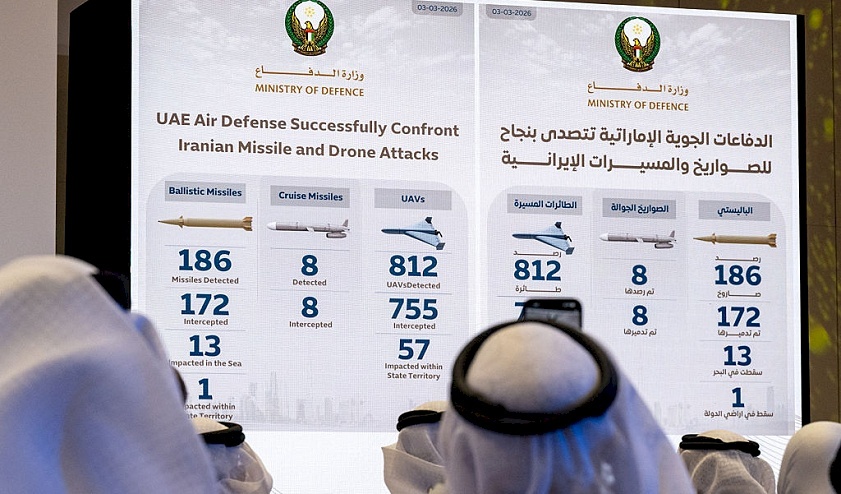
According to data from the National Security Studies Institute at Tel Aviv University, Iranian attacks during the first four days of the war were distributed across several countries, with Iran launching 812 drones and 186 missiles towards the UAE.
It also launched 92 drones and 74 missiles towards Bahrain, and 46 drones and 116 missiles towards Qatar. The data indicates 36 drones and 13 missiles launched towards Jordan, in addition to 5 drones towards Oman.
Furthermore, Iran launched 178 missiles and 384 drones towards Kuwait, and two missiles and three drones towards Cyprus. In contrast, Saudi Arabia was targeted with 13 drones and two cruise missiles, while approximately 70 missiles and drones were directed towards the Kurdistan region of Iraq.
 Follow the latest Sada News via Google News
High-level sources reveal to SadaNews: Washington seeks to hold a Gaza Reconstruction Conf...

Will the election of Khalil al-Hayya change Hamas's approach and path?!

Iraqji Reveals Details of the Attack on the Iranian Supreme Leader's Headquarters

صراع على إرث خامنئي وسط غياب مجتبى.. والمتشددون يتهمون قادة إيران بـ«الانقلاب»

The European Union Reiterates Its Call for Israel to Refrain from Expanding Settlements in...

"Mamdani Berlin".. The German Left Bets on a Politician of Turkish Descent to Lead the Cap...

Hebrew Channel: Kushner Pushing to Enhance Communication Between the United States and the...
