

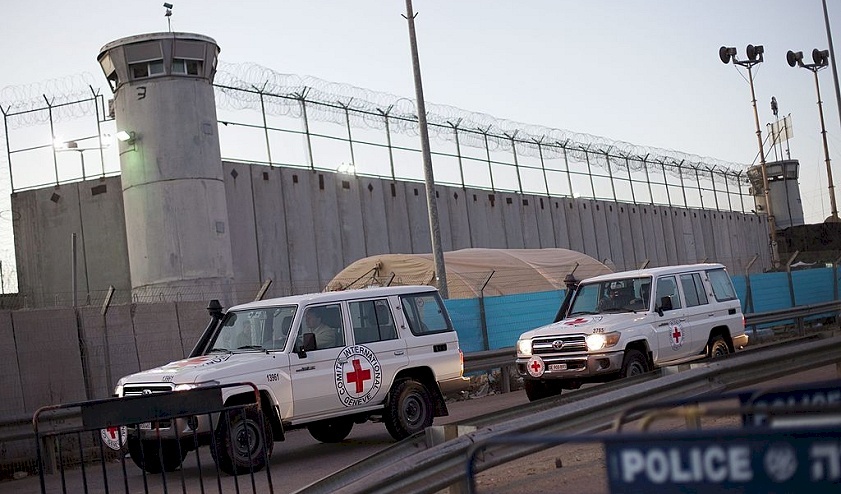
Israeli Supreme Court Rules Against Legality of Preventing Red Cross Visits to Palestinian Detainees
SadaNews - The Israeli Supreme Court has ruled that the policy imposed by the government since October 2023, which prevents the International Committee of the Red Cross from visiting Palestinian prisoners and detainees or conveying information related to them, is illegal. The court annulled the policy after the state failed for more than two years to provide any legal basis justifying its continuation.
The decision came unanimously from a panel composed of Court President Yitzhak Amit, Deputy Noam Solberg, and Justice Dafna Barak-Erez, who wrote the main ruling. The court concluded that the government did not present any legal basis justifying this policy, despite the "numerous opportunities" afforded to it during the proceedings to clarify and legally establish its position.
Barak-Erez stated that the case was characterized by exceptional circumstances, noting that the state submitted dozens of requests for postponements and extensions over more than two years, both to provide its initial response and for detailing statements or supplemental memos, which significantly prolonged the proceedings.
She added that the court displayed "a great deal of patience," but eventually found itself faced with a lack of an organized and detailed legal position from the state to justify the continuation of the ban. The court pointed out that the central justification relied upon by the state during the deliberations was related to the file of Israeli prisoners held in the Gaza Strip, yet the policy continued even after their repatriation process was completed, without the government presenting new justifications or concrete reasons to continue its enforcement.
The court examined the relevant Israeli legislation along with the rules of international law, concluding that there was no legal basis allowing for a comprehensive ban on visits by the Red Cross or the cessation of conveying information related to Palestinian prisoners. Consequently, it ruled that the adopted policy contradicts existing law and must be annulled.
For his part, Vice President of the Court, Solberg, concurred with the same conclusion, asserting that the state failed to provide any legal basis for the decisions made despite the numerous opportunities provided to it, and that this failure alone is sufficient to annul the policy without the need for extensive resolution on issues related to international law. The Court President, Amit, also agreed with the rationale of the ruling and supported the observations regarding the state’s ongoing failure to justify its position.
The government imposed the ban following the outbreak of war on October 7, 2023, ending a policy that lasted for decades, which had allowed the International Committee of the Red Cross to visit Palestinian prisoners in Israeli jails and convey information regarding their detention sites and conditions. The court notes that this practice had been conducted regularly since the late 1960s, including during periods of previous wars and military confrontations.
The decision responded to a petition submitted by human rights organizations, including "Adalah," the "Association for Civil Rights in Israel," "Physicians for Human Rights," "Hamoked," and "Moked," which challenged the legality of the ban on Red Cross visits, especially in light of increasing reports regarding the conditions of Palestinian detainees since the war began.
The decision follows more than two years of legal battles, during which the Israeli government made a series of postponement requests during the petition proceedings. Human rights organizations had approached the Supreme Court in February 2024, demanding the cancellation of the prohibition on visits by the International Committee of the Red Cross to Palestinian prisoners and the resumption of conveying information related to them, after Israel halted these procedures post October 7, 2023.
During the proceedings, the government continued to request postponements for presenting its final position to the court repeatedly, citing what it described as "sensitive security and political considerations." Some postponement requests were justified by the ongoing consultations with the United States regarding an alternative mechanism for visits to Palestinian prisoners, while the court granted it repeated opportunities to clarify the legal basis for the applied policy before ultimately concluding that there was no legal basis for it.
The government had informed the court last year that it had agreed in principle to explore an alternative mechanism for Red Cross visits, which would include a former Israeli judge and foreign monitors, as part of communications with the U.S. administration. However, these efforts did not lead to a change in policy or the resumption of visits, while the ban on contact with the Red Cross continued.
The case emerged against a backdrop of escalating human rights criticisms regarding the conditions of Palestinian detainees since the start of the war on Gaza, amid increasing reports of torture, ill-treatment, restrictions on visits, and surveillance of detention locations.
The case also raised concerns over detainees from Gaza whose whereabouts were lost after being detained by the Israeli military, as reviews conducted following human rights petitions revealed that some individuals who were said to have no information regarding their fate were held by Israeli authorities or had been killed during detention.
 Follow the latest Sada News via Google News
Morocco Hosts Formative Exercise for International Stabilization Force in Gaza

Sheikh Holds Meeting with Security Leaders to Follow Up on Current Developments

Hebrew Channels: The Likelihood of Israel's Participation in the Attack on Iran is Increas...

Netherlands Sets September Deadline for Ban on Settlement Products

12 Martyrs in Gaza Strip since Dawn Today

A Series of Important Decisions Taken.. The Cabinet Discusses Developments in the Deterior...

Organizations of the Temple Prepare for the Largest Raid on Al-Aqsa on What is Called the...
