

Doctors Without Borders: The Militarization of Humanitarian Aid in Gaza Should Not Be Repeated Under Any Circumstance
SadaNews - Doctors Without Borders published a comprehensive report today, Wednesday, on the humanitarian situation in the Gaza Strip, particularly concerning the activities of what is known as the Gaza Humanitarian Foundation, which led aid operations in the region for a period and where incidents of killings of Palestinians occurred.
SadaNews publishes the organization's report as it was received in full:
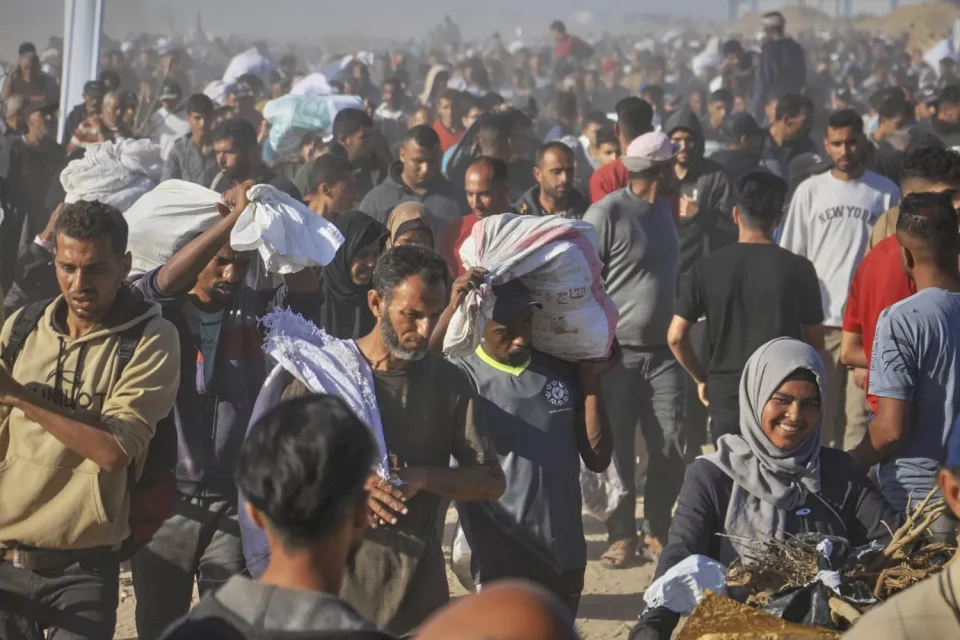
One year ago, the Gaza Humanitarian Foundation began operating military-style distribution points for food throughout the Gaza Strip, replacing the aid distribution system coordinated by the United Nations. The foundation was managed by Israel with financial support from the United States and other allies, but it closed its doors after about six months, following violence associated with it that resulted in the deaths and injuries of thousands. Doctors Without Borders continues to treat a number of patients affected by this violence, who today live with psychological trauma and injuries that will accompany them for life. In light of the proposals circulating about the Gaza Strip, Doctors Without Borders reminds Israel and the United States that the militarization of humanitarian aid carries grave risks, as it exposes people to violence and causes severe harm, and should not be repeated under any circumstances.
The head of the Doctors Without Borders mission in the occupied Palestinian territories, Juan Tubo, explains, "As Doctors Without Borders has documented with medical evidence, those who were seeking food in conditions marked by despair and siege have faced horrific levels of directed and random violence. Children have been shot in the chest while trying to obtain food, others have been crushed or suffocated in stampede incidents, and entire crowds have come under gunfire at distribution points. Today, many of the patients who were injured in the incidents involving the Gaza Humanitarian Foundation rely entirely on charitable aid and community kitchens, as their injuries have limited their ability to move, work, and support their families."
The Gaza Humanitarian Foundation was created to distribute food aid to the population in Gaza after months of a complete Israeli siege, replacing approximately 400 previously existing aid distribution points. The foundation's four locations began operations in late May 2025, and "security" was provided by American private contractors, while Israeli forces maintained control of the broader surrounding area.
Between June and October 2025, Doctors Without Borders teams documented at least 32 deaths and provided treatment to 1,885 injured at the Attar and Muwassi primary healthcare centers in Khan Younis.
Kareem, who worked as a barber before sustaining injuries that changed his life and caused permanent damage to one of the nerves in his leg, explains, "My friend was executed before my eyes, and that moment still haunts me to this day. Both of us were stopped and handcuffed behind our backs [by Israeli soldiers]. Then a drone was summoned to hover above me, and four men were asked to take me away."
Mohammad is another patient who was shot nine times. He still hopes to walk again, but he suffers from chronic pain and needs physical therapy. He explains, "The food was not enough for everyone. The stampede was severe because the narrow iron gates could not accommodate such large numbers. I saw many killed, including women. One was shot in the chest, another in the back. The gunfire came from several directions, and the Israeli soldier who shot me was positioned on a hill."
He adds, "While I was lying on the ground, I waved my hands pleadingly, saying, 'Please stop, that's enough.' But he shot at my hands for fun."
Mustafa, a taxi driver from Rafah, lost his 17-year-old nephew, who was shot in the head by a sniper. Mustafa was also injured by a bullet that broke two bones and later led to an infection in his foot and gangrene in his heel.
He says, "The Gaza Humanitarian Foundation was a highly humiliating experience. Thousands of people were running towards it while Israeli forces were shooting at us from fixed positions. Two-thirds of the injured people I know in Gaza were harmed in incidents related to the Gaza Humanitarian Foundation."
These testimonies reflect the reality of many who have been forced to live with external skeletal fixators or still require precise and ongoing medical follow-up.
The emergency coordinator with Doctors Without Borders in Gaza, Nicholas Papakrisostomo, explains, "Despite the short lifespan of this disastrous aid distribution plan, it has left wide social effects, pushing people to live in extreme fear under scarcity and competition, causing psychological trauma and affecting the dynamics of relationships within the community."
The Gaza Humanitarian Foundation played a key role in the crisis of malnutrition caused by Israel. The severe reduction in food and aid distribution points, along with the complete siege, escalating violence, mass displacement, and destruction of health facilities, has pushed the Gaza Strip toward the famine declared in mid-2025, which has had devastating effects on the most vulnerable groups, particularly pregnant women, newborns, and children.
Tubo adds, "What the Gaza Humanitarian Foundation provided was not a humanitarian solution in any way. A year later, the extent of harm suffered by people at distribution points, in the absence of any accountability, calls for an independent investigation. The ruling by the International Court of Justice issued on October 22, 2025, reaffirms Israel's obligation to ensure the unhindered access of humanitarian aid to Gaza and condemns aid distribution models that have failed to alleviate the suffering of the population, including the Gaza Humanitarian Foundation."
Doctors Without Borders urges Israel, the United States, and all parties able to influence the situation to ensure that humanitarian aid is not militarized and is made available and provided according to the principles of independence, impartiality, neutrality, and humanity. Humanitarian aid must safely reach all civilians based on their needs, wherever they choose to reside, on a scale that matches the magnitude of the needs.
 Follow the latest Sada News via Google News
Morocco Hosts Formative Exercise for International Stabilization Force in Gaza

Sheikh Holds Meeting with Security Leaders to Follow Up on Current Developments

Hebrew Channels: The Likelihood of Israel's Participation in the Attack on Iran is Increas...

Netherlands Sets September Deadline for Ban on Settlement Products

12 Martyrs in Gaza Strip since Dawn Today

A Series of Important Decisions Taken.. The Cabinet Discusses Developments in the Deterior...

Organizations of the Temple Prepare for the Largest Raid on Al-Aqsa on What is Called the...
