

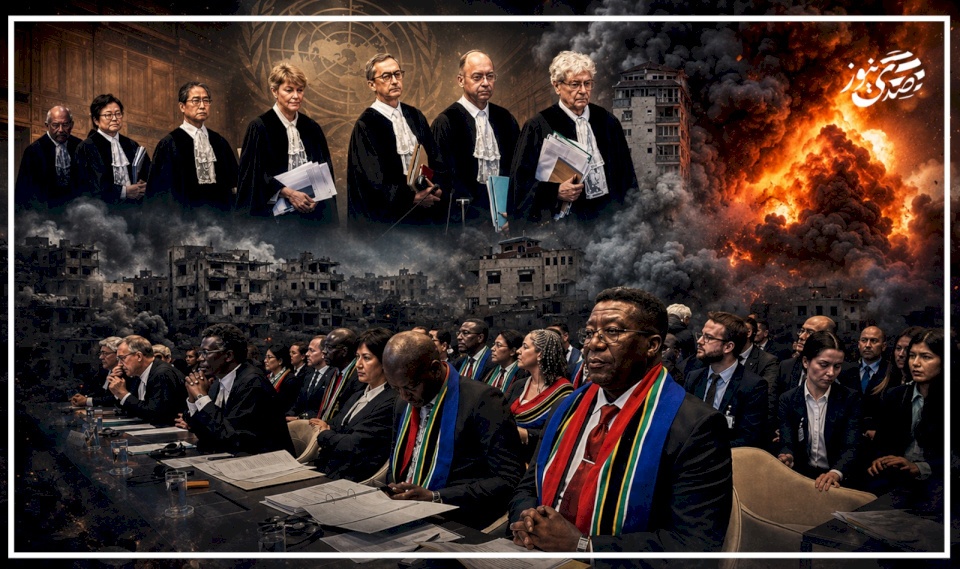
What are the true motives behind South Africa's extension of its lawsuit against Israel after "financial deal" rumors?
SadaNews Report: In the context of the ongoing legal proceedings at the International Court of Justice in The Hague, the court officially approved in May 2026 a request from the Republic of South Africa for an extension of at least 18 months to submit its supplementary written response in the case against Israel, which accuses it of committing genocide related to the war on the Gaza Strip since 2023. This request came as a procedural step after Israel submitted its counter-defensive memorandum in mid-March 2026, which was massive and exceeded 1,000 pages, in addition to nearly 4,000 pages of annexes and documentary evidence. Given the size of these documents and the extreme complexity of the legal and factual details, South Africa requested this additional time to allow its legal team to accurately refute the Israeli defense and present additional updated evidence that includes all developments on the ground. The decision was officially adopted based on a meeting held on April 29 between the court's presidency and the two parties.
Based on this request, the court issued a new timeline determining the deadlines for the second round of written responses, granting South Africa until November 22, 2027, to submit its written response, while May 22, 2029, was set as the deadline for Israel to submit its final written comments.
Another potential secret behind this postponement...
In the context of analyzing these timelines, a report by the "Jerusalem Post" translated by SadaNews revealed other political and tactical dimensions behind this postponement, indicating that some Israeli sources expressed concern that South Africa did not seek the postponement merely to buy time to gather evidence for its case, but perhaps hopes to return to the International Court of Justice in 2029 after the term of U.S. President Donald Trump ends, betting on the possibility that the next U.S. president will be more supportive of its position, which may contribute to bolstering the case within the court where international politics often influence how some of its judges vote.
In contrast to this tactical reading, Israeli official and media narratives attempted to portray the extension as a sign of weakness. The "Jerusalem Post" report suggested that Pretoria's moves might reveal its concerns over the collapse of the case under the scrutiny of evidence submission and the high legal standards prevailing in genocide proceedings.
In this context, the Israeli Ministry of Foreign Affairs stated that "all claims of urgency have now turned into quiet requests from South Africa to gain more time," while Israeli Deputy Attorney General for International Law, Gilad Noam, claimed that Israel's counter-memo and the extensive supporting evidence prove that South Africa's claims are completely baseless, arguing that the case should not have been brought in the first place, and emphasizing to the Israeli newspaper that this lengthy delay represents a significant procedural victory for Israel as it postpones the final ruling to 2030 or later.
Although this procedural extension, which delays the oral sessions and final determination, has drawn criticism from some Palestinian parties like Hamas, who consider that prolonging the proceedings contributes to allowing the responsible parties to escape punishment, legal experts confirm that such long timelines are quite normal and common in complex international cases for the meticulous review of thousands of pages and testimonies.
Rumors of a "financial and political deal"!
In the context of this ongoing scene, a wave of rumors and allegations has intensified, attempting to distort the legal and political position, alleging that South Africa's request for postponement came at the wish or request of Palestine to conclude a political or financial deal, such as the release of withheld Palestinian tax funds by the occupying authorities.
However, official and legal entities have categorically denied this direction, explaining that this connection lacks the slightest degree of political or procedural logic. The Republic of South Africa has not withdrawn or retreated from the case at all, but rather requested time to strengthen it. Moreover, it is not the only party in this lawsuit to unilaterally decide to withdraw, as more than ten countries have officially joined it to become an integral part of this judicial process.
Based on this, all reports and informed sources unanimously assert that the postponement is purely a technical matter for gathering evidence and preparing to refute the Israeli response, confirming that the circulating rumors about trading the case for financial matters like the tax funds are entirely baseless allegations, without any legal basis or official reference, and fall only within the framework of attempts to confuse the international judicial process.
 Follow the latest Sada News via Google News
High-level sources reveal to SadaNews: Washington seeks to hold a Gaza Reconstruction Conf...

What are the true motives behind South Africa's extension of its lawsuit against Israel af...

Washington-Tehran Agreement: Israel Between Tension and Rejection

Yedioth Ahronoth Reveals New Details from the Tense Call Between Netanyahu and Trump

2025.. More than half of the victims of explosive weapons attributed to Israel

Kharj... A Strategic Island for Iran Trump Threatened Again to Take Control of

Sources to "SadaNews": Under Pressure from Mediators, Israel Temporarily Halts Attacks in...
