

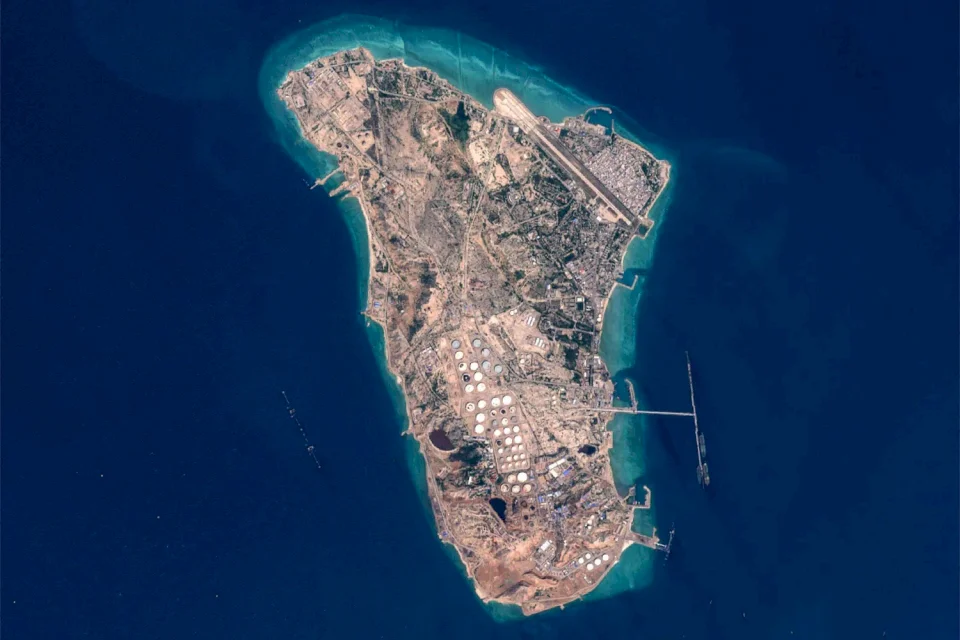
Kharj... A Strategic Island for Iran Trump Threatened Again to Take Control of
SadaNews - The islands controlled by Iran, which spread between the northern Gulf and the entrance to the Strait of Hormuz, have returned to the forefront of the war as part of direct military calculations.
These islands gain additional importance as potential points for engagement in a new phase of the war that may extend beyond conventional military pressure to attempts to strike energy hubs, transit points, and strategic positioning.
At the heart of this map stands Kharj Island, which U.S. President Donald Trump threatened to take control of as it is considered a lifeline for Iranian oil exports. Meanwhile, the other islands have roles in transit control, military fortification, and advanced positioning on one of the world's most sensitive maritime corridors.
Kharj Island is an 8-kilometer long coral island in the Arabian Gulf, located about 43 kilometers from the mainland and approximately 500 kilometers northwest of the Strait of Hormuz. It serves as the endpoint for the pipelines coming from Iran's oil fields in its central and western regions. It was developed by the American oil giant Amoco and was seized by Iran during the 1979 revolution.
Kharj Island occupies an exceptional position in Iran's strategic structure as the lifeline for the majority of Iranian crude exports. It lies north of the Gulf, off the Iranian coast, making it close enough to remain under the umbrella of its missiles and drone capabilities.
Its importance stems primarily from its direct economic function. The island houses the station through which nearly all of Iran's oil exports pass and secures the bulk of the state's revenue from crude. During the ongoing war, it has quickly become a target in military discussions, as striking it would affect one of the state's key sources of funding.
Key Gateway
The island developed during the Iranian oil boom of the 1960s and 1970s because large parts of the Iranian coastline were shallow and did not allow for the docking of giant oil tankers. Hence, the island, with its ports and deep stations, became the most important gateway for Iranian oil exports, especially to Asian markets, particularly China.
Theoretically, any American control could choke off a vital financial artery for the regime and provide Washington with leverage to compel Tehran to keep the Strait of Hormuz open. Additionally, given its location, the island could become a forward platform for military pressure on the Iranian mainland in such a scenario. However, this allure faces heavy obstacles. Seizing it would require deploying U.S. forces on a small island very close to the Iranian shore, thus within range of Iranian drones, missiles, and mobile artillery, with the potential use of mines and fast boats. As such, the attacking force could quickly become a stationary target vulnerable to attrition.
Moreover, retaining control of the island after the troops arrive would require constant air cover, advanced air defense systems, and protected supply lines by sea and air. Tehran has increased its fortifications in Kharj during recent weeks, with additional troop deployments and the positioning of air defense systems, alongside reports of mines around the island.
Significant Strategic Advantages
It has also threatened to target American forces if they attempt to enter the island and to strike the energy infrastructure of companies dealing with the United States if their oil facilities are targeted.
The island houses storage tanks, accommodations for thousands of workers, and has a clear civilian presence, as well as an ancient Portuguese fort and the ruins of an early Christian monastery in the Gulf.
The American newspaper "Washington Post" stated that weakening Kharj Island carries significant strategic advantages for the United States, given its economic and military importance and its connection to Tehran's ability to export oil and finance its institutions, including paying army salaries.
Despite the intensive strikes launched by the United States and Israel against targets within Iran, Kharj Island, the most important center for Iranian oil exports, has so far remained off the list of such strikes; experts warn that striking it could lead to a catastrophic collapse in global markets.
Threat to Strike the Island
Trump has repeatedly threatened to strike the oil infrastructure on the island if Tehran does not stop its attacks on ships in the Strait of Hormuz, a warning that observers say could increase tensions in markets already suffering from unprecedented supply disruptions.
Trump had stated during the bombing of Iran that the United States "completely destroyed" military targets on the island. He added that American strikes did not target the oil infrastructure on Kharj Island, but wrote: "If Iran or any other party does anything to interfere with the free and safe passage of ships through the Strait of Hormuz, I will reconsider this decision immediately."
For its part, U.S. Central Command at the time stated that its forces "successfully struck more than 90 Iranian military targets on Kharj Island while preserving the oil infrastructure," while the U.S. military said the strike destroyed mine storage facilities, missile storage depots, and several other military sites.
 Follow the latest Sada News via Google News
High-level sources reveal to SadaNews: Washington seeks to hold a Gaza Reconstruction Conf...

Kharj... A Strategic Island for Iran Trump Threatened Again to Take Control of

Sources to "SadaNews": Under Pressure from Mediators, Israel Temporarily Halts Attacks in...

Details of the Border Attack Attempt.. Israeli Doubts on Establishing the Equation of 'Nor...

Sources for SadaNews: Anticipated Agreement in Cairo.. Palestinian Factions Move Towards W...

The European Union Provides $395 Million to Support Palestinian Banks Along with €2.1 Mill...

Report reveals: Israel spies on Trump team in Iran talks
