

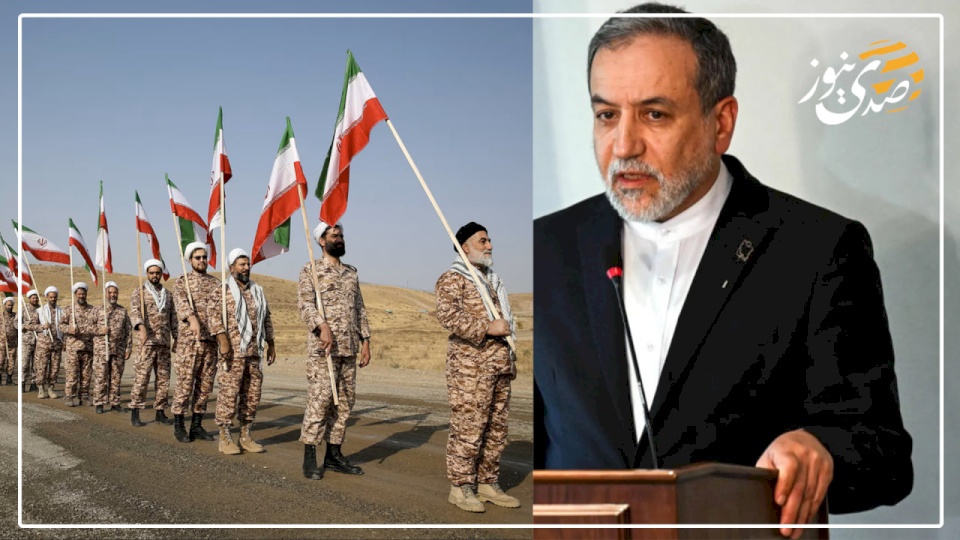
Analysis: The Hormuz Crisis Reveals a "Divide" Between Politicians and Military in Iran
SadaNews - An analysis conducted by the American "Wall Street Journal" highlighted what it considered a "divide" in Iran between hardline political and military leaders who have strengthened their grip on power since the war began.
The newspaper pointed to the "rapid retreat of Iran from reopening the Hormuz Strait," complicating the task of Tehran and Washington negotiators in reaching a deal to completely end the war.
Just a day after Iranian Foreign Minister Abbas Araghchi announced the reopening of the strait, the Iranian Revolutionary Guard fired on at least two commercial vessels in the Gulf for the first time during the ceasefire, issuing warnings to navigators that the Hormuz Strait remained closed, prompting ships attempting to cross to turn back.
This public expression of division points to upcoming difficulties in dealing with the Iranian regime at a time when U.S. President Donald Trump is trying to extract concessions that would allow him to end the war victoriously.
While mediators say that the United States and Iran have shown some flexibility in the talks, and Trump has announced that an agreement is imminent, subsequent events regarding the strait show that those expressing a willingness to resolve the crisis may not enjoy the full support of the hardline Iranian military leaders who have recently tightened their grip on power.
Mohammad Amirsi, an expert on Iranian affairs and a member of the global advisory council at the Wilson Center, a research center in Washington, stated: "The West generally acts as if Iran is a country with a clear leadership chain: negotiating with the Foreign Ministry, then elevating the matter to senior officials for decisions. Case closed."
He added to the "Wall Street Journal": "When things heat up, those with weapons, drones, and speedboats tend to win the debate," referring to the growing influence of the military in Iran.
An Iranian diplomat and another source familiar with the negotiations reported that Araghchi's announcement to open the Hormuz Strait on Friday was an attempt to demonstrate openness to negotiation at a critical moment for the talks, as the ceasefire declared by Trump was nearing its two-week expiration.
The announcement by the Iranian Foreign Minister caused a drop in oil prices and received swift praise from Trump on social media platforms.
Michael Singh, a former senior director for Middle East affairs at the U.S. National Security Council, said: "It appears that Araghchi's statement is aimed more at opening the door for negotiations than at reopening the Hormuz Strait, indicating Iran's interest in reaching an agreement."
However, hours later, a person identifying himself as a member of the Revolutionary Guard's navy broadcasted a message over marine radio stating that the strait remained closed and that ships needed his permission to pass, according to recordings made by a crew in the Gulf shared with the "Wall Street Journal."
Around the same time, the "Tasnim" news agency, affiliated with the Revolutionary Guard, sharply criticized Araghchi for announcing the strait's opening via social media, stating: "The Foreign Ministry should reconsider this type of communication."
Moreover, a prominent hardline legislator, Morteza Mahmoudi, called for Araghchi's dismissal, stating that his statement "contributed to lowering oil prices and gave a gift to the United States."
The Iranian military command officially announced the closure of the strait on Saturday, with reports indicating that Revolutionary Guard warboats approached a tanker off the coast of Oman and fired upon it without causing any injuries, and a report indicated that a container ship off the same country's coast was hit by an unknown projectile, damaging some of its containers.
A senior adviser in the Revolutionary Guard reported that the Guard was angry with Araghchi for not coordinating with them before his announcement, and some analysts have stated that the Revolutionary Guard is still seeking retribution for its losses during the war and feels it has the upper hand militarily.
Trita Parsi, Executive Vice President of the Quincy Institute for Responsible Statecraft, a research center in Washington, commented: "The intensity of hardline resistance to reaching an agreement with the United States has increased, presenting a significant political challenge."
The incident at the Hormuz Strait recalled a similar stance at the beginning of the war, when Iranian President Masoud Behzadiyan apologized for attacks on his neighbors in the Gulf and announced a de-escalation of strikes, but his statements were met with outright rejection from hardline elements within Iran, with Revolutionary Guard leaders denying taking such a position as attacks continued.
The political leadership and military in Iran have shown a rapid response to the developments of battle, but they have sometimes faced difficulties in communication following attacks that resulted in the death of numerous regime leaders, including Supreme Leader Ali Khamenei, according to sources from the "Wall Street Journal."
 Follow the latest Sada News via Google News
High-level sources reveal to SadaNews: Washington seeks to hold a Gaza Reconstruction Conf...

France Studies Imposing Sanctions on Settlers Involved in Violence Against Palestinians

Sources to "SadaNews": The New Revolutionary Council of Fatah Will Hold Its First Meeting...

85 Members of Congress Urge Trump to Intervene to Halt Colonial Project East of Jerusalem

CNN: Israeli Secret Units Operated from Azerbaijan Against Iran

Sources to 'SadaNews': A Hamas delegation arrives in Cairo on Friday to begin new negotiat...

New Poll Shows Likud Decline and Smotrich's Party Surpassing the Threshold
