

Top News
Report: Israel Informed Washington in Advance of the Al-Dhahieh Airstrike and Promises to Continue Targeting Beirut
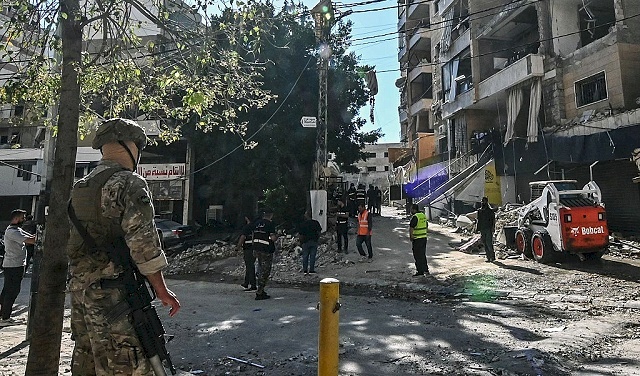
SadaNews - Israel informed the administration of U.S. President Donald Trump in advance of the airstrike that targeted the southern suburbs of Beirut today, Sunday. An Israeli source confirmed that the attack targeted a command center belonging to Hezbollah, at a time when Iran threatened to respond to the attack.
According to Axios, Israel briefed the Trump administration on the airstrike before carrying it out, informing Washington that the attack was a response to rockets recently fired from Lebanon towards towns in northern Israel, which the Israeli army said it intercepted earlier today.
Axios added that Israel informed Washington that it considers Hezbollah's continued attacks on northern Israel a violation of understandings related to the ceasefire, and that it will continue to target Beirut as long as rockets or drones are launched towards Israeli towns.
The airstrike on the southern suburb, in its initial toll, resulted in the martyrdom of two individuals and the injury of 11 others, according to the Lebanese National News Agency, after targeting a building in the Tahwita al-Ghadir area in the southern suburbs of Beirut.
The report quoted Israeli officials as saying that the airstrike targeted a "command center" for Hezbollah in the southern suburbs. Israeli sources also mentioned that the attack targeted two buildings used for managing and planning operations, rather than specific individuals or leaders.
In the same context, Israeli media reported that the aim of the attack was not to carry out an assassination, but to target operational infrastructure of the party. The Israeli army radio pointed out that the targeted site was used as a center for planning operations against Israeli areas.
Yedioth Ahronoth reported on its website "Ynet" that "according to available information, the headquarters targeted in Beirut was empty, making this attack largely symbolic."
In the first Iranian reaction, a member of the Iranian Parliament's National Security and Foreign Policy Commission, Ebrahim Raee, threatened to respond to the Israeli attack, writing on the platform "X" that Iran "will deliver a decisive and painful response to the Zionist regime's attack on the suburbs," calling for "monitoring the skies of Israel tonight."
Israeli estimates stated today, Sunday, that there are currently no indications of an imminent Iranian attack in response to the Israeli airstrike that targeted the southern suburbs of Beirut. According to Israel Hayom newspaper, an Israeli source said: "So far, and I emphasize 'so far,' we do not see indicators of a close Iranian attack."
Israeli Prime Minister Benjamin Netanyahu and his Security Minister Israel Katz stated in a joint statement that "based on the directives of the Prime Minister and the Security Minister, the Israeli army launched an attack on Hezbollah positions in the suburbs of Beirut, in response to the gunfire on Israeli territory"; this came shortly after Netanyahu announced that Tel Aviv would respond to Hezbollah as appropriate in light of the targeting of towns in northern Israel.
The Chief of Staff of the Israeli army, Eyal Zamir, approved the airstrike in the southern suburbs of Beirut today while present in the Gaza Strip. According to Israeli media, two warplanes launched 10 missiles at the targeted site.
The airstrike on the southern suburb of the Lebanese capital comes in the wake of previous Iranian warnings that targeting Beirut could lead to broader escalation in the region and affect the ongoing communication and negotiation processes between Tehran and Washington.
Last week, the U.S. president intervened to prevent a wide-scale Israeli attack on Beirut after conducting a sharp phone call with Israeli Prime Minister Benjamin Netanyahu, followed by an announcement of a partial ceasefire that included an Israeli commitment not to target the Lebanese capital in exchange for halting Hezbollah's attacks on border towns.
Later, Israel and Lebanon announced reaching a broader understanding for a ceasefire that included stopping Hezbollah's attacks and the withdrawal of its elements to the north of the Litani River; however, the party announced its rejection of these arrangements, leaving the agreement without effective implementation on the ground, amid the continued mutual escalation between the two sides.
 Follow the latest Sada News via Google News
Read Also

Washington Investigates Possible Russian Role in Iranian Attacks on Its Sites

Mossad Chief Visited Washington to Discuss Iran and Its Nuclear Program

Report: Washington Informed Israel It Is Preparing to Intensify Attacks on Iran and Use St...

Organization of Islamic Cooperation Condemns Nauru's Decision to Open an Embassy in Occupi...

Video:: Nablus: Settlers Evict Tubasi Family from Their Home in Jaloud and Take Over It

Netanyahu: I Intend to Form a Broad National Unity Government

Syrian Foreign Minister Meets with Yasser Abbas in Damascus
