

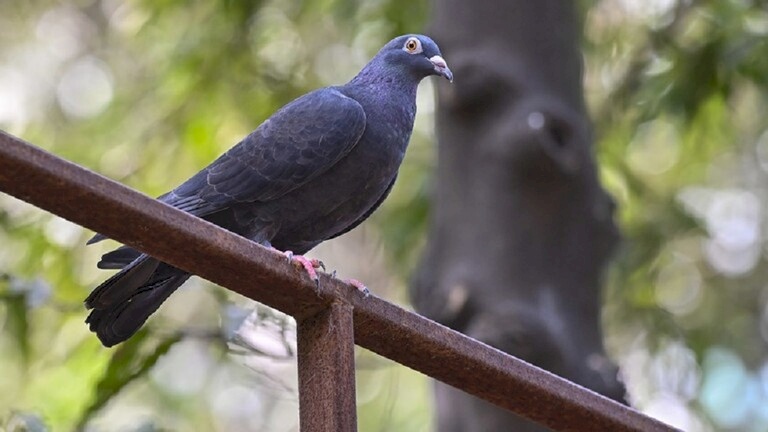
How Pigeons Return Home: The Secret Lies in the Liver
SadaNews - Pigeons are known for their ability to cover long distances and return home. For decades, scientists have sought to understand how they accomplish this. A new study suggests that part of the answer may lie in an unexpected location: the liver.
The Pigeon’s Liver
According to a report by SciTechDaily citing the journal Science, specialized immune cells in the pigeon’s liver can help it sense the Earth's magnetic field, providing it with an internal compass to aid in navigation.
Magnetic Perception
These immune cells are known as macrophages, and they usually help break down aging red blood cells. During this task, iron accumulates in them. According to researchers, this iron can give the cells unique quantum properties that allow them to respond to magnetic fields.
When these cells were removed, the birds struggled to return home.
Professor Christian Kurts, director of the Institute of Molecular Medicine and Experimental Immunology at Bonn University Hospital and a senior researcher in the study, said: "It was completely unexpected that immune cells function as sensors for magnetic fields. The study's findings reveal a previously unknown mechanism of magnetic perception in animals."
Professor Martin Wikelski, director of the Max Planck Institute for Animal Behavior and another co-researcher in the study, adds: "What seems like intuition in guiding birds may actually have a physical basis."
A Puzzling Mystery in Bird Navigation
Scientists have always known that migratory birds and homing pigeons use the Earth's magnetic field as one of their navigation tools. However, how they sense this field remains unclear.
Previous ideas suggested that birds might detect magnetic fields through light-sensitive molecules in their eyes or through tiny magnetic particles in their beaks. Despite years of research, it has been difficult to obtain conclusive evidence supporting either explanation.
A Different Possibility
The new study presents a different possibility. The international research team included immunologists from Bonn University and Bonn University Hospital, physicists from the University of Duisburg-Essen, and bird scientists from the Max Planck Institute for Animal Behavior.
To determine where magnetic sensing occurs, researchers examined several parts of the body considered potential candidates, including the eyes, beak, brain, as well as the liver and spleen.
Using techniques known as "vibrating sample magnetometry" and "magnetic cell sorting," the team measured magnetic properties in different tissues.
Magnetic Properties
Dr. Klivia Lisovski, the lead researcher from Bonn University who led the immunological work, stated: "There were some indications that the liver and spleen have magnetic properties, as they break down red blood cells and thus store a substantial amount of iron in the body."
The liver stood out among all other tested tissues, showing the highest concentration of iron.
Professor Ulf Weidwald from the University of Duisburg-Essen stated: "Iron crystallizes into nano-sized oxide particles, making the cells supermagnetic and reactive to magnetic fields. The strongest magnetic response was found in liver tissues." Subsequent studies revealed that liver macrophages are the source of this magnetic response.
Testing the Pigeon's Magnetic Compass
To verify whether these cells truly affect navigation, researchers conducted homing experiments with pigeons at the Max Planck Institute for Animal Behavior in Konstanz, Germany, from distances exceeding twenty kilometers.
When liver macrophages were removed, the birds lost their sense of direction on cloudy days when the sun was absent. However, on sunny days, they were able to successfully return home, likely relying on solar signals rather than magnetic signals.
The results suggest that pigeons use multiple navigation systems, and that magnetic sensing becomes critically important when no visual guidance from the sun is available.
Information Transfer from the Liver to the Brain
After demonstrating the cells' impact on navigation, the researchers investigated how information is transferred from the liver to the brain. Using electron microscopy, they discovered that iron-rich macrophages are located near nerve fibers. This arrangement may provide a pathway for transmitting magnetic information to the nervous system.
Lisovski commented: "These results provide the first tangible evidence of how the Earth's magnetic field is perceived within the body and communicated to the brain for directional movement."
Researchers note that this discovery integrates several known biological processes, including iron metabolism and the communication between the immune and nervous systems, in a potential explanation of how animals utilize the Earth's magnetic field to determine directions.
Wikelski stated: "Direction finding in animals is one of the most exciting phenomena in nature. If immune cells are part of the mechanism by which birds sense direction, it would fundamentally change our understanding of navigation."
Implications Beyond Birds
Many questions remain, particularly regarding how the brain processes the signals coming from the liver cells.
These findings could extend to other species beyond pigeons. Animals like sharks can determine their direction without relying on light, suggesting the possibility of similar mechanisms in other species.
Researchers state that this work opens the door to explore whether animals, and perhaps even humans, respond to magnetic fields in ways that are not yet fully understood.
 Follow the latest Sada News via Google News
Goodbye to Cavities.. A New Gel That Rebuilds Tooth Enamel

UNESCO Officially Lists the Tunisian Village of "Sidi Bou Said" as a World Heritage Site

Morning Chaos of Choosing Clothes.. Is the "Capsule Wardrobe" the Solution?

Joshua defeats Brinjar by knockout and approaches a fight with Fury

After a Century of Unity.. Discovery of an Unknown Relative of a Rare Plant in Oman

Can you be healthy while obese?

Opening of the National Festival for Theater.. Esaad Younes dedicates her honor to Samir G...
