

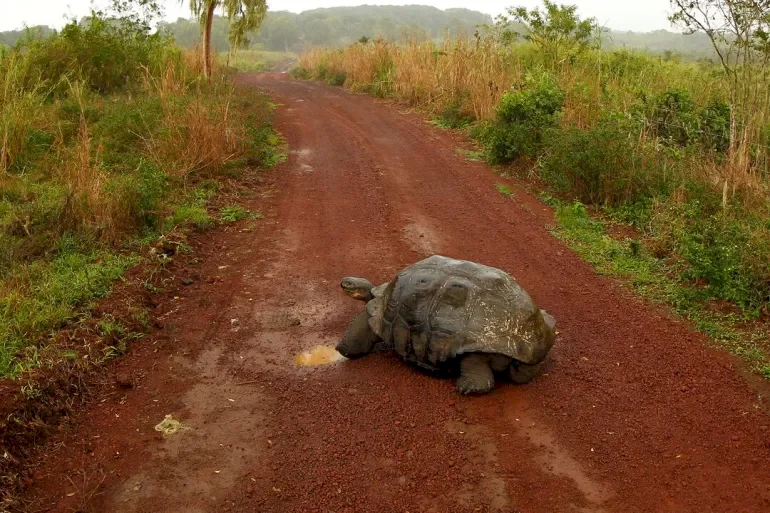
Living for Two Centuries: What is the Scientific Secret Behind the Age of the Turtle "Jonathan"?
SadaNews - Nearly two centuries have passed with significant events in the world, during which empires have fallen, others have risen, and generations have come and gone. Throughout this time, the turtle "Jonathan", awarded the title of the oldest living creature on Earth by the Guinness World Records, has continued to move at its slow pace, as if time means nothing to it.
With this turtle, residing on a remote island in the Atlantic (Saint Helena) at the age of 193 years, many have awaited the news of its death one day. Hence, it was easy to promote the rumor of its death, which surfaced at the beginning of April, in the context of what is known as "April Fool's Day".
As the government of Saint Helena rushed to deny the death rumor that dominated social media platforms, most comments revolved around how this turtle has managed to survive since 1882 until now.
Convergence of Environmental and Biological Factors
One of the most prominent studies was conducted by researchers from the University of Southern Denmark and published in the journal "Science". In this study, researchers analyzed data from 52 species of terrestrial turtles in zoos and aquariums, revealing that about 75% of these species suffer from extremely slow or nearly non-existent aging, while nearly 80% showed aging rates slower than humans, which means that the risk of death does not significantly increase with age as it does for humans.
The study indicated that longevity in these creatures is linked to both biological and environmental factors, showing that increased body weight is associated with a higher average lifespan, which explains the effect of size differences between males and females on their lifespan variations.
What was most striking was the study's discovery that turtles may have a unique ability to reduce their aging rate in response to improved environmental conditions, suggesting that their "biological clock" is not fixed but can slow down in safe and stable environments, such as gardens.
The study did not delve into the biological reasons linking large size to longevity, merely indicating statistical implications, but research by John Speakman from the University of Aberdeen in Scotland, published in the "Journal of Experimental Biology", uncovered the biological reasons. It primarily emphasized that larger creatures tend to have a slower metabolic rate per unit of body.
The study illustrated that when metabolism is slower, free radicals (substances that harm cells) are reduced, cellular damage accumulates less, and as a result, cells deteriorate more slowly, which extends the lifespan of the organism.
A Genetic Reason for Longevity
A third study by researchers from the Spanish University of "Oviedo", published in "Nature Ecology & Evolution", reveals a genetic reason for longevity.
The researchers found that giant turtles possess unique genetic signatures that may explain their exceptional lifespan. The study showed they have specific mutations affecting genes related to DNA repair, inflammation regulation, and cancer development, indicating that these creatures have developed effective biological mechanisms to resist cellular damage and age-related diseases.
Thus, what these studies reveal is that Jonathan's longevity is not a mystery but rather a natural result of living in a stable and safe environment, with cellular mechanisms that repair any damage and beneficial genetic mutations accompanying extremely slow or nearly non-existent aging.
Source: Various websites
 Follow the latest Sada News via Google News
After Deschamps' Departure... Zinedine Zidane Tops the Candidates to Lead France

Mbappe Surpasses Messi and Becomes the All-Time Top Scorer in the World Cup

England Defeats France and Achieves Largest World Cup Achievement Since 1966

Messi Refused to Play for Spain and Missed 3 World Cups

Publishers Sue Google for Allegedly Using Books to Train Artificial Intelligence

Google Expands Capabilities of Google Search Console to Support Social Media Accounts

The Mediterranean Table... An Ancient Diet Revealing Its New Secrets for Health and Longev...
