

Art and Words: A Cultural Evening in Taiz that Opens Doors to Memory and Colors
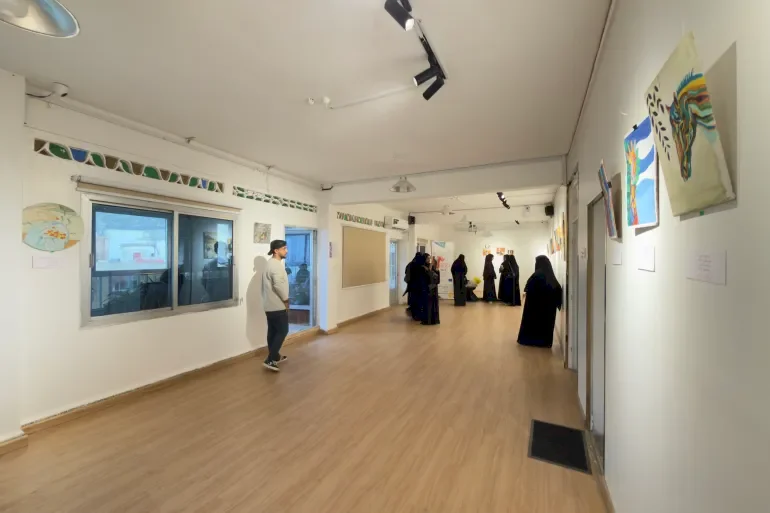
SadaNews - On the upper floor of the "Basement" cultural foundation in Taiz - specifically the Creative Center of Taiz - music quietly wafted between the seats, as if it were opening layers of silence one after the other.
On the walls, the paintings stretched out like internal pathways charged with questions, not quickly read, but discovered like memory when suddenly recalled.
There was no red carpet or loud celebratory atmosphere, but the place filled with an audience that came from behind the details of daily life to participate in an evening that combined visual art, music, and writing, as part of the "European Days" activities and the Creative Centers project in Taiz; a city living for years between the weight of reality and its continuous attempts to open small windows to beauty. Among the works that caught the visitors' attention:
The "Tale" exhibition by visual artist Hadeel Mohammed stood out, appearing more like an open emotional notebook on the walls, where her works were not presented as answers, but as spaces that allow each viewer to reinterpret them from their own perspective, as if the paintings were only completed within the eye of the beholder.
Colors as Layers of Experience
Inside the hall, the paintings were not viewed quickly; many in attendance stood before a single work for a long time, as if the act of looking transformed into an internal understanding, while others settled for the silence that here replaced speech.
Artist Hadeel Mohammed told Al Jazeera Net: "The 'Tale' exhibition came from my desire to transform personal experiences into a visual impact that can be shared," explaining that the paintings emerged from accumulated emotional states related to fear, nostalgia, calm, and confusion—feelings she sees as part of the details of daily life in the city.
In some works, the colors seemed intermingled, as if in a state of internal conflict seeking resolution, while in others they appeared calmer, like moments of breathing within a space crowded with experience, creating a contrast that sparked a silent discussion among attendees about the relationship between color, memory, and feeling.
Music as an Extension of the Visual State
Before the exhibition opened, music played an essential role in the scene, when musician Shumos Rasam performed pieces on the piano accompanied by artist Mohamed Al-Sabbari, in a moment where the hall seemed to breathe with a single rhythm.
Musician Shumos Rasam explained to Al Jazeera Net that performing in such artistic spaces differs from traditional halls, as the audience does not merely watch or listen; they enter into a shared emotional state with what is presented before them, adding: "The music here does not operate in isolation from the paintings, but coexists with them in a single space, as if every note attempts to open a path to a color or idea hanging on the wall."
Rasam pointed out that the experience in Taiz carries a clear specificity; people come to art weighed down by their daily experiences, making interactions more genuine and less artificial, confirming that the continuation of such events gives artists a sense that there are still those who seek art as an internal necessity rather than a luxury.
Art as a Space for Life
For his part, the coordinator of the Creative Center of Taiz, Jamal Al-Maqtari, believes that these activities are not presented merely as elite cultural events, but as essential spaces for restoring human balance within the city, explaining that the idea revolves around making art part of daily life, not an exceptional event separate from it.
Al-Maqtari adds that the experience aims to build a new relationship between the audience and art based on interaction rather than passive reception, and on participation rather than mere viewing, noting that this type of event opens the door to a wider dialogue between generations and various interests within the city.
In this context, writer and researcher Imran Al-Hamadi sees that what happens in such evenings reflects a genuine attempt to rebuild the cultural memory in Taiz, asserting that the city - despite all it has been through - still retains a latent cultural energy that appears in such initiatives.
Al-Hamadi continues: "Art in this context is no longer separate from reality, but has become an extension of it; therefore, works tend to express the human experience from within, about daily anxiety, and attempts to understand the world without ready-made molds," indicating that the importance of these meetings lies in recreating a moment of human gathering around art, at a time when the distances between people have become larger than before.
An Audience Rediscovering Details
The evening witnessed a diverse attendance of university students, artists, activists, and cultural enthusiasts, with notable female participation in interaction and discussion about the works. Salwa Saleh, one of the attendees, said: "The paintings do not present a single meaning, but open the door to multiple possibilities; the experience made me view art as an open question with no final answer."
At the end of the evening, many attendees continued to wander slowly among the works, as if they were postponing the moment of departure from the spiritual state of the place.
Outside, Taiz was reclaiming its usual daily rhythm; a tired city, yet it still leaves a small space in its corners for something resembling light, even if from afar.
 Follow the latest Sada News via Google News
After Deschamps' Departure... Zinedine Zidane Tops the Candidates to Lead France

Mbappe Surpasses Messi and Becomes the All-Time Top Scorer in the World Cup

England Defeats France and Achieves Largest World Cup Achievement Since 1966

Messi Refused to Play for Spain and Missed 3 World Cups

Publishers Sue Google for Allegedly Using Books to Train Artificial Intelligence

Google Expands Capabilities of Google Search Console to Support Social Media Accounts

The Mediterranean Table... An Ancient Diet Revealing Its New Secrets for Health and Longev...
