

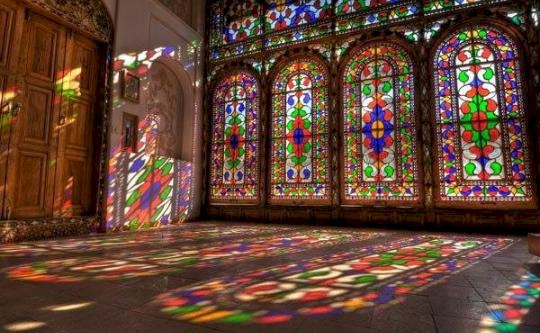
"Qamariyat" of Sanaa Defies the Consequences of War and Economic Stagnation
SadaNews - In Sanaa, the traditional "Qamariyat" resist the repercussions of years of conflict, economic stagnation, and a decline in restoration work, remaining witnesses to a visual identity that refuses to fade away. The "Qamariya" is not merely a window above doors and windows; it serves as the "eye of the city that does not close its eyelids," embodying the spirit of Yemeni architecture that infuses ancient earthen homes with life and privacy.
These artistic pieces date back centuries; Professor Ali Saif, an archaeology professor at the University of Sanaa, explains the historical roots of this craft, saying: "The Qamariya is an authentic Yemeni mark, its history began before Islam, specifically during the period of the Sabaean state. The historian Al-Hamdani referred to this when describing the construction of the famous Ghamdan Palace, noting that the Mufaraj (the upper council) at the top of the palace was covered with a single slab of marble, which is in essence the first Qamariya."
Despite this extended history, this craft is currently undergoing difficult times. The years of war and economic stagnation have cast heavy shadows over craftsmen, and the spread of windows and imported ready-made materials has gradually altered the features of traditional architecture. With the decline in restoration projects for historic cities, this craft now faces the risk of severe contraction.
Inside a small workshop amidst the alleys of Sanaa, craftsman Yasser Al-Wasabi confronts these challenging circumstances. Al-Wasabi has devoted 16 years of his life to creating Qamariyat, skillfully shaping gypsum and colored glass with his hands to transform them into exquisite geometric panels that reshape the light flowing into homes.
Al-Wasabi confirmed that completing a single Qamariya can take him many long days of arduous work and patience. For him, the motivation behind holding onto this demanding profession is not purely financial; rather, it stems from a passion to save a visual and historical heritage from the danger of extinction and to keep the windows of Sanaa open to beauty and authenticity, no matter how harsh the circumstances.
Among the most prominent challenges facing the "Qamariyat" today are economic stagnation, weak purchasing power of citizens, declining restoration and maintenance work on ancient heritage buildings, and the invasion of ready-made and imported materials that threaten authentic architectural styles.
 Follow the latest Sada News via Google News
Goodbye to Cavities.. A New Gel That Rebuilds Tooth Enamel

UNESCO Officially Lists the Tunisian Village of "Sidi Bou Said" as a World Heritage Site

Morning Chaos of Choosing Clothes.. Is the "Capsule Wardrobe" the Solution?

Joshua defeats Brinjar by knockout and approaches a fight with Fury

After a Century of Unity.. Discovery of an Unknown Relative of a Rare Plant in Oman

Can you be healthy while obese?

Opening of the National Festival for Theater.. Esaad Younes dedicates her honor to Samir G...
