
Qatar Relies on Gas Expansions to Compensate for Production Affected by War
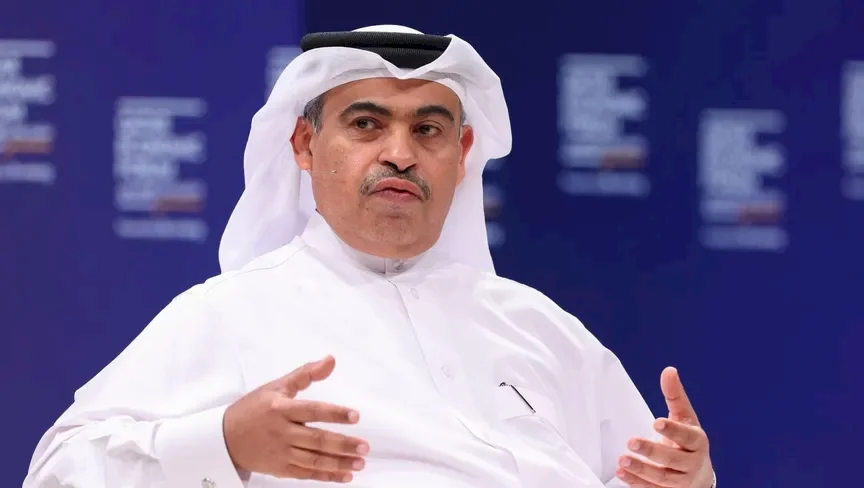
SadaNews - Qatari Finance Minister Ali Al-Kuwari confirmed that Qatar is capable of compensating for the production losses caused by the war in Iran through ongoing gas expansion projects and its joint ventures in the United States, emphasizing that the repercussions of the war will not change the country's economic plans or its path in the energy sector.
Al-Kuwari stated during a session at the "Milken Institute" conference in Los Angeles that Qatar lost a production capacity of 2.8 million tons annually after two production lines were halted due to attacks. However, he clarified that the country has already begun operating new expansion projects, including a production line with a capacity of 8 million tons per year expected to become operational by the end of the year, which will help compensate for lost production.
He added that production has also commenced from liquefied natural gas facilities in the United States as part of a joint venture between "QatarEnergy" and "Exxon", with a total capacity of 17 million tons per year, of which Qatar holds a stake worth about 12 million tons, pointing out that this "equates to what we lost entirely".
At the end of March, the joint venture "Golden Pass LNG" in Texas started production from its first of three units, paving the way for the delivery of the first shipment from its facilities. Global exports from the project are expected to begin in the second quarter of the year.
Al-Kuwari also noted that Qatar is moving forward with its plans to increase liquefied natural gas production by 85% by 2030 to reach 142 million tons annually, asserting that the combination of local expansions and U.S. projects will help the country mitigate the impact of production losses associated with the war.
He added that the main risk lies only in the possibility of postponing some expansion projects for a year or two, but stressed that this "will not materially affect" the long-term expansion plans.
Energy Disturbances and Hormuz
These developments come after the war that began at the end of February forced the state-owned "QatarEnergy" to declare "force majeure" on liquefied natural gas supplies until mid-June, following damage to the "Ras Laffan" facility, the largest in the world for exporting liquefied natural gas, due to Iranian missile strikes in March.
The war has also caused widespread disturbances to global energy flows, leading to nearly a complete closure of the Strait of Hormuz, through which about a fifth of the world's energy supplies passed before the war, whereas Qatar represents about 20% of global energy supplies through liquefied natural gas, according to Al-Kuwari.
The Qatari finance minister indicated that Gulf countries faced "hostilities" from Iran, as the latter was subjected to U.S. and Israeli attacks, explaining that the targets were not limited to U.S. bases but also included civilian infrastructure in Gulf countries.
He added that Qatar has been subjected to numerous missiles and drones, and that the air defense systems intercepted most of them, but some attacks caused damage to infrastructure and energy facilities and to gas-to-liquids conversion.
Economy and Public Finances
Although Al-Kuwari confirmed the war's impact on "various aspects of the economy and public finances", he clarified that these repercussions will not drive Qatar to change its objectives, plans, or path of economic diversification, noting that the country is operating within crisis management mechanisms and relying on financial safety margins built over the years, in addition to a medium-term fiscal policy framework to manage different scenarios and crises.
He explained that "Qatar Investment Authority" and the central bank's reserves provide strong support to the economy, but noted that Doha does not expect to need to use these resources extensively at this time.
The "International Monetary Fund" has sharply lowered its growth forecasts for the Qatari economy by 14.7 percentage points, forecasting an economic contraction of 8.6% during this year.
However, Al-Kuwari mentioned that the international organization expects Qatar to recover what it loses this year during the next year, with an average growth of 6.6% in the following years, adding that the government is establishing a new baseline for growth without changing the overall economic trajectory.
Al-Kuwari indicated that Qatar has reduced its debt ratio from around 70% of GDP after the Corona pandemic to 42% in recent years, noting that this year's budget was built on an oil price of $55 per barrel, which is much lower than current levels, with an expected deficit close to 1% of GDP, highlighting that the debt plans have not changed compared to what they were before the war.
He pointed out that the government has implemented some financial tightening measures and restructured the priorities of some projects, but has not changed the strategic plans related to "Qatar Vision 2030".
U.S. Investments and Long-term Partnership
Regarding foreign investments, Al-Kuwari confirmed that Qatar continues to invest in technology, healthcare, and entertainment sectors, explaining that the country has committed over $10 billion in investments since the beginning of the war, "most of which will head to the United States".
He added that the economic partnership with the United States is "long-term", and that most of the announced investment commitments have already begun materializing, alongside ongoing cooperation between the two countries on several issues.
 Follow the latest Sada News via Google News
Bitcoin Drops to Lowest Level Since the Start of the Iran War

Oil Prices Drop After Ceasefire Agreement Between Israel and Lebanon

Fluctuations in Gold and Silver Prices Due to Tensions in the Arab World

The Fastest in History: The Number of ChatGPT Users Exceeds One Billion

European Bank for Reconstruction and Development Cuts Growth Forecasts for 2026

International Warning of a "Dark Scenario" for the Global Economy if the War Lasts

Launch of the Petersburg International Economic Forum.. Saudi Arabia as Guest of Honor and...
