

South Syria Between Occupation Constraints and Anticipation of an Unharvested Season
SadaNews - The impacts of Israeli violations in southern Syria are deepening, with direct repercussions on agriculture and livestock raising in Quneitra and Daraa, amid increasing restrictions on residents' access to their lands, and damage to vast areas of agricultural land and pastures that form the basis of their livelihood.
These violations occur almost daily, despite Damascus's announcement of its commitment to the 1974 disengagement agreement, while Israel has renounced it following the fall of the Assad regime. These measures include ground incursions and artillery shelling, in addition to the detention of civilians, setting up field checkpoints, and destroying crops.
This escalation comes despite the announcement on January 6 of establishing a communication mechanism between Syria and Israel under American supervision, aimed at coordinating information exchange, reducing tension, and engaging in diplomatic tracks, as well as "discussing economic opportunities."
However, the field developments reflect the ongoing tension. Syrian authorities confirm that these violations hinder efforts to restore stability and limit the government’s ability to improve the economic situation and attract investments amid a decline in productive sectors.
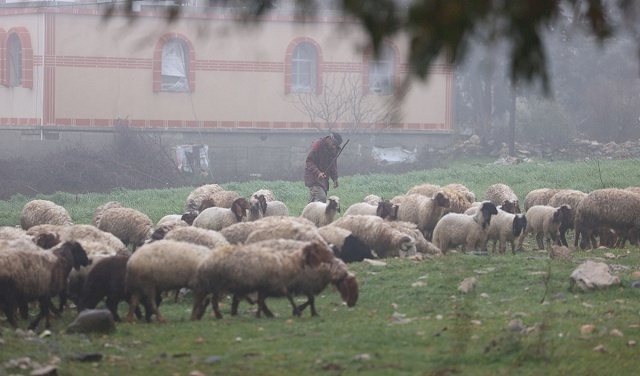
On the ground, these measures have led to the division of the rural areas of Quneitra through the establishment of dozens of military bases and points, as well as causing damage to hundreds of hectares, including uprooting and destroying fruitful trees. The establishment of military sites has also contributed to converting areas of pasture into unusable regions, directly affecting livestock breeders.
Farmers are facing increasing difficulties in accessing their lands, while fruitful trees, such as olives and grapes, continue to produce without their owners being able to harvest their crops, leading to direct economic losses, along with social repercussions for the residents who depend on agriculture as a primary source of income.
In this context, the Director of Agriculture in Quneitra, Mohamed Rahal, indicates that the damages are not limited to the military side but extend to environmental dimensions, explaining that the violations along the ceasefire line and within the area "have significantly affected farmers," with forests being damaged and access to vast areas of land being restricted.
He adds that "chemical materials sprayed in some areas have caused damage to crops and pastures," noting that analyses showed they are herbicides, which have inflicted significant losses on winter crops and pastures.
He points out that livestock breeders are facing difficult conditions, leading many of them to sell their herds due to a lack of pastures and ongoing pressures.
For their part, farmers affirm that agricultural activity has significantly declined. Farmer Mohamed Al-Hassan says that accessing the lands has become fraught with danger, as Israeli forces could enter at any moment, prompting residents to refrain from going there or allowing their children to do so.
He notes that several farmers have been unable to harvest their crops, including olives and cherries, while the livestock sector has been greatly affected, with shepherds unable to use the pastures for fear of being shot, prompting some to sell their livestock.
For his part, farmer and livestock breeder Hussein Bakir says that they have become unable to invest in their lands, adding: "We have lands but we cannot access them, neither for farming nor for grazing, and even passing through the roads has become restricted."
He points out that shepherds face repeated threats, explaining that Israeli forces inform them that these lands belong to them, "but in reality, they are our lands, inherited from father to grandfather." He adds that he cannot access his land, which is about 500 dunams in size, calling for intervention from the concerned authorities, in light of a reality he describes as "no longer bearable."
It is noteworthy that Israel has occupied most of the Syrian Golan Heights since 1967 and has expanded its control following developments that occurred after the ousting of the Syrian regime in late 2024, including areas within the buffer zone.
 Follow the latest Sada News via Google News
Trump: We will make great progress with Beirut.. Aoun: It is time for Lebanon to be stable

The Lebanese Army Deploys in the South and Comes Under Gunfire; Israel Clarifies

Bezhkian: Directives from the Leader to End the State of No War, No Peace

Saudi Arabia condemns the Houthi threats to navigation and pledges to protect its ships

Global Warning to Americans Due to Rising Tensions in the Middle East

Houthi Movement Announces Ban on Maritime Navigation Against Saudi Arabia

Earthquake of 5.5 Magnitude Hits Western Iran
