

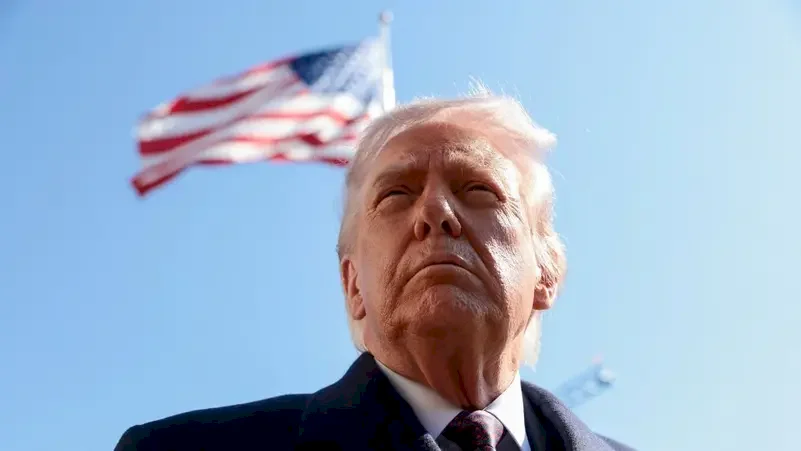
Mixed Reactions to Trump’s Call for an International Alliance for Hormuz
SadaNews - President Donald Trump's call for forming an international maritime alliance to protect navigation and escort oil tankers stuck outside the Strait of Hormuz has faced cautious and rejecting responses, with legal, political, and logistical complexities turning its implementation into a high-cost adventure that could exacerbate the crisis rather than resolve it.
Trump called, in statements made aboard Air Force One and on posts on the "Truth Social" platform, for seven countries, including China, France, Japan, South Korea, and Britain, to join a maritime alliance that would escort tankers and protect navigation. He promoted this alliance as a step to correct "injustice," stating to reporters that "America no longer needs Hormuz oil as it once did; others must protect their interests themselves." He warned NATO allies of facing a "very bad" future if Washington’s allies do not contribute to opening the Strait of Hormuz.
Rejection and Reservations
However, this call, aiming to share the burden of securing one of the world's most important maritime corridors, faced explicit rejection and widespread reservations from several allied countries, amidst fears of military and economic risks that could far exceed the boundaries of a commercial vessel escort mission. Both Japan, Australia, and Britain have rejected sending warships to the Strait of Hormuz, citing legal, logistical, and security challenges.
Japanese Prime Minister Sanae Takaichi (who is visiting the White House on Thursday) stated that her country is exploring what it can do independently or within the existing legal framework.
In Europe, several countries expressed concern over the ramifications of closing the strait, but they showed significant reservations about being drawn into an open war and direct confrontation with Iran.
British Prime Minister Keir Starmer said on Monday that his country is working with its allies to devise an "actionable" plan to reopen the Strait of Hormuz, emphasizing that this would not occur under NATO's umbrella. Starmer clarified: "We are working with all our allies, including our European partners, to devise a feasible collective plan that restores freedom of navigation in the region as soon as possible and mitigates economic impacts." He noted that he discussed the issue with Trump. He stressed that Britain "is taking necessary measures to defend itself and its allies, but it will not be drawn into a broader war" in the Middle East.
For its part, the German government confirmed that NATO is not concerned with the current war in the Middle East following U.S.-Israeli strikes on Iran. Stefan Kornelius, a spokesperson for German Chancellor Friedrich Merz, stated that "(NATO) is a defense alliance for the territories" belonging to its members, adding that "there is no mandate for deploying the alliance's forces" in the current situation. The spokesperson indicated that "the current war has nothing to do with (NATO). This is not the alliance's war."
France announced that it does not intend to join the war and that its role in the region remains defensive.
Greece rejected participation, noting that any military involvement could escalate confrontation in the region. Italy called for diplomacy to be adopted as the best way to resolve the crisis in the Strait of Hormuz. Meanwhile, Danish Foreign Minister Lars Rasmussen said his country must consider, with an open mind, how it can contribute to ensuring navigation in the Strait of Hormuz. Rasmussen added to reporters in Brussels: "As a small nation, but a major maritime nation, we must remain open to this matter."
In Asia, both China and South Korea, which are most affected by the closure of the Strait of Hormuz, expressed concerns that their tankers could suffer retaliatory strikes and preferred diplomatic pressure.
The Chinese Foreign Ministry responded succinctly stating that Beijing is in contact with all parties and is committed to de-escalation in the Strait of Hormuz.
This international hesitation reflects increasing fears of being dragged into a direct military confrontation with Iran, especially given estimates that any maritime alliance to protect navigation could become a target for Iranian attacks, potentially broadening the war and dragging new countries into the conflict.
Legal and Political Complexities
Legally, the idea of the international alliance is based on the principle of "freedom of navigation" under the Law of the Sea Convention, but Iran considers the strait "under its sovereignty" and rejects any expanded foreign military presence. Any inspection or escort could be accused of being a "blockade" or "unlawful use of force."
Politically, European and Asian public opinion remembers previous "alliances" that ended in prolonged exhaustion in Iraq and Afghanistan, making parliaments hesitant to grant wide mandates for such a maritime coalition.
Experts at the Center for Strategic and International Studies (CSIS) see that the Strait of Hormuz represents a "choke point" through which approximately 15 million barrels of crude oil and more than 4 million barrels of derivatives pass daily, along with vast amounts of liquefied gas, and any disruption to navigation could quickly lead to a significant increase in energy prices and turmoil in global markets, threatening the global economy. They warn of Iran's track record and expertise in mining and the use of fast boats, as well as its capability to deploy "smart" explosives that could close the Strait of Hormuz for days or weeks.
Even if countries agree to join this alliance, the on-ground and logistical difficulties remain enormous; the task of clearing mines requires specialized minesweepers and underwater drones operating in a narrow corridor under the threat of coastal missiles. Experts point to other logistical challenges related to command and engagement chains that will need unified bases and defining when to allow for a response, and who bears responsibility for casualties. As the number of foreign flags in the strait increases, the likelihood of escalation rises in a narrow environment, making catastrophic incidents likely. Furthermore, deterrence requires unified rules of engagement and a clear command center, along with a precise understanding of Tehran's behavior, which uses escalation as a gradual pressure tool rather than an existential aim.
The Threat of Mines
The threat of naval mines is one of the greatest challenges facing any naval force seeking to secure the strait. These mines can easily disrupt navigation, and their removal requires complex, time-consuming operations. Any mistake – such as hitting a tanker or frigate – could turn protection into a political disaster.
Military experts told CBS News that any effort to secure the passage of oil tankers through the strait, passing through areas that may contain potential Iranian mines, or missiles, drones, or suicide boats laden with explosives, will require prior preparations to undermine Iran's capacity to strike maritime targets. After completing those preparations, the operation may require the involvement of U.S. ships, fighter aircraft, and surveillance and reconnaissance capabilities.
Military analyst Aaron MacLean described any potential mission to escort oil tankers as a two-phase operation: first, the U.S. must "prepare the battlefield by depleting Iran's stocks of anything that could be used to destroy ships," and then, in a second phase, it could begin executing escort operations.
The Ghost of Tanker Wars
The idea of the maritime alliance revolves around escorting oil tankers and commercial vessels as they cross the strait, a strategy previously employed by the United States in the 1980s during the Iraq-Iran War. However, experts indicate that current military conditions are far more complex than they were during that period. Iran now possesses a broad array of unconventional capabilities, including armed fast boats, anti-ship coastal missiles, drones, in addition to naval mines that can be swiftly deployed in narrow passages.
A report from the Center for Political and Strategic Studies warns of a comprehensive tanker war, or a single incident turning the mission into a broad regional conflict, citing an incident in 1988 when the U.S. destroyer USS Samuel B. Roberts hit a naval mine in the Gulf during a tanker protection operation, leading to severe damage to the ship's hull and injuring several sailors, nearly causing it to sink.
The United States responded at the time with a widespread military operation against Iranian naval forces.
However, today's challenge may be greater, as military estimates suggest Iran may possess a large stockpile of naval mines that can be quickly deployed in the strait. Additionally, modern technology, including drones and unmanned boats, may complicate mine clearance operations and the protection of ships.
Many experts fear that the Strait of Hormuz may once again turn into a theater of naval confrontation similar to what occurred during the "Tanker Wars" in the 1980s, but with far greater consequences and dangers.
 Follow the latest Sada News via Google News
Death of a Moroccan Man During His Arrest in Italy Sparks Calls for Investigation

Due to Trump's Sanctions.. Canada Cancels Joint Ceremony with the US for Bridge Opening

Trump: We will make great progress with Beirut.. Aoun: It is time for Lebanon to be stable

The Lebanese Army Deploys in the South and Comes Under Gunfire; Israel Clarifies

Bezhkian: Directives from the Leader to End the State of No War, No Peace

Meeting Between Aoun and Trump Expected Alongside 'Experimental Areas'

Saudi Arabia condemns the Houthi threats to navigation and pledges to protect its ships
