

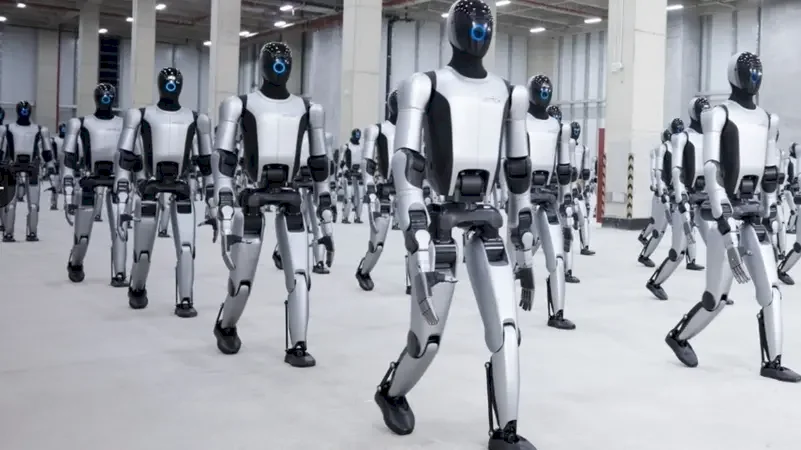
Human Robot Owners Will Outnumber Car Owners by 2060
SadaNews - The revolution in robots won't be driven by science fiction, but by demographic changes, according to Bank of America.
In a detailed research note, the global research unit at Bank of America predicted that the number of humanoid robots worldwide will reach 3 billion units by 2060, exceeding the number of cars in the world, which currently stands at about 1.5 billion, in terms of per capita share.
By that time, the bank estimates that 62% of all humanoid robots, nearly two billion units, will be spread across people's homes, according to a report by Fortune magazine, which was reviewed by "Al Arabiya Business".
This is a significant figure for a product category that currently has almost no presence in the market, but Bank of America points to an undeniable economic reality in 21st-century life as a major driver: there will not be enough workers.
The Workforce Problem That Robots Are Designed to Solve
The robotics revolution will not be driven by innovation but by necessity. Analysts Lynelle Haskins and Vanessa Cook from Bank of America identified structural factors that make working with humanoid robots economically attractive, including an aging workforce, a continuous labor shortage, wage inflation, and high employee turnover rates.
The analysts confirmed that this will remain the case even before humanoid robots fully match human capabilities. People do not need a perfect robot, but rather a robot that shows up for work, does not quit, and costs less than the workers they cannot find.
This pressure is a global phenomenon. In Japan, Germany, and South Korea, the declining number of working-age people has stressed the manufacturing and services sectors for years.
In the United States, wage growth in the logistics, warehousing, and elder care sectors has outpaced overall inflation.
At the Human Robots Summit in December 2025, more than 2,000 executives, engineers, and investors gathered to reach a clear consensus: "The real question is: How long will it take?" Bank of America is now setting a timeline for that.
From Factories to Living Rooms
Before humanoid robots reach living rooms, they will spend years in loading docks and assembly lines.
Data from Counterpoint Research, cited in the Bank of America report, indicates that by 2027, 72% of all humanoid robot installations will be concentrated in storage and logistics sectors (33%), automotive (24%), and manufacturing (15%).
Retail and service applications will represent only 12%. The household humanoid robot will be the story of the 2040s, while the robot that unloads your truck will be the story of 2027.
This industrial-first pattern is already evident in current deals. UPS is actively discussing deploying humanoid robots through its logistics network with Figure AI. Tesla's Optimus robot has been logging paid hours inside Tesla's Gigafactory, targeting a public sale by the end of 2027, although Elon Musk has warned that the rollout will be "painfully slow".
Arm CEO Rene Haas said at the Fortune Brainstorm AI conference in December that embodied AI will automate "large sections" of work in factories within five to ten years, with multi-purpose humanoid robots capable of switching tasks instantly in ways that traditional industrial machines cannot.
$4.3 Billion and a Continuous Acceleration
Investments tell the story of an industry that has crucially transitioned from research to a race. Bank of America estimated that funding in the field of humanoid robotics rose from $0.7 billion in 2018 to $4.3 billion in 2025, a sixfold increase over seven years.
By January 2026, the bank found over 50 companies actively working on developing humanoid robots, with 150 commercial product launches already recorded.
Bank of America expects annual shipments to rise from 90,000 units in 2026 to 1.2 million by 2030, indicating a compound annual growth rate of 86%, a sharper trajectory than the early electric vehicle market.
The cost curve is the driving force behind this acceleration. The cost of raw materials for the Chinese robot in 2025 is expected to be around $35,000, and Bank of America predicts it will drop to below $17,000 by 2030. Meanwhile, the production costs of Western prototype robots currently range between $90,000 and $100,000 per unit, which means the expected decline is still substantial.
A Norwegian startup, 1X, is already leasing a humanoid robot for $499 per month, while the "G1" from Unitree is priced at $13,500, figures that force Western competitors to accelerate their plans for cost reduction.
Sceptics Are Not Wrong but the Numbers Prevail
Of course, the robotics revolution is not without its critics. Rodney Brooks, a robotics scientist at MIT and founder of iRobot, stated in September that Musk's vision of home robots is "purely fanciful thinking", predicting that successful robots will use wheels and not resemble humans.
Peter Cappelli from Wharton warned in Fortune magazine last month that the panic over job losses due to robots is premature.
At the same time, Silicon Valley researchers remain more cautious about timelines compared to their Chinese counterparts, where government directives and production volume are driving a quicker deployment.
 Follow the latest Sada News via Google News
After Deschamps' Departure... Zinedine Zidane Tops the Candidates to Lead France

Mbappe Surpasses Messi and Becomes the All-Time Top Scorer in the World Cup

England Defeats France and Achieves Largest World Cup Achievement Since 1966

Messi Refused to Play for Spain and Missed 3 World Cups

Publishers Sue Google for Allegedly Using Books to Train Artificial Intelligence

Google Expands Capabilities of Google Search Console to Support Social Media Accounts

The Mediterranean Table... An Ancient Diet Revealing Its New Secrets for Health and Longev...
