
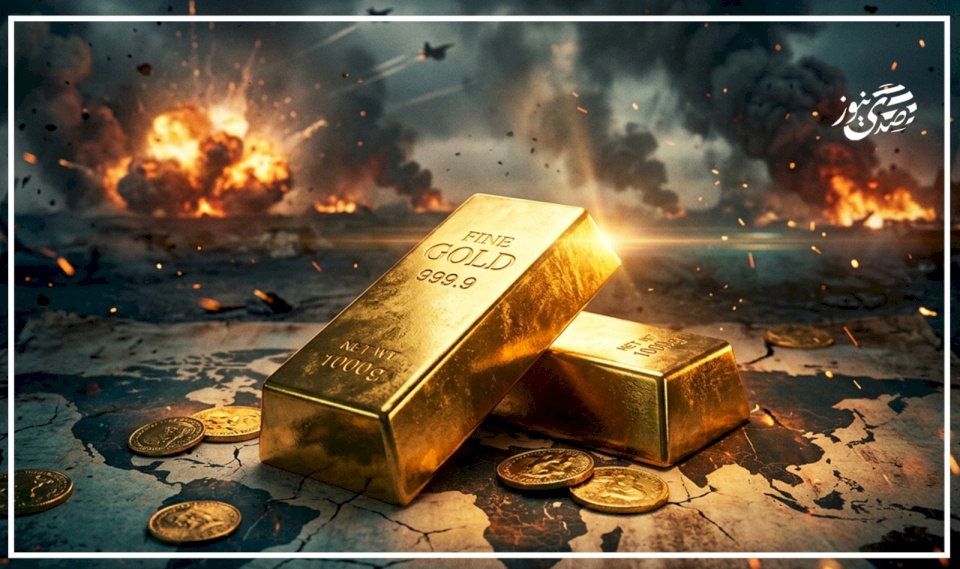
Why Has Gold Not Surpassed the $5,500 Per Ounce Barrier Despite the War on Iran?
Special SadaNews - Wars typically drive gold prices sharply upward, as it is the king of safe havens. However, the precious metal has moved contrary to expectations and conventional economic logic, as the price of an ounce has not exceeded the $5,500 barrier. Notably, its highest historical price was recorded last January, reaching record levels close to $5,600 in some trades, driven by geopolitical fears, declining confidence in the U.S. dollar, and demand as a safe haven.
Some analysts had projected an upward trend for gold to exceed the $6,000 per ounce mark in a short period, while others went much further in the event of war. So why did prices defy expectations?
Financial expert and banking consultant Mohamed Salama states that several reasons have led to the gold prices not rising despite geopolitical risks, the most important being the need for liquidity to cope with the pressures of rising energy costs. He explains that the significant rise in energy prices requires adequate liquidity to provide it at high prices.
He noted that investment funds need liquidity to support the required insurance collateral for hedging, in addition to the return of the dollar as a safe haven currency during wartime, regaining its status supported by expectations of rising inflation and reduced prospects of interest rate cuts.
Among the reasons, according to Salama, is that the U.S. economy is not affected by the war to the same extent as the competing economies of Europe and China, in addition to the lack of another currency that competes with the dollar and its ability to provide investment instruments for funds.
He added: "There is a rearrangement of priorities for building reserves during wartime, as central banks need easily liquidatable assets to meet current demands in the economy such as energy or liquidity constraints."
Salama pointed out that gold had initially risen due to expectations of currency declines and increased risks, and that profit-taking had begun before the war, making it difficult to push prices higher in this historically elevated price range.
He continues: "Gold benefits from rising inflation; however, the process of compressing inflation into the price of gold usually takes time and comes after the general price level stabilizes. Gold is not affected by inflation in the short term," predicting that the precious metal will later reflect this inflation increase, saying: "Gold will respond and rise later if the war continues and prolongs."
For his part, economic expert Dr. Thabet Abu Al-Rous states that the natural state of gold is to rise during wars, as it is considered a safe haven, citing that during the Israeli war on Gaza, it rose naturally. However, with the onset of the Israeli-American aggression against Iran, the opposite occurred.
He pointed out that the main reason for the recent fluctuation in gold prices is due to a global liquidity shortage, noting that investors in crises attempt to benefit from safe havens, particularly those that yield high profits.
He explained that since the onset of the war on Iran, the focus has shifted towards oil first, as investors aim for quick profits from oil, in addition to the obligations on investors pushing them to sell digital currencies like Bitcoin, which has experienced a sharp decline.
Dr. Abu Al-Rous also clarified that the losses incurred by financial markets drove investors to swiftly seek cash liquidity to stop the hemorrhage of losses in stocks, noting that cash liquidity directed towards buying oil halted the losses from Bitcoin due to financial markets, leading to a reluctance to purchase gold, which caused price fluctuations.
Regarding the future, Dr. Abu Al-Rous stated that this war has carried many surprises, as the world was waiting for the appointment of a successor to the Iranian leader who was assassinated, which has cast ambiguity on the duration of the war, in addition to the American and Israeli statements rejecting the resumption of negotiations (before President Donald Trump spoke about the impending end of the war).
He adds: "I believe that fluctuations will remain the dominant situation in the coming period, whether in gold, oil, silver, Bitcoin, or financial markets."
As for the analyses predicting a significant rise in gold prices in the event of war, Dr. Abu Al-Rous affirmed that analyses take into account two factors: independent and dependent, and the dependent factor can have a much higher impact. Thus, it was assumed that gold prices would rise, taking into consideration that there is a war, but the dependent variable can influence much more than the independent variable, as evidenced by the election of a new Supreme Leader in Iran having a direct impact, even if unanticipated, on the trends of global economic and financial markets.
It is noted that gold prices fell about 2% during the first week of the American-Israeli war on Iran due to the strong dollar and its effect on safe havens, despite geopolitical fears.
However, prices rebounded today, Tuesday, supported by a weakening dollar and declining energy costs after President Donald Trump indicated that the war could end soon.
The spot gold price rose by 0.8% to $5,179.52 per ounce, while U.S. gold futures for April delivery increased by 1.7% to $5,188.70.
It is likely that a potential decrease in inflation resulting from the war will reduce the likelihood of central banks raising interest rates, which is a positive factor for gold that does not generate returns.
 Follow the latest Sada News via Google News
Why Has Gold Not Surpassed the $5,500 Per Ounce Barrier Despite the War on Iran?

The Death Toll in Gaza Rises to 72,134

Occupation Continues to Close Al-Aqsa Mosque, Preventing Tarawih Prayers and I'tikaf for t...

Netanyahu Warns: The War on Iran Is Not Over Yet

The Election Committee Publishes the Final Voter Registration List for the Upcoming Electi...

War Developments: Iranian Army Confirms Striking Fuel Stores in Haifa and New Casualty in...

Due to Settler Attacks: 3 Families Forced to Leave Atof Southeast of Tubas
