

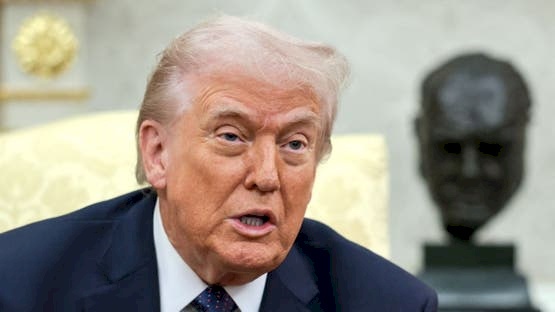
Trump: The selection of Mojtaba Khamenei as the Leader of Iran, succeeding his father, is a "big mistake"
SadaNews - U.S. President Donald Trump did not rule out the confiscation of Iranian oil amid the escalating joint Israeli-American war on Tehran.
Trump stated in remarks made to NBC: "I believe the Iranians made a big mistake by choosing Mojtaba Khamenei as their new leader."
He added, "It is too early to talk about the confiscation of Iranian oil, and we do not rule that out."
The American president also expressed that he is "not happy" with the choice of Mojtaba Khamenei as the new leader of Iran during an interview with the New York Post, without commenting on the nature of the path he might follow with him.
On Sunday, the Assembly of Experts in Iran officially announced the selection of Mojtaba Khamenei (56 years old) as the new leader of the country, succeeding his father Ali Khamenei, who ruled for 37 years.
Trump also indicated that his country is not considering sending American troops to the region to "secure" nuclear materials at facilities in the Iranian city of Isfahan.
He continued, "We have not made a decision on this matter at this time, but we are not even close to such a step."
On Saturday, Iranian authorities announced "significant damage" at a radiological facility in Isfahan, due to an attack carried out by the United States and Israel.
Trump is considering options to control energy prices amid the war
Two informed sources stated that President Trump is expected to review a set of options on Monday to regulate oil prices, which have risen to over $100 per barrel due to the war on Iran.
These efforts reflect White House concerns that rising crude prices will hurt American companies and consumers ahead of the midterm elections in November, while the Republican Party hopes to maintain control of Congress.
The sources indicated that U.S. officials in Washington are discussing with their counterparts from the Group of Seven industrialized nations the possibility of a joint release of quantities from strategic reserves as one of several measures currently under discussion, according to Reuters news agency.
They added that other options include restricting American exports, intervening in oil futures markets, providing exemptions from certain federal taxes, and raising requirements under an American law called the Jones Act, which stipulates that domestic fuel can only be transported on ships flying the American flag, among other things.
Analysts stated that U.S. policy options will have little impact on global oil markets as long as fighting in the Middle East obstructs oil shipments from the Strait of Hormuz.
White House spokesperson Taylor Rogers stated in a statement that "the White House is in continuous coordination with the relevant agencies on this important issue, as it is a top priority for the president. Trump and his energy team had a strong plan to maintain stability in energy markets before the start of the 'Rage Saga', and they will continue to review all reliable options."
Global crude oil prices reached levels not seen since mid-2022, briefly touching $119 per barrel, with rising gasoline and fuel costs as a result, since the start of U.S. and Israeli strikes on February 28.
Reuters earlier reported that the White House requested last week that federal agencies submit proposals that could help alleviate pressure on crude oil and gasoline prices.
Analysts and industry officials stated that the White House does not have many effective tools to quickly curb rising oil prices unless authorities can restore the flow of tankers through the Strait of Hormuz, the narrow waterway between Iran and Oman, through which nearly one-fifth of global oil supplies pass.
One source involved in the efforts with the White House said, "The problem is that the options range from marginal and symbolic to extremely unwise."
The disruptions in energy markets come at a sensitive time for the president, who has sought to keep fuel prices low as a key pillar of his economic appeal to voters. A prolonged increase in oil and gasoline costs could have broader economic effects, leading to higher prices for transportation and consumption.
The White House's plan to provide naval escort and secure a reserve for tankers passing through the Strait of Hormuz has so far failed to boost shipping traffic through the vital waterway.
Since February 28, the U.S. and Israel have carried out attacks on Iran, resulting in the deaths of hundreds, including leader Ali Khamenei and security officials, while Tehran retaliates with rocket fire and drones towards Israel.
Iran is also targeting with missiles and drones what it describes as "American interests" in GCC countries, Jordan, and Iraq, causing deaths and injuries and damaging civilian properties, which has been condemned by the targeted Arab countries, calling for an end to these aggressions.
 Follow the latest Sada News via Google News
Smotrich: Israel Has No Interest in Joining the War Against Iran

Occupation Issues Military Order to Seize 5 Dunams of Land in Jaba'

Axios: Proposal for a 10-day Ceasefire Between Washington and Tehran and Two Options for M...

In a Rapid Pace.. The Occupation Builds a Huge Earth Barrier Inside Gaza

Meeting Between Aoun and Trump Expected Alongside 'Experimental Areas'

Gaza Health Warns of Collapse of Oncology Services Due to Depletion of Treatments and Susp...

The Occupation Demolishes a House in the Town of Sa'ir near Hebron
