

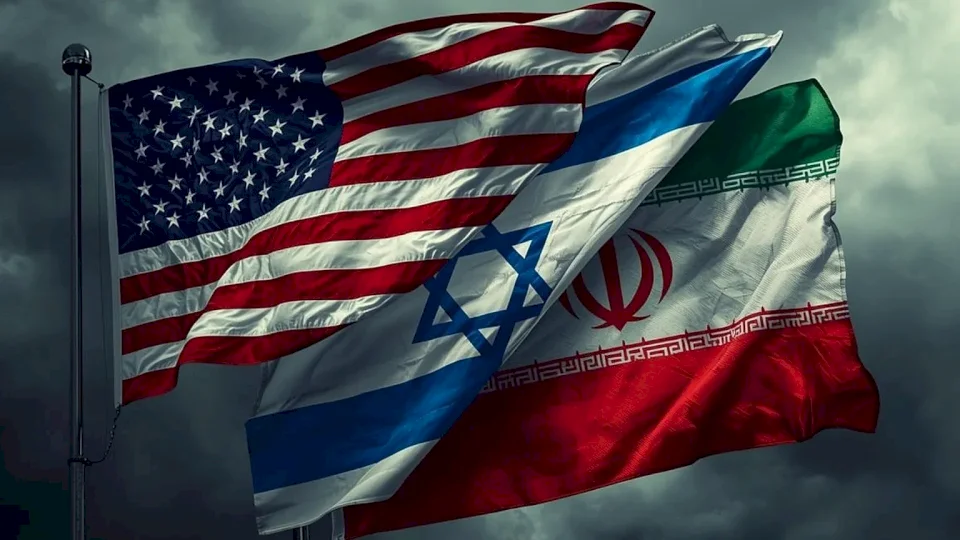
Analysis: An Iranian Strategy for Resilience, Striking Energy Markets, and Overcoming America and Israel
SadaNews - Iran bets on its ability to withstand the United States and Israel, not militarily, but by transforming the war into a brutal conflict that is hard to bear. Its strategy to achieve this is clear: launching drones and missiles, cutting vital energy routes, and destabilizing global markets with enough force to compel Washington to retreat first.
Despite the shock of American-Israeli strikes and the loss of key figures, the Revolutionary Guard, which has always been the main guardian of Iran, firmly controls the situation, directs the battlefield, implements pre-prepared contingency plans, and dictates the strategy and objectives of the war.
The Revolutionary Guard also played a crucial role in advancing Mojtaba Khamenei to the position of Supreme Leader after the killing of his father, Ali Khamenei, in the American-Israeli strikes at the beginning of the war.
Fawaz Gerges from the London School of Economics said, "They are fighting for their existence. This is a total war," adding, "They believe their survival is at stake. They are prepared to destroy the temple on everyone's heads."
Alex Vatanka, a senior researcher at the Middle East Institute and an expert on Iranian politics, remarked, "They're like a wounded animal, bleeding, but that makes them more dangerous than ever."
This all-encompassing war mentality is why Iran is escalating its strikes across the Gulf, targeting energy centers from Qatar to Saudi Arabia, maximizing economic disruption in a calculated attempt to raise costs on its neighbors, Europe, and the United States, while testing Washington's political will.
U.S. President Donald Trump told Republican lawmakers on Monday that the war will continue until "Iran is completely and decisively defeated," but he expects it to end soon.
He added that once the United States finishes its military operation against Iran, Tehran will have no weapons left to use against the U.S., Israel, and Washington's allies for a long time.
Insiders in Iran indicate that this escalation was expected long before the war began 11 days ago. Iranian planners assumed that confrontation with Washington and Israel was unavoidable and prepared a multi-layered strategy coordinated through the Revolutionary Guard's extensive military networks and proxy forces.
Now, with little left to lose, Iran is implementing that plan, transforming the conflict into a brutal war of attrition aimed at exhausting its adversaries politically and economically.
The consequences are already starting to show.
The same sources note that the selection of Mojtaba as Supreme Leader confirms the Revolutionary Guard's dominance as the "kingmaker." They point out that the balance of power has shifted. Despite the selection of a new Supreme Leader, the future of the Islamic Republic and the authority of the religious establishment itself now depend on the Revolutionary Guard's ability to withstand the storm unleashed by the American-Israeli campaign.
Until When?
But one of the critical unknown factors in the war, as said by Mohannad Haj Ali, a senior researcher at the Carnegie Middle East Center, is how long the Revolutionary Guard can sustain its missile campaign, which forms the backbone of its strategy against its enemies.
American officials indicate that a large part of Iran's arsenal has already been destroyed, but regional sources say Tehran may still retain more than half of its pre-war stock. If these estimates are accurate, Iran could continue launching missiles for several more weeks, a timeframe that may be significant for Washington as economic pressures mount both domestically and abroad.
The Revolutionary Guard's influence also extends beyond the battlefield, reshaping daily life. An Iranian observer noted that goods that used to sit in ports for weeks are now being cleared immediately. Paperwork follows later.
Officials describe this as a preparation for a war economy, ensuring that supply lines continue under pressure while enhancing the Revolutionary Guard's control over the state and affirming the continuity of governance.
"People are not ready for the disintegration of Iran"
Internal stability is equally important. Observers and sources within Iran have reported no indicators of protests or fractures among the elite, or divisions within the establishment yet.
One insider described the situation in Tehran as being bombarded but still functioning. He said, "The windows shake day and night, but life goes on."
Shops and banks remain open, supplies are available, and most of the population has not fled the capital.
However, he pointed out that the attacks could have the opposite effect of what Washington and Israel aim for. Despite long-standing grievances with the authorities, a wave of national solidarity is growing as the attacks target infrastructure and there is open talk about the possibility of internal waves of rebellion erupting.
The source stated, "People are not ready for the disintegration of Iran."
For now, this sentiment may give the leadership more time.
The source added, "I don't know if the regime will last in the long run. But it will not collapse in the next two weeks."
Who Will Back Down First?
For strategists on both sides, the war is increasingly defined by two parallel tests of endurance: the first, whether Iran can continue launching missiles; the second, whether the United States and Israel can bear the economic, military, and political costs of stopping them.
Gerges stated, "The big question is who will back down first in this total war, Donald Trump or Iran's leaders?"
By raising energy prices and making Western economies groan under financial strain, Tehran hopes that pressure will force the United States to retreat.
Initial indicators suggest that the effects are already beginning to show, with oil prices rising, gas costs increasing, and political turmoil escalating in Washington as the economic repercussions intertwine with the mid-term elections in November.
Gerges stated that Trump may ultimately seek to extract himself from the deadlock by declaring victory under this pressure, citing the killing of the Iranian Supreme Leader, the destruction of Iran's nuclear and missile capabilities, and its key military infrastructure.
However, for Tehran, mere survival may be sufficient.
Even if most of its strategic infrastructure is destroyed, the Iranian leadership can declare victory, remaining in the face of one of the largest military fleets in history.
Iran may emerge wounded, but in this situation, it could be just as dangerous, if not more unpredictable and opaque than the establishment that entered this conflict.
 Follow the latest Sada News via Google News
The Organization of Islamic Cooperation Welcomes Achievements in the Palestinian Reform Pl...

India Participates in the Second Ministerial Meeting of the Donor Group for Palestine

What Do Syrians Expect from the New People's Assembly?

Water and Food Shortages Threaten Displaced People in Southern Lebanon

Between De-escalation and Bab el-Mandeb.. How Does Tehran View the Escalation in Yemen?

Russia Bombs Kyiv Following Announcement of European Alliance to Enhance Support for Ukrai...

Britain Classifies the IRGC as a Threat to National Security
