

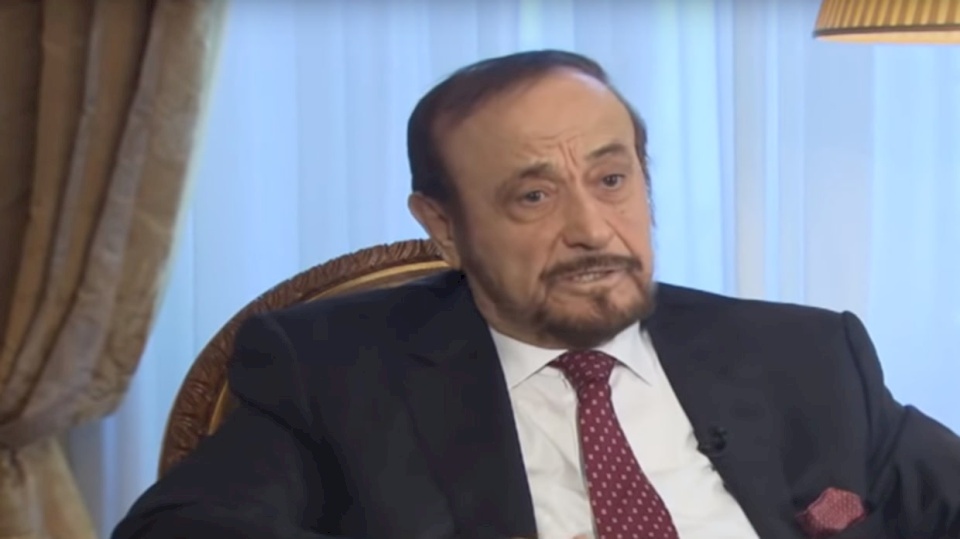
Despite a Judicial Ruling.. Why Did France Facilitate the Escape of Rifaat al-Assad?
SadaNews - In a major judicial and political paradox, France closed the curtain on decades of Rifaat al-Assad's presence, the brother of the late Syrian president Hafez al-Assad, on its territory with a judicial decision condemning him to four years in prison and confiscating real estate assets worth 90 million euros.
The ruling came based on serious charges including money laundering within an organized gang, embezzlement of Syrian public funds, and tax evasion, which the court described as "illicit gains".
However, this judicial ruling collided with a more complex intelligence reality; intelligence sources revealed - in the film "The Empire of Rifaat" produced by Al Jazeera 360 - his role as one of the most important "intelligence assets" for Paris in the Middle East for 30 years.
In turn, a former officer in French intelligence, Marc Eshinger, disclosed that Rifaat al-Assad's escape to Syria in 2021 was with the approval of French President Emmanuel Macron and that he entered with the consent of François Mitterrand, then President of France.
Eshinger revealed that facilitating Rifaat's escape was the last chapter of an "unwritten contract" between him and the deep state in France.
"The Agent" Who Did Not Break His Promise
According to the film, Rifaat al-Assad's relationship with France was not merely a political asylum for a "prince" ostracized from his family, but rather an intelligence partnership that began upon his arrival in Paris in 1984 following a failed coup attempt in Damascus.
French security sources and observers of the file reveal that Rifaat turned into a "mobile depository of secrets" in favor of French external intelligence "DGSE".
According to testimonies from former intelligence officers, Rifaat provided Paris with invaluable services, the most notable of which include:
Structure of the Syrian regime: Rifaat provided detailed insights about the backstage of governance in Damascus, military and security influence networks, and sites of power within the "old guard", which enabled Paris to have a better understanding of the power balances in Syria.
Arms deal broker: Rifaat played the role of a "trusted intermediary" in major French arms deals with Arab countries, benefiting from his extensive relationships with regional political and military elites, which ensured French military manufacturing companies wide influence in the region.
Decrypting terror codes and secret operations: During the periods of security tension that Europe experienced in the 1980s, Rifaat was a "back channel" of communication between Paris and several capitals in the region, contributing to the de-escalation of complex security files.
How Did the Escape Occur?
The question that occupied the legal public opinion in France was: how could a defendant sentenced to prison and subjected to "judicial supervision" preventing him from traveling leave Charles de Gaulle Airport so smoothly?
Testimonials, including from Hussein As'ad, Rifaat's personal secretary, confirm that the French security services supervised his exit, denouncing its description as an "escape"; rather, it was a return trip to Syria after lifting the judicial supervision against him in 2018.
Rifaat was transported in luxury cars (limousines) and accompanied by official elements from the French Ministry of Interior to the aircraft door, a clear indication that the "deep state" in France decided to honor its "old servant" and spare him the humiliation of prison at the age of eighty-eight.
The Last Silence Deal
Analysts believe that France, which for years raised the slogan of "judicial independence", found itself in an ethical and legal dilemma; incarcerating Rifaat al-Assad could mean forcing the man to "open his vault of secrets", which may implicate high-ranking French political figures who were partners in deals or ambiguous policies in the Middle East.
Thus, "safe exit" was the optimal solution; the French state exits with a judicial condemnation decision that satisfies human rights organizations (like Sherpa), while at the same time fulfills the intelligence services’ desire to dispose of an "intelligence asset" that has expired without causing noise behind bars.
Thus, Rifaat al-Assad left Paris, leaving behind an empire of stolen real estate from the Syrians and a judicial ruling that was never enacted.
He died a week ago in the UAE at the age of 88 after a long battle with illness, according to what Reuters reported from two sources familiar with the news of his death.
Rifaat al-Assad was known by the title "Butcher of Hama" and is accused of leading the massacre in the city in 1982 before plunging into power struggles in vain and seeking exile, according to Reuters.
Rifaat al-Assad was a former army officer who assisted his brother Hafez al-Assad in seizing power in 1970 and establishing his iron rule. He aspired to the presidency during the years of exile he spent in France and returned to Syria in 2021, before fleeing again at the end of 2024 after the ousting of his nephew, Bashar al-Assad.
Source: Al Jazeera
 Follow the latest Sada News via Google News
Trump: We will make great progress with Beirut.. Aoun: It is time for Lebanon to be stable

The Lebanese Army Deploys in the South and Comes Under Gunfire; Israel Clarifies

Bezhkian: Directives from the Leader to End the State of No War, No Peace

Saudi Arabia condemns the Houthi threats to navigation and pledges to protect its ships

Global Warning to Americans Due to Rising Tensions in the Middle East

Houthi Movement Announces Ban on Maritime Navigation Against Saudi Arabia

Earthquake of 5.5 Magnitude Hits Western Iran
