

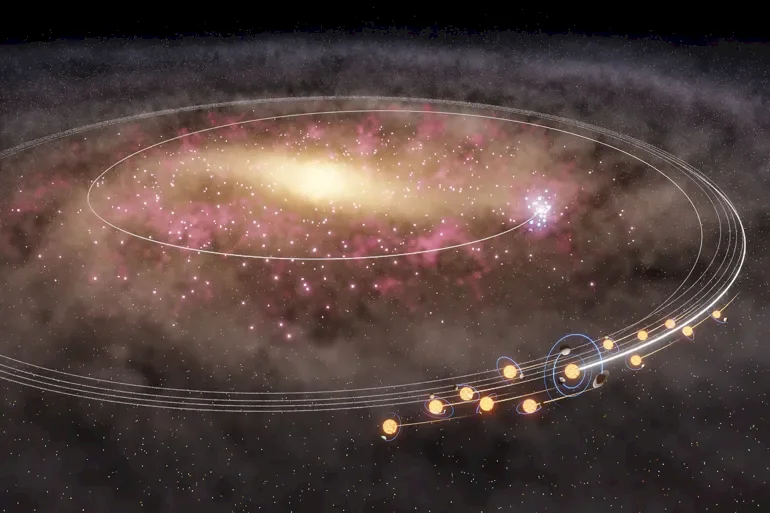
Study reveals: Mass migration of the Sun and thousands of stars from the heart of the Milky Way
SadaNews - A new study conducted by the University of Tokyo and the National Astronomical Observatory of Japan has shown that the Sun was part of a mass migration of stars similar to it, known as "solar twin stars," which left the inner regions of the Milky Way galaxy about 4 to 6 billion years ago.
This mass migration, which extends over thousands of light-years, helped the Sun move from the galaxy's core, characterized by a high density of stars and strong radiation, to a quieter and more life-suitable area. The Sun is currently located 27,000 light-years from the center of the galaxy.
By using data from the European Space Agency's Gaia Observatory, nearly 6,600 stars similar to the Sun were collected and classified based on age, temperature, surface gravity, and chemical composition, approximately 30 times more than previous studies, allowing for a precise understanding of the distribution of star ages and their locations in the galaxy.
The influence of the galactic central disk on stellar migration
The center of the Milky Way is characterized by dense structures in the form of a galactic disk, creating what is known as a "common rotation barrier," which usually prevents stars from escaping far from the center. However, the study indicated that the disk was not fully formed during the migration period, allowing the Sun and its similar stars to leave the center together in a remarkable collective motion.
Although the inner areas of the galaxy are filled with stars and potential planets, they are hostile environments due to radiation and high stellar density, making them less suitable for the emergence of life.
The migration to the outer regions of the Milky Way provided the Sun with a suitable position for the Earth, where conditions became safer for the evolution of living organisms.
Researchers plan to continue these studies using the Japanese satellite "JASMINE" to monitor stars similar to the Sun, with the aim of determining their original locations and the migration paths of other star groups, as it is believed that these efforts will enhance our understanding of the galaxy's history and the solar system's evolution.
The significance of the discovery
This discovery represents a qualitative step in understanding the history of our galaxy and the Sun's position within it, as it not only clarifies the origin of the Sun and its path through the Milky Way but also contributes to explaining how the Earth found itself in a suitable area for the emergence of life.
It also enhances the field of galactic archaeology, which studies the deep history of stars and galaxies, and opens new horizons for studying the evolution of the galaxy and the mass migration of stars over billions of years.
Source: Various websites
 Follow the latest Sada News via Google News
After Deschamps' Departure... Zinedine Zidane Tops the Candidates to Lead France

Mbappe Surpasses Messi and Becomes the All-Time Top Scorer in the World Cup

England Defeats France and Achieves Largest World Cup Achievement Since 1966

Messi Refused to Play for Spain and Missed 3 World Cups

Publishers Sue Google for Allegedly Using Books to Train Artificial Intelligence

Google Expands Capabilities of Google Search Console to Support Social Media Accounts

The Mediterranean Table... An Ancient Diet Revealing Its New Secrets for Health and Longev...
