

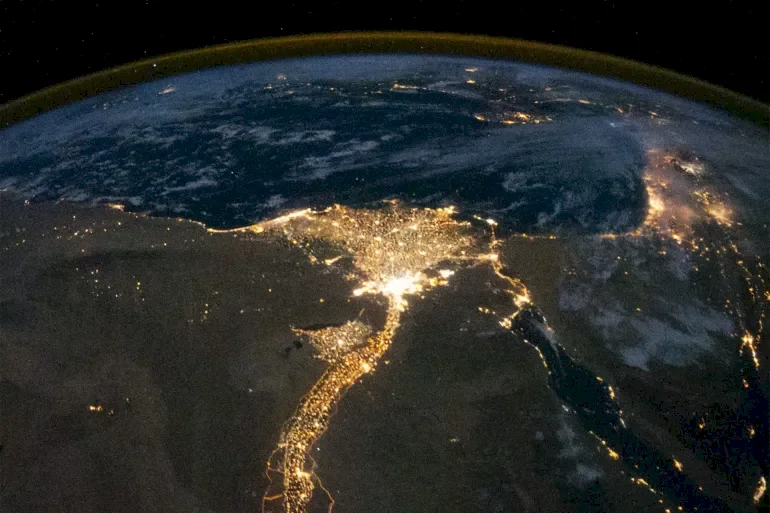
Nile Delta Sinks Faster Than the Sea: A Silent Danger Threatening Millions of Residents
SadaNews - The Nile Delta in Egypt is facing an increasing risk not only from rising sea levels but also from the land sinking beneath the feet of its residents, according to the results of a new study that revealed the Nile Delta is among the most at-risk deltas globally for subsidence, a phenomenon accelerated by both human activity and climate change.
The study, published on January 14 in the journal "Nature," relied on satellite data from recent years and revealed that large areas of the Nile Delta are sinking at rates exceeding the average sea-level rise, indicating that coastal and agricultural areas in the northern delta are at risk of flooding and salinization at a faster pace than previously anticipated.
A Global Phenomenon: But the Danger is Local
The Nile Delta is not just a geographical area; it is the agricultural and demographic heart of Egypt, home to tens of millions of people, and it produces a significant portion of the country’s food supply. As the ground continues to sink, cities like Alexandria, Rosetta, and Damietta, along with vast agricultural lands, become more vulnerable to the intrusion of salty seawater into groundwater, jeopardizing both agriculture and drinking water sources simultaneously.
The lead author of the study, "Leonard O'Hearn" – an Assistant Professor of Earth and Coastal Environmental Sciences at the University of California, Irvine, states that this issue is not limited to Egypt alone, as over half of the world's major river deltas are currently experiencing land subsidence. This list includes the Mekong Delta in Vietnam, the Ganges–Brahmaputra Delta in Bangladesh and India, and the Yellow River Delta in China.
The study estimates that between 350 and 500 million people live in low-lying deltas, many of whom reside in areas that are no more than two meters above sea level, facing a double hazard: slowly rising sea levels and land that is sinking faster.
Why Do Deltas Sink?
Leonard explains in statements to Al Jazeera Net that delta subsidence is not only a natural process but has significantly accelerated due to human interventions that include excessive groundwater extraction, particularly for irrigation and agriculture, which leads to soil compression and sinking. Dams on rivers also play an important role, as they reduce the amount of sediment that rivers historically carried to nourish the delta and compensate for natural erosion.
In the case of the Nile Delta, researchers point out that the decreased silt reaching the northern delta for decades, along with heavy urban sprawl on inherently soft lands, has exacerbated land subsidence, transforming what was a slow change over centuries into a tangible crisis over just a few decades.
Leonard adds: "One of the key findings of the study is that land subsidence has become in many cases the most significant factor in what is known as "relative sea-level rise," meaning the level that residents actually experience. In many deltas, the rate of land subsidence has surpassed the rate of sea level rise, indicating that focusing solely on climate change is insufficient to understand the magnitude of the threat."
According to the researchers, subsidence differs from sea-level rise at a fundamental point: it can be slowed down if its causes are addressed. Solutions include regulating groundwater extraction, improving sediment management, and reconsidering construction patterns and urban expansion in low-lying and vulnerable areas.
Researchers warn that ignoring these factors will render any investments in coastal barriers or protection projects inadequate in the long term.
Source: Al Jazeera
 Follow the latest Sada News via Google News
After Deschamps' Departure... Zinedine Zidane Tops the Candidates to Lead France

Mbappe Surpasses Messi and Becomes the All-Time Top Scorer in the World Cup

England Defeats France and Achieves Largest World Cup Achievement Since 1966

Messi Refused to Play for Spain and Missed 3 World Cups

Publishers Sue Google for Allegedly Using Books to Train Artificial Intelligence

Google Expands Capabilities of Google Search Console to Support Social Media Accounts

The Mediterranean Table... An Ancient Diet Revealing Its New Secrets for Health and Longev...
