

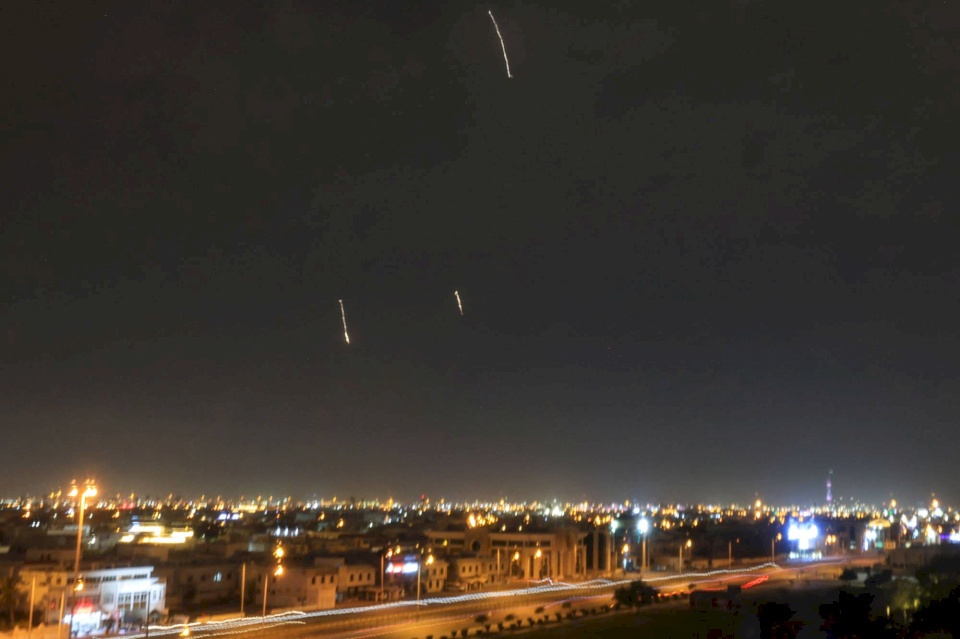
Gulf Defenses Repel Over 1,800 Iranian Missiles and Drones
SadaNews - On the fourth day, Iranian attacks on cities and vital facilities in the Gulf countries continued, while Gulf air defenses announced they had intercepted over 465 missiles and 1,414 drones since the beginning of the confrontations.
Major General Turki Al-Maliki, the official spokesman for the Saudi Ministry of Defense, announced that the U.S. embassy in Riyadh was attacked (on Tuesday) by two drones, in addition to intercepting and destroying 8 drones near the cities of Riyadh and Al-Kharj.
The Saudi Ministry of Foreign Affairs strongly condemned the Iranian attack on the U.S. embassy building in Riyadh, expressing its rejection of this aggression.
The Gulf countries reiterated their full right to take all necessary measures and actions to protect their security, the safety of their territories, and their citizens and residents, and to safeguard their vital interests.
Saudi Arabia: Interception of 8 Drones
Major General Turki Al-Maliki explained that the U.S. embassy in Riyadh was attacked (on Tuesday) by two drones, in addition to intercepting and destroying 8 drones near the cities of Riyadh and Al-Kharj.
Al-Maliki pointed out that initial estimates indicate that the embassy was targeted by two drones, resulting in a limited fire and minor material damage to the building.
The Saudi Ministry of Foreign Affairs condemned the Iranian attack on the U.S. embassy building in Riyadh in the strongest terms, expressing its rejection of this aggression.
In a statement, it confirmed that "the repetition of this cowardly and unjustifiable attack is in blatant contradiction to all international norms and laws, including the Geneva Conventions of 1949 and the Vienna Convention of 1961 on diplomatic relations, which grant immunity to diplomatic premises and their staff even in armed conflict situations."
Saudi Arabia emphasized that "the repetition of this blatant Iranian behavior, despite the Iranian authorities’ knowledge that the Kingdom has confirmed it will not allow the use of its airspace and territories to target Iran, will drive the region towards further escalation."
Furthermore, the Kingdom reaffirmed its full right to take all necessary measures and actions to protect its security, the safety of its territories, its citizens and residents, and to safeguard its vital interests, including the option of responding to aggression.
Oman: Targeting of Duqm and Dhofar Ports
In the Sultanate of Oman, an Omani security source reported that fuel tanks at the Duqm commercial port were targeted by several drones, one of which hit one of the tanks. The source clarified that the resulting damage was contained, with no human injuries reported.
The Sultanate of Oman, according to what was reported by the Omani News Agency, condemned this targeting, indicating that it is taking all necessary measures to deal with the situation. A security source also reported the downing of two drones in the skies of Dhofar Governorate, and the fall of a third drone near the vicinity of Salalah port, with no human or material losses recorded.
Oman renewed its condemnation and denunciation of the targeting operations, confirming that it will take all necessary measures to maintain the security of the country.
Kuwait: Responding to a Wave of Missiles
The General Staff of the Kuwait Army announced on Tuesday that its armed forces had dealt with a wave of missiles and drones that were detected in the country's airspace, confirming that it continues its operations to intercept and shoot them down.
The U.S. embassy in Kuwait was also attacked by Iranian forces. The Kuwait Ministry of Foreign Affairs expressed its "rejection and condemnation in the strongest terms of the brutal Iranian attack that targeted the building of the U.S. embassy in the country, describing it as an act that constitutes a blatant violation of all international norms and laws, including the Geneva Conventions of 1949 and the Vienna Convention of 1961 on diplomatic relations, which grant immunity to diplomatic premises and their staff even in armed conflict situations."
The ministry reiterated Kuwait’s right to take all necessary measures and actions to protect its security, the safety of its territories, its citizens, and residents.
Qatar: Sufficient Missile Stockpiles
In Doha, the Qatari Ministry of Defense confirmed that its armed forces have full capabilities and resources to protect their territory, stressing their ability to resolutely respond to any external threat targeting the state's security. The International Media Office in Qatar denied a Bloomberg report regarding having an interceptor missile stock sufficient for only four days.
The office explained in a statement that the interceptor missile stockpiles for the Qatari air defense system "Patriot" have not been exhausted, and they still maintain full readiness and adequate reserves.
In the meantime, QatarEnergy announced the cessation of production of some of its chemical, petrochemical, and conversion industries in the country, following its previous decision to halt the production of liquefied natural gas and related products. The decision includes a number of products, including urea, polymers, methanol, aluminum, and others.
Doha also strongly condemned the Iranian attacks targeting the U.S. embassies in Riyadh and Kuwait, asserting that this constitutes a blatant violation of international charters and laws.
Bahrain: Destruction of 73 Missiles
The General Command of the Bahrain Defence Force announced that its air defense systems destroyed 73 missiles and 91 drones that were launched as part of the "blatant Iranian terrorist aggression" against the Kingdom, confirming its success in thwarting what it described as "random Iranian terrorist aggression" that constitutes a blatant violation of international humanitarian law and the Charter of the United Nations.
The command affirmed that the Bahrain Defence Force possesses advanced defensive systems, developed combat capabilities, and modern military resources to protect the airspace, waters, and territory of the Kingdom, stressing that all its defense systems are on high alert and ready to deal with various threats, and that they will remain a strong shield against anything that could threaten the security and stability of the Kingdom of Bahrain or infringe upon its national sovereignty.
UAE: Fire in Fujairah
The relevant authorities in the emirate of Fujairah announced their handling of a fire that broke out on Tuesday morning in the Fujairah Petroleum Industry Area (Fawaz), due to falling debris after the successful interception by air defense of a drone, with no injuries reported. They confirmed the fire was contained and that operations returned to normal in the area.
The relevant authorities called on the public to obtain information from official sources in the country and to avoid circulating rumors or unverified information.
GCC: Treacherous Iranian Attacks
Jasem Al-Budaiwi, Secretary-General of the Gulf Cooperation Council, expressed the council's strongest condemnation of the continuation of "cowardly and treacherous Iranian attacks" on its states, targeting civilian and diplomatic facilities, most recently at the offices of the U.S. embassies in Saudi Arabia and Kuwait.
Al-Budaiwi affirmed that the Iranian attacks on the territories of the Gulf states, along with the accompanying escalation of "unjustified, illegal, and unethical" acts, serve as a blatant indicator of Tehran's intentions towards these states, and its attempts to destabilize security and stability in the region and the world.
He added that "targeting the territories of the GCC states cannot be accepted under any pretext or justification," calling on Iran to immediately stop what he described as its "savage aggression," reiterating the solidarity of the GCC states and their unified stance in the face of these attacks, in defense of their sovereignty, security, and national interests.
 Follow the latest Sada News via Google News
Trump: We will make great progress with Beirut.. Aoun: It is time for Lebanon to be stable

The Lebanese Army Deploys in the South and Comes Under Gunfire; Israel Clarifies

Bezhkian: Directives from the Leader to End the State of No War, No Peace

Saudi Arabia condemns the Houthi threats to navigation and pledges to protect its ships

Global Warning to Americans Due to Rising Tensions in the Middle East

Houthi Movement Announces Ban on Maritime Navigation Against Saudi Arabia

Earthquake of 5.5 Magnitude Hits Western Iran
