

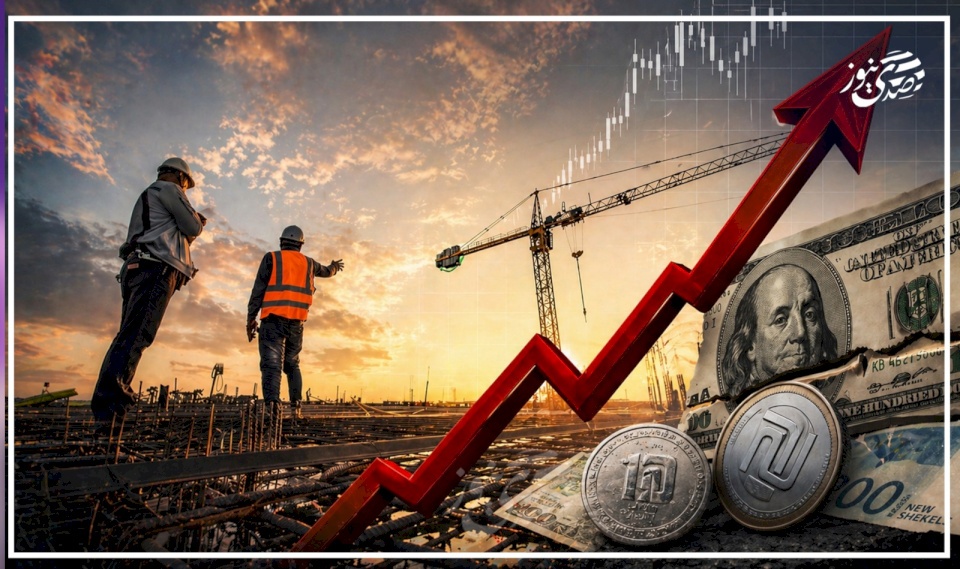
The Decline of the Dollar and Rising Material Costs Pressure the Construction Sector in Palestine
Exclusive to SadaNews: The construction sector in Palestine is under increasing pressure due to the devaluation of the dollar against the shekel and the rising costs of production.
Ahmad Al-Qadi, the head of the Contractors' Union, confirms to "SadaNews" that the exchange rate is a critical factor in construction contracts, especially in a local environment lacking a domestic currency, noting that contracts are made in dollars while expenses are paid in shekels.
He points out that the decline of the dollar affects the financial balance of contracts. He states, "The contractor receives their dues at a lower value upon converting the amount since they signed the contract at a high exchange rate and received at a lower price," explaining that the real goal of the contract, which is to achieve profit, is no longer being met.
Most Costs in Shekels
He adds: "Most operational costs such as wages, materials, and transportation are paid in shekels, which has led to a shrinkage of profit margins, and in some projects, the profit has turned into a loss," stressing that the impact has been greater in projects signed with the government, especially those under execution, as the contractor is obligated to deliver the project by a specific time, according to a specific bill of quantities, and based on a previous pricing that is not flexible since the contract does not include compensation for currency fluctuations in case it loses its value. He notes that this also covers projects executed by Arab or Islamic funds or donor institutions, leading to direct losses when collecting dues. However, projects signed directly with the Ministry of Finance have not been directly affected as they are conducted in shekels, while private projects have been more affected as they do not enjoy protected compensation for currency differences.
He confirms that this reflected on the inability to implement projects at the same pace, noting that some projects have stalled while others have experienced delays, especially small and medium-sized projects.
No Signing of Contracts
He clarified that contractors are currently unable to sign contracts under referral as they do not know what will happen regarding currency differences, noting that the sharp drop in the dollar coincided with an increase in construction inputs, emphasizing that the rise in fuel prices, especially diesel, has affected the prices of production inputs in the construction sector.
He adds: "Current projects under referral face a significant problem and suffer from disruption, while future projects are in a state of uncertainty due to fluctuations in currency prices and the prices of imported goods from abroad."
Why Have Apartment Prices Not Decreased?
Regarding apartment prices, Al-Qadi stated that a decline in the dollar's value should lead to a decrease in prices. However, the issue in the real estate developer sector is that a large portion of contracts were signed previously, during the time when the dollar was high, and during construction, expenses were incurred in shekels, yet when collections were made, the dollar was low, which is why the lack of stability and protection in pricing has disturbed feasibility studies of projects, indicating that this issue might affect future contractual disputes.
Al-Qadi notes that if the exchange rate is fixed at 3 shekels for instance, it means the price of the apartment will be in shekels; if the exchange rate falls below this level, the buyer will compensate the difference, while in the opposite case, the developer must compensate the buyer for the difference.
He says: "The decline in the dollar exchange rate does not necessarily lead to a drop in property prices, as some developers bought land at a relatively high dollar price, therefore, if the dollar's value falls against the shekel, it automatically means a decrease in the land's value, which forces them to compensate for this loss by not lowering prices."
He called for renegotiation between contractors and developers with contracting parties to ensure balance and rights, explaining that many projects may stall if the issue is not addressed.
He adds: "Banks are now dealing with us more cautiously amid currency fluctuations, and this has begun to affect the cash flow of contractors, as there are losses in prices, delays in collecting government dues, and an increase in returned checks due to the disruption in many sectors, and a decline in lending capacity, causing a financial congestion across all components of the sector," pointing out that these problems are also linked to supply chains; due to the demand for the lower dollar, there is now a shortage of this currency in the market, leading to a lack of availability of the necessary currency.
Absence of a Shock Absorption Mechanism
He explains that the current problem lies in the absence of a legal framework and a financial mechanism to absorb shocks and address the risks facing the Palestinian economy as a whole and the contracting sector in particular, noting that the dollar's decline was supposed to favor the end consumer. However, looking at the market today, it's clear that all projects have increased in cost by approximately 15% due to the simultaneous decline of the dollar alongside the significant increase in production inputs bought in shekels. He clarifies that these problems have left a structural impact rather than a temporary one on the construction sector.
Al-Qadi affirms that the construction sector demands the stabilization of the dollar's exchange rate against the shekel in various contracts to ensure the financial balance for all parties involved, including developers.
He notes that the dollar's decline indirectly decreases the purchasing power of citizens, as the majority have their income in shekels while properties are priced in dollars, indicating that fluctuations in exchange rates leave citizens confused about whether to make a purchasing decision or not, and that this uncertainty does not make the real estate sector a safe haven for some, leading to a slowdown in demand.
Stagnation
Al-Qadi notes that banks' cautious lending policies, whether for public sector employees or others, due to the financial crisis experienced by the Palestinian Authority and increased risks, have reflected on the state of the real estate sector which has seen a decline in demand, resulting in stagnation in buying and selling movements, pointing out that while some materials have decreased in cost due to the dollar's decline, most costs are paid in shekels such as some essential building materials, worker wages, and transportation costs; moreover, most materials have seen price increases ranging between 20-40% in recent years, adding that those who benefited from the dollar's decline are the importers and suppliers, not the contractors and developers.
Conservatism Is the Norm
He emphasizes that the state of "uncertainty" has led property owners to adopt a conservative pricing policy due to increased material costs, port closures, price fluctuations, and issues in supply chains, indicating that this drives developers and contractors to price with a safe margin out of fear of all these fluctuating factors, even in the face of weak demand, and this reflects on the final price for consumers. He points out that the decline in the dollar's exchange rate alongside rising construction costs will lessen activity in the real estate sector, and make investors in this sector more cautious due to their fears of price fluctuations.
He adds: "Most contracts concluded by developers with buyers contain significant losses, as pricing was done in dollars which saw a decline against the shekel of about 20%, thus developers will be more cautious in the coming period, becoming strict on pricing at a high margin of safety to ensure no losses, which in turn will not lead to a decrease in apartment prices despite the decreased demand due to the prevailing economic conditions."
What Do the Numbers Say?
The construction sector contributes about 12-13% to the GDP (according to Al-Qadi's statements), and employs around 20-25% of the workforce in Palestine, directly and indirectly activating about (160) economic sectors.
The Palestinian Monetary Authority announced the results of the housing property price index in Palestine for the fourth quarter of 2025, where the general index showed a continued state of stability compared to previous quarters, recording slight growth of 0.63% compared to the third quarter of the same year, reaching 108.2 points, in line with the performance of sub-indices. The housing price index recorded an increase of 0.83% reaching 108.4 points, while the residential apartments index remained stable at 107.8 points. The situation remained unchanged on an annual basis, with the general index rising by 0.6% compared to the fourth quarter of 2024.
There is no doubt that the specifications of the properties offered for sale remain a key factor in determining prices. During the fourth quarter of 2025, data showed that 59.9% of the residential apartments offered for sale in Palestine were new apartments, with an average area of 158.7 square meters. The results also indicated that about 54.9% of these apartments contained one or two bathrooms, while nearly 70% of them included three bedrooms or more, in addition to the existence of a balcony.
As for the houses offered for sale, their average area was about 235 square meters, with 53.7% of them being new homes. The data revealed that around 70% of these houses contain three bedrooms or more, in addition to more than three bathrooms. It is noteworthy that property prices are not only influenced by internal specifications, but also by other crucial factors in determining prices, such as the price of the land on which the property is built, the geographical location, and the nature of the residential neighborhood.
 Follow the latest Sada News via Google News
Soaring Oil Prices Burn the Pockets of the Palestinian Citizen "The Poor"

Millions of Dollars in Losses.. "SadaNews" Reveals Shocking Figures for Traders from Pales...

The Problem of Shekel Overcrowding Worsens.. Fuel Station Owners Threatened with Closure o...

The Palestinian Economy at a Crossroads: 4 Files Awaiting Resolution

Palestinian Monetary Authority to SadaNews: Over 16 Billion Shekels in Cash Surplus Accumu...

For the First Time Since the Corona Crisis: The Bank of Israel Intervenes in the Foreign E...

Currency Exchange Rates Against the Shekel on Sunday (June 7)
