

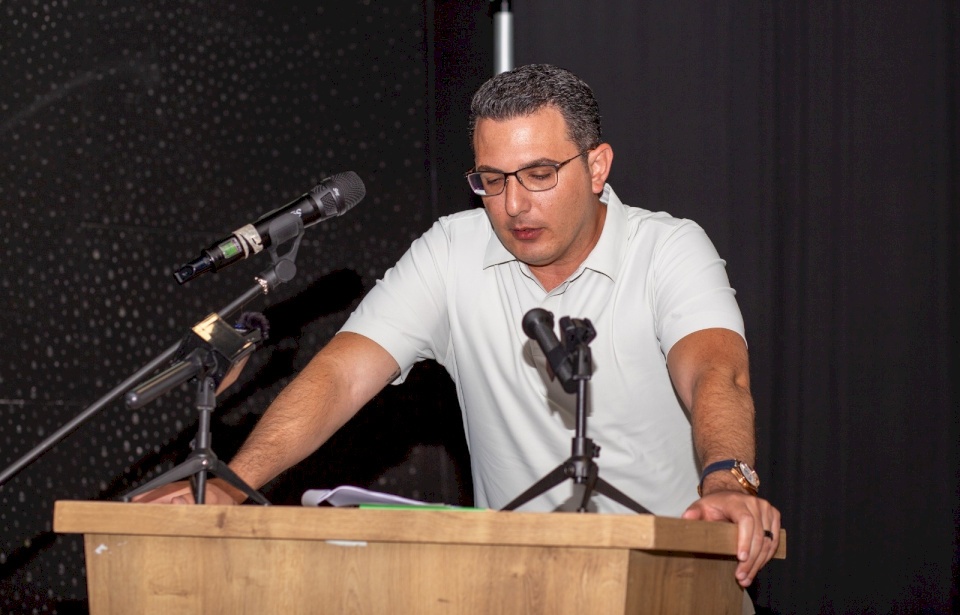
Nazareth Hosts Seminar on the Book "The Severed Political Discourse" by Thinker Azmi Bishara
SadaNews - An intellectual seminar titled "A Reading of the Book The Severed Political Discourse and Its Relevance Amid Current Challenges" was held in the city of Nazareth yesterday, Saturday, to celebrate the release of a new edition of the book by Arab thinker Azmi Bishara.
The seminar, organized by "Mada Al-Karmel - The Arab Center for Applied Social Studies" at the Al-Hanin Theater in Nazareth, featured contributions from writer and researcher at "Madar - The Palestinian Center for Israeli Studies" Antoine Shlehit, political sociology researcher at the University of Haifa Dr. Amir Fakhouri, and associate researcher at Mada Al-Karmel Dr. Khaled Anabtawi. They presented readings and interventions that discussed the themes of the book, its intellectual and political significance, and its relevance in light of the current challenges facing Palestinian society.
The seminar was moderated by the General Director of Mada Al-Karmel Dr. Arin Hawari, with the attendance of those interested in intellectual, political, and cultural affairs.
Background of the Book:
The new edition of the book "The Severed Political Discourse and Other Studies" (Mada Al-Karmel, Haifa, 2026) by Arab thinker Azmi Bishara sees the light after more than two decades since its first publication. In the new edition, thinker Azmi Bishara asserts that the book still retains its relevance because the issues and social and political structures addressed in it are still present in different forms.
The book links the reality of Palestinians in 1948 with the outcomes of the Nakba in 1948, particularly the loss of the Palestinian city and the resulting emergence of a community economically dependent on Israel within what he calls "modernization without modernity".
It traces the development of political awareness among Palestinians in 1948, from the military rule era through the enhancement of national identity after 1967, to the pivotal shift represented by Land Day in 1976.
It presents the concept of "the severed political discourse", which reflects the contradiction between practical integration into Israeli state institutions and the adherence to Palestinian national identity.
It criticizes the reduction of political action to narrow service demands on one hand, and the total rejection of political participation on the other.
It calls for a "State of Citizens" project based on full civil equality and recognition of the collective rights of Palestinians within Israel.
It warns that the absence of a national project and the weakness of modern structures contribute to the spread of phenomena such as tribalism and organized crime.
The book concludes that the tension between citizenship and national belonging continues to form the essence of the Palestinian experience within 1948 to this day.
 Follow the latest Sada News via Google News
A Young Man Killed by Israeli Police Gunfire Inside 1948 Territories

Elderly Woman Seriously Injured in Violent Crime in Sulam

"We Hope for the Harshest Penalties on the Killer": Final Session Before the Ruling in the...

Two Young Men Seriously Injured in a Self-Driving Car Accident in Haifa

Popular Committee in Rahat: Tsvi Sokot's visit will pass by two schools in the morning, an...

Court Suggests Public Service Instead of Jail for Raji Ighbarieh Due to Health Condition

إصابة شاب بجروح خطيرة إثر حادث دراجة نارية ذاتي في حيفا
