

Investigation: All Evidence Confirms Israel's Use of White Phosphorus in Lebanon
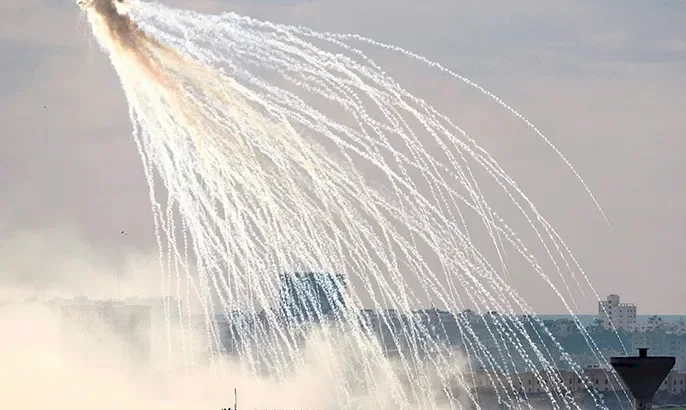
SadaNews - The New York Times published an investigation stating that verified visual evidence and videos indicate that the Israeli army used munitions containing white phosphorus in populated areas in southern Lebanon.
According to the investigation prepared by journalist Sanjana Fargeez as part of the newspaper's investigative team, footage captured on May 30 in the Lebanese city of Nabatiyeh showed smoke trails that experts believe correspond to the characteristics of white phosphorus munitions during Israeli forces' control of the Qalaat al-Shuqif area.
The newspaper added that other verified clips showed similar indicators near the coastal city of Tyre and also around the towns of Qlaiaa, Khiam, and Yuhmor during the months following the resumption of hostilities between Israel and Hezbollah since March.
According to the report, white phosphorus is a substance that ignites spontaneously when exposed to air and is difficult to extinguish; it is typically used militarily to create smoke screens, ignite fires, and provide cover during combat operations.
The New York Times explained that the use of white phosphorus is not absolutely banned under international law, but intentionally using it against civilians or in populated areas may be considered a violation of the laws of war.
For its part, Israel denied using this substance in violation of international law. The newspaper quoted a statement from the Israeli army saying that its internal procedures prohibit the use of such munitions in densely populated areas except in exceptional cases, affirming that this is in line with international law requirements.
The newspaper mentioned that Israel uses American-made 155mm M825A1 artillery shells, containing dozens of pieces saturated with white phosphorus, designed to produce dense smoke clouds lasting several minutes. These shells can explode in the air, spreading their contents over a wide area.
Lebanese independent researcher Ahmed Baydoun stated that he documented over 200 instances of white phosphorus use in Lebanon during the period following the attack on October 7, 2023.
The investigation relied on assessments from munitions experts who analyzed recordings from news agencies and social media platforms, concluding that the circulated images show a pattern similar to previous uses of these munitions.
The report noted that Israel's use of white phosphorus in Lebanon and Gaza previously sparked human rights criticism in earlier years. It cited a report by Human Rights Watch in 2024, which documented widespread use of this substance in southern Lebanon and raised questions about the necessity of its use given the availability of less dangerous alternatives.
The investigation also quoted Lebanese independent researcher Ahmed Baydoun asserting that he documented over 200 instances of white phosphorus use in Lebanon during the period following the October 7 attack.
The newspaper indicated that the Lebanese government sent four letters to the United Nations and the Security Council since October 2023, expressing its concern over Israel's use of white phosphorus, mentioning in one letter that hundreds of fires broke out in southern Lebanon as a result.
The newspaper quoted the World Health Organization stating that white phosphorus can cause severe burns upon skin contact and may lead to respiratory damage and eye injuries when its smoke is inhaled.
Bonnie Docherty, a weapons specialist at Human Rights Watch, stated that injuries from it could reach the bones, and remnants of the substance could reignite even after wound treatment.
The report also mentioned that the effects of white phosphorus may persist in soil and water for long periods, impacting agriculture, the environment, and the possibility of residents returning to their areas.
 Follow the latest Sada News via Google News
Washington Investigates Possible Russian Role in Iranian Attacks on Its Sites

Mossad Chief Visited Washington to Discuss Iran and Its Nuclear Program

Report: Washington Informed Israel It Is Preparing to Intensify Attacks on Iran and Use St...

Organization of Islamic Cooperation Condemns Nauru's Decision to Open an Embassy in Occupi...

Video:: Nablus: Settlers Evict Tubasi Family from Their Home in Jaloud and Take Over It

Netanyahu: I Intend to Form a Broad National Unity Government

Syrian Foreign Minister Meets with Yasser Abbas in Damascus
