

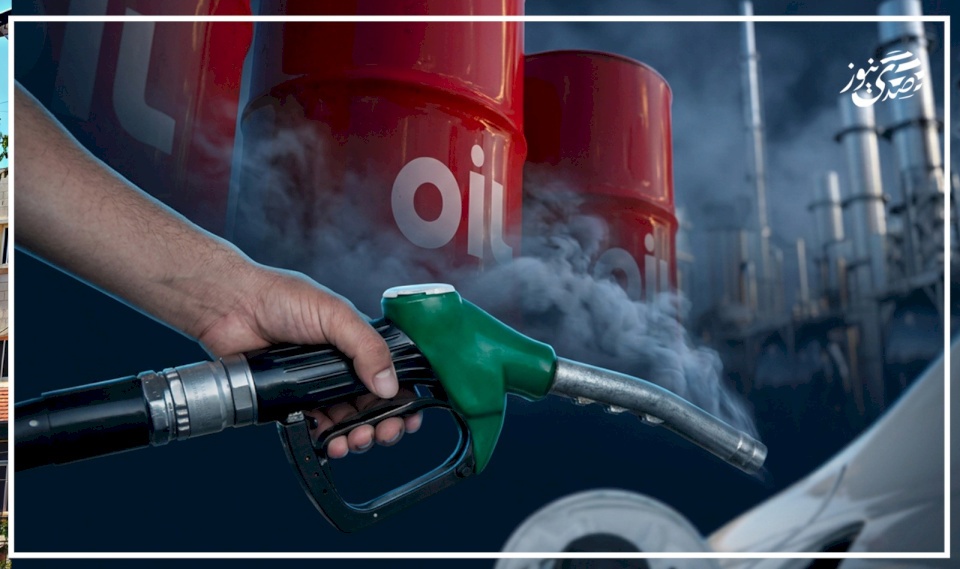
Soaring Oil Prices Burn the Pockets of the Palestinian Citizen "The Poor"
Exclusive to SadaNews: Due to the intensifying geopolitical risks stemming from the American-Israeli war on Iran, global market fears of a shortage in oil and energy supplies have surged, witnessing significant increases in oil prices, with the price per barrel nearing the $120 mark, amid warnings of an unprecedented global inflation wave.
After Brent crude approached $119 per barrel, soaring by 28% in a single day—the highest daily increase since 1988—due to a series of production cuts following the disruption of traffic through the Strait of Hormuz, which carries about 20% of global oil consumption, prices again began to decline to around $110 per barrel after reports emerged of Saudi Arabia offering immediate crude supplies, in addition to announcements from countries discussing the use of strategic reserves. However, ongoing geopolitical risks continue to impose the potential for oil prices to rise to even higher levels.
Negative Implications
The rise in oil prices will have negative repercussions on the Palestinian economy, which has already been suffering from significant contraction for over two and a half years due to the Israeli war on the Gaza Strip and the extensive aggression in the West Bank.
Economic expert Hani Najm from inside Palestine tells "SadaNews": "There is no doubt that the rising oil prices will affect the prices of many goods and will push production costs upwards, which means there are real fears of significant inflation," pointing out that fuel prices in Israel will be linked to two important factors: the first being the continuation of the war beyond this March, as prices are set at the end of each month. If the war stops, then oil prices may drop, and this will be reflected in the price in Israel. The second factor is linked to the exchange rate of the shekel against the dollar, especially since the appreciation of the shekel during this period effectively reduces the import costs that are conducted in dollars.
Prices Are Dependent on Developments
For this reason, Najm believes that the developments that will occur over the next two weeks will dictate the prices in Israel, downplaying some expectations in Israel that suggested that the price of a liter of 95 octane gasoline could reach around 10 shekels per liter, saying: "Typically, the Israeli government will intervene in such a case by offering tax reductions to reduce the price sold in the markets."
He adds: "Until this moment, the scene is ambiguous, and the matter is left to the developments in the war, whether in terms of its continuation or its course, such as whether more oil production facilities will be targeted or not."
The "Meariv" newspaper reported that the price per liter of gasoline could leap to ten shekels if there is no major drop in global fuel prices and prices remained at their current level until the end of this March.
According to the newspaper, the price of a liter of 95 octane gasoline is expected to rise to about 10 shekels in early April, according to senior officials in the energy industry.
It should be noted that Israel has not seen such a price, where the price of a liter of 95 octane gasoline is currently sold at 7.02 shekels. On the other hand, the price per liter in Palestine, which relies entirely on the Israeli market, is about 6.85 shekels per liter, meaning that the price will be around 9 shekels at least in the West Bank next month if it reaches about 10 shekels in Israel. It is worth mentioning that prices for this month were set with the global oil price reaching 72 dollars.
Meanwhile, diesel is sold this month in Palestinian markets at approximately 5.96 per liter, which could rise to 7-8 shekels if the forecasts reported in the Hebrew media are accurate.
How are Prices Determined?
Gasoline and diesel prices in Israel are primarily determined based on global fuel prices, taking into account fluctuations in the dollar exchange rate, the excise tax, and the value-added tax (18%). Taxes comprise about 50% of the price. The newspaper stated that taxes will not change this month (unless decided otherwise), and the exchange rate will remain relatively stable (around 3.1 shekels to the dollar), meaning that a rise in global fuel prices will lead to an increase in domestic prices.
The Cost Increases Will Affect Many Goods and Services
For his part, economic and financial expert Muayad Afana tells "SadaNews" that the rise in global oil prices directly affects prices in Palestine, and this does not only pertain to fuel derivatives (gasoline, diesel, kerosene, gas) but extends to additional groups of goods and services. He pointed out that Palestine completely relies on importing fuel derivatives from Israel according to the Paris economic protocol, under price constraints on certain fuel derivatives.
He added: "Israel, for its part, also relies on importing energy, so any rise in global oil prices is transmitted to the Israeli economy and in turn to the Palestinian economy, which will also reflect on production costs associated with energy, such as industries, bakeries, transportation and communications, and others," estimating that the rise in oil prices will directly affect certain products like petrochemical industries, and indirectly affect other goods and services, such as transportation costs, supply chains, and imports from abroad, especially since Palestine relies heavily on imports.
Afana anticipated that the current situation will reflect on the prices of certain goods and services in Palestine, primarily oil derivatives, and increase the living pressures on the Palestinian citizen.
A Significant Share in the Family Spending Basket
The Palestinian territories (primarily the West Bank) consume on average about 90 to 100 million liters of fuels monthly. This consumption is distributed with approximately 57%-75% being diesel and 25%-43% being gasoline, with a daily consumption rate ranging between 2.5 to 3 million liters.
The price of gasoline in Palestine is calculated monthly by the General Petroleum Authority based on fuel prices in Israel. The price consists of a base price, an excise tax "bloo" (approximately 100% of the base price), value-added tax (16%), in addition to transportation costs and profit margin for the stations (approximately 30-49 agorot per liter).
According to the Central Bureau of Statistics, the transportation group accounts for about 16% of total Palestinian household expenditures in the West Bank, ranking second after the food and beverage group in terms of its weight in the basket. Fuels (gasoline and diesel) alone constitute about 4% of the Palestinian household spending basket, alongside 6% for transport costs (whether by bus or taxi), and an additional 6% for purchasing vehicles and the costs of licensing, registration, and driving tests.
 Follow the latest Sada News via Google News
Soaring Oil Prices Burn the Pockets of the Palestinian Citizen "The Poor"

Millions of Dollars in Losses.. "SadaNews" Reveals Shocking Figures for Traders from Pales...

The Problem of Shekel Overcrowding Worsens.. Fuel Station Owners Threatened with Closure o...

The Palestinian Economy at a Crossroads: 4 Files Awaiting Resolution

A Severe Blow to the Economy of the West Bank.. New Israeli Measures at the Karama Commerc...

Exchange Rates of Currencies Against the Shekel (24 July)

The United States Imposes New Sanctions on Network Linked to the Muslim Brotherhood and Ha...
