

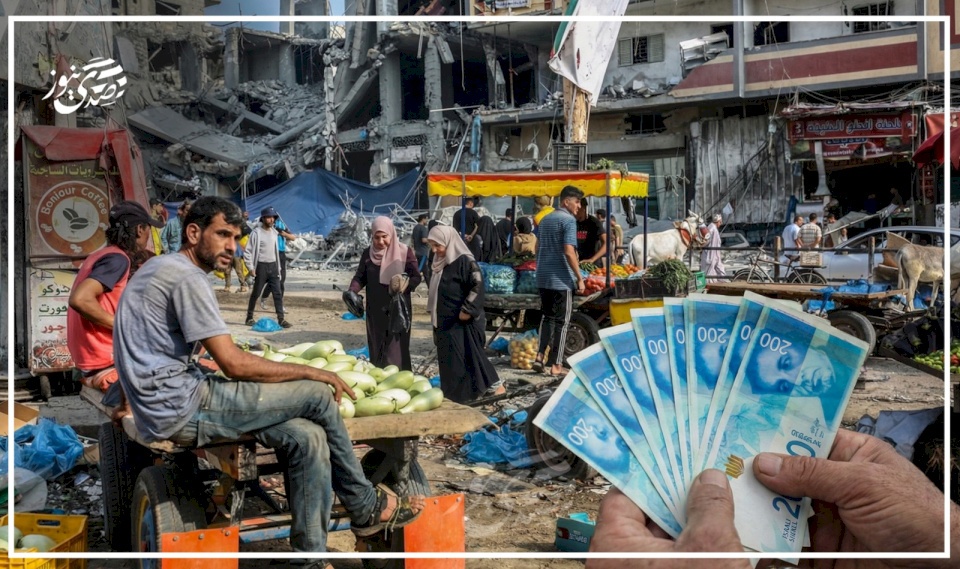
After Two Years of War.. Prices in Palestine Surge by 75%
Special to "SadaNews" - The genocide war waged by the Israeli occupation against the Gaza Strip for more than two years since the events of October 7, 2023, along with the extensive aggression on the West Bank, has left not only political and field effects but also cast its shadow on various economic indicators, particularly prices. How has the war altered price levels in Palestine?
The Consumer Price Index (CPI), adopted by the Palestinian Central Bureau of Statistics, measures changes in (13) commodity groups, each weighted in the index according to the average spending of Palestinian families. However, the group of food and beverages remains the most significant, constituting about 28% of the total weight of the index, meaning that Palestinian families practically spend around 28% of their income on the food group.
Meanwhile, the food groups, housing and its necessities (including electricity, water, and gas), and transportation (which includes fuel prices, licenses, and public transportation fares) collectively represent the three heaviest weighted baskets in the CPI, reaching around 52% of the 13 groups measured in the overall index, indicating that any change in them has a greater impact than the other groups. According to economic observers, the absorption of these groups of the highest percentage in the index indicates low levels of wages and incomes, as the average spending of families on food, beverages, housing, and transportation reflects the basic needs of any family.
After nearly two years of war, cumulative data on price levels in Palestine, prepared by the Central Bureau of Statistics and reviewed by "SadaNews", shows that the CPI has witnessed significant developments, concluding with a cumulative inflation rate of 74.5% across Palestine, with 334% in the Gaza Strip, 2.35% in the West Bank, and 5.45% in Jerusalem. (Cumulatively considering the years 2024 and 2025).
According to the cumulative data, the CPI recorded a rise in Palestine in 2022, one year before the war, by 3.74%, with a rate of 3.74% in the West Bank, 3.16% in Gaza, and 4.70% in Jerusalem. In 2023, when the aggression began in the last two months of the year, the CPI recorded an increase of 5.87% across Palestine, with 4.77% in the West Bank, 10.53% in Gaza, and 4.05% in Jerusalem.
In 2024, which witnessed a continuation of aggression at a high pace interspersed with a temporary ceasefire, the CPI recorded an increase of 17.29% across Palestine, with 37.59% in the Gaza Strip, 1.53% in Jerusalem, and a slight decline of 0.21% in the West Bank. Although inflation is a global phenomenon, with most economies recording a yearly price increase averaging between 2-3%, the aforementioned figures regarding the cost of living in Palestine do not present a fair or balanced picture and confirm that most of the rise in the index does not arise from natural economic factors but rather stems from the shortages in goods supply to the Gaza Strip resulting from this war, causing unprecedented price hikes. Asil Zidan, Director of the Prices and Index Numbers Department at the Palestinian Statistics Bureau, told "SadaNews", "Indeed, the inflation rate in Palestine is unprecedented, demonstrating a 75% rise in prices over two years, but the reality is that what happened in the Gaza Strip due to siege, starvation, and supply shortages was the main reason for the inflation. There is a significant gap between the cumulative price changes in the West Bank and the Gaza Strip, as prices in the West Bank did not exceed 2.35%, which is within the normal range or even lower, while inflation in the Gaza Strip reached 334%, which is an unprecedented and abnormal situation caused by the genocide war waged against our people in Gaza and characterized by a significant economic blockade through a shortage of supply for various types of goods."
She added, "Although the indicators show a rise in prices with the onset of the aggression at the end of 2023, it did not deepen clearly and sharply until 2024 and 2025, as prices skyrocketed amid the intensification of the genocide war, shortage of supply, and the spread of looting and monopolistic practices, among other negative phenomena."
The Central Bureau of Statistics recently indicated a sharp decline in consumer goods prices in the Gaza Strip during November 2025 for the second consecutive month since the announcement of the ceasefire, which led the consumer price index to record a sharp decline of 34.70% compared to October 2025, leading the overall consumer price index in Palestine to record a decline of 15.45%. However, the decrease in the index during the last two months in the Gaza Strip, after the announcement of a ceasefire, has not returned prices to the levels they were at before the war, especially given the Israeli side's reluctance to open crossings and allow assistance and goods into the Gaza Strip, where prices remain more than three and a half times higher compared to the period before the aggression.
 Follow the latest Sada News via Google News
Soaring Oil Prices Burn the Pockets of the Palestinian Citizen "The Poor"

Millions of Dollars in Losses.. "SadaNews" Reveals Shocking Figures for Traders from Pales...

The Problem of Shekel Overcrowding Worsens.. Fuel Station Owners Threatened with Closure o...

The Palestinian Economy at a Crossroads: 4 Files Awaiting Resolution

Inflation Expectations in Israel Stabilize at 1.5%

Ministry of Economy Announces the Opening of Import Application Submissions for Commodity...

Relative Stability of the Dollar Near 3.04 Shekels and Predictions of Returning Inflationa...
