

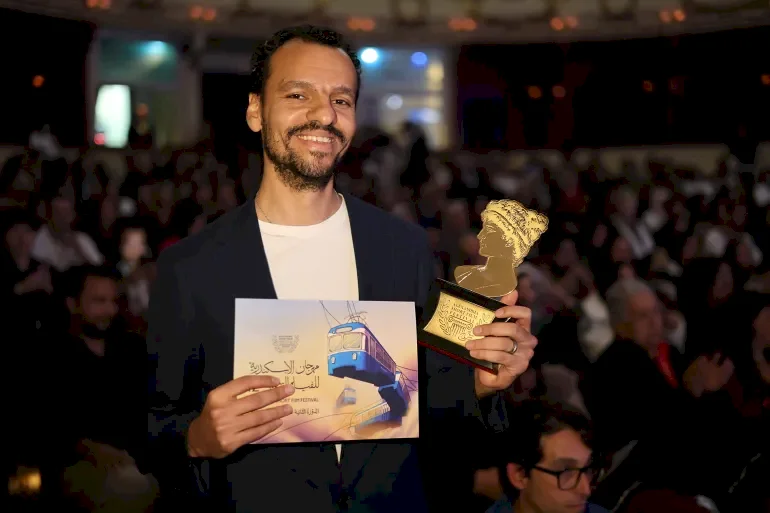
How 'The Last Miracles' Was Born from Naguib Mahfouz's Story? The Film Director Reveals the Behind-the-Scenes
SadaNews - The film "The Last Miracles" does not merely adapt Naguib Mahfouz's story "Miracle" but reinterprets it from a contemporary perspective, raising open questions about faith and doubt, reality and illusion, fate and choice, without leaning towards a single answer.
Since its premiere at the Cairo International Film Festival, the film has continued its journey through several international festivals, winning three awards before arriving at the Rotterdam Festival.
Director Abdel Wahab Shawqi talks about his bet on classical literature, the behind-the-scenes process of transforming Mahfouz's text into cinematic language, his philosophy of adaptation, building images, and the future of independent cinema.
Why did you choose Naguib Mahfouz's story "Miracle" to be your first directorial experience? To what extent did you find it close to your generation?
I believe that we need to return to classical literature because we are living in a crisis of writing in cinema and literature. The suggestion to adapt "Miracle" came from Mark Lotfi, my partner in writing and production, and when I reread it, I felt it addressed the anxieties and questions that occupy me personally.
What attracted me to the story was its contradictory perspectives on humanity and the questions it raises which are not tied to a specific time, as history repeats itself and major human issues remain. Although it was written in the atmosphere following the 1967 setback, I felt it also expresses our reality after the Arab Spring; when grand dreams collided with limited possibilities, turning into shock and fracture. For me, the story discusses our present as much as it reflects the past.
Therefore, I didn't need to update the timeframe of events except to the slightest extent. All I added were telephones and voice notes (Voice Note) to serve the drama and maintain the unity of place, which could have been omitted. Thus, the film can be read as occurring in the late sixties or in the present, as the essence of the story hasn't changed.
Transforming literature into cinema always presents a dilemma between adhering to the original text and granting filmmakers the freedom to change. Which direction do you lean towards, especially since you didn't adhere literally to the story "Miracle"?
I belong to the school that adheres to the spirit of the literary work rather than its literalness. We were aware that changing a story by Naguib Mahfouz could provoke criticism, but if we approached the text with fear, we wouldn't make a good film.
In my view, if I conveyed the story as it is, what is the need for the film? The literary text already exists, and what matters to me is transferring its spirit to a new cinematic language. Therefore, it was natural for me to change the places, professions, some dramatic lines, and characters, while preserving the essence of the story and its goals. For me, adaptation is not a mere transfer of text but a complete transformation from a literary medium to a visual medium.
What was the toughest challenge you faced in turning a story based on internal contemplation into a film?
The biggest challenge was that the story isn't suitable to be transported to the screen as it is because most of it is based on internal contemplation. It would have been easy to resort to monologues or an omniscient narrator -as happened in other films- but I rejected that path from the beginning because I wanted the images themselves to convey the thoughts and feelings, not words.
I relied on silence, the actor's movement, framing, rhythm, sound, and all visual elements, and developing the screenplay took about two years until it reached its final form.
I remember that after completing the seventh version, I discovered that the phrase that initially drove me to adapt the story into a film was no longer present in the text; it was a phrase where Naguib Mahfouz describes the moment the protagonist realizes he possesses a "miracle" and that glory awaits him. I felt that I didn't want to retrieve it in words; rather, I had to find a visual equivalent within the film.
Why did you change the title from "Miracle" to "The Last Miracles"?
Initially, the film's title was not "Miracle" but "Two Steps Away". As the screenplay evolved, I felt that "The Last Miracles" is the most accurate name to express the film.
I cannot fully explain the reason for its choice, as that would reveal the ending and spoil part of what I wanted the film to provoke in terms of discussion. For me, the title "The Last Miracles" is not a ready key for interpreting the ending but an element that adds to its ambiguity and opens a broader door for interpretation and raising questions, and this is one of the film's objectives.
The film moves between magical realism and psychological drama. Did you intend to build a surreal world, or is what we see a reflection of the protagonist's state?
This is one of the most pressing questions I faced during the directing. It's true that the viewer might think they are watching a magical realism film, as the protagonist receives a call from someone presumed dead, but I did not want to approach the film this way. For me, the film is realistic, and I didn’t want to deceive the viewer or push them to accept what they see as the only truth.
From the beginning, I was keen on planting visual and auditory signals suggesting that things are not necessarily as the protagonist sees them and that there is another truth unfolding in the background. Even in the spiritually themed scenes, I intentionally avoided celebratory imagery and music, using cold colors and harsh electronic music, along with sharp editing rhythms, to keep the viewer in a state of tension and uncertainty.
In the end, what we see is reality as it passes through the protagonist’s consciousness and psychological state, not a world of magical realism in the traditional sense.
The film raises questions about the "sacred" and the "mundane", coincidence and fate. Do you fear the audience's interpretations of these complex concepts?
On the contrary, this film was made for interpretation. What pleases me most is to find contradictory readings of the work, because that means it has succeeded in provoking questions rather than providing answers. I did not create a film to express my opinions or impose a single viewpoint but to leave space for each viewer to read it in their own way.
I was keen throughout the writing and directing process that the film does not lean towards a single interpretation, whether regarding faith or doubt, or the sacred and the mundane. For me, this is not a battle between right and wrong but a human and spiritual journey experienced by each person in their own way.
Therefore, the ending is open to multiple readings because I believe that the value of an artistic work lies in its ability to stimulate dialogue and interpretation, not in providing a final answer or resolving one position at the expense of another.
How did you choose the cast, especially since independent and short films often rely on non-professional actors and new faces, while you employed several stars?
By virtue of my work as an assistant director for 11 years, most of my experiences were with stars and professional technicians, so collaborating with them was easier for me than searching for new faces. I had previously worked with Ghada Adel on several projects as well as with a large part of the crew, so I knew their capabilities, and it was natural to choose those I see as the most suitable for the film.
As for Khaled Kamal, he is a friend, and we have previously worked together, so I know his way of thinking, culture, and sensitivity as an actor, and I was convinced from the very first moment that he was the most suitable to embody this character. I also enlisted the editor Yasser Azmy because he belongs to independent cinema, and I was looking for this sensibility in building the film.
In the end, my choices were not linked to whether the film was independent or commercial, but rather to what serves the work. It may be different in another film because the nature of some films may dictate the need for non-professional actors if that is the language most suitable for them.
The cinematic imagery in "The Last Miracles" relies on an atmosphere of mystery and anticipation. How did you create this state?
From the moment I wrote the screenplay, I envisioned the film visually and imagined the shape of the lighting, colors, and nature of each scene. Discussions with the director of photography Omar Abu Douma began about two years before filming, and we were developing this vision step by step until it reached its final form.
I wanted the imagery to reflect the psychological state of the protagonist, so we relied on neon colors and a duality of red and green to express his turmoil, even making daytime scenes intentionally appear cold and leaning towards blueness, so the viewer remains in a state of anxiety rather than reassurance. Abu Douma is one of the best directors of photography in dealing with color, and he was a key partner in shaping this visual world.
What about the filming locations and set design?
The location scouting also took about two years, running parallel to the screenplay writing and funding search. I visited dozens of sites, especially in Cairo's cemeteries, searching for places that visually express the world of the film.
As for the set design, it was the result of close cooperation with engineer Asim Ali; I would specify the feeling I wanted for each location while he would translate it into a visual design that serves the drama, providing practical observations related to filming, which helped us reach the best choice.
After the film's participation in prominent international festivals from Cairo Festival to Rotterdam and winning three awards, how did the audience and critics receive it? Did it come as you expected?
The audience's reactions exceeded all my expectations. Since the premiere at the Cairo Festival, I felt that the film created a state of dialogue and discussion, which was repeated in all subsequent screenings. For me, the audience is the true teacher, as it reveals points of strength and weakness and gives filmmakers the opportunity to learn and develop.
I was also pleased with the critical reception of the film. I hoped it would open space for different readings and interpretations, and this indeed happened. What stands out to me is reading contradictory interpretations of the film because that means it has succeeded in provoking questions and opening the door for dialogue.
As for the festivals and awards, I see them as an extension of this journey because they give the film a chance to reach new audiences in different cultures, which I noticed in its screenings outside of Egypt. Awards are important, of course, but ultimately they express the opinion of a jury, while what matters most to me is that the film continues its journey with the audience and remains capable of provoking discussion.
Does "The Last Miracles" represent the beginning of a cinematic project that reintroduces classical literature with a contemporary vision, or do you prefer to move between different experiences?
I have always believed that literature, especially classical literature, is an important refuge, and that we need to return to it. But that does not mean that all my upcoming works will be adaptations of literary texts.
My first feature film "Younes in the Land of Longing" is my original work, and so is my upcoming short film, but at the same time, I wish to present more works adapted from literature. I currently have more than one project in the works, including works inspired by texts by Naguib Mahfouz and others based on a novel by a young writer, and I hope they will see the light soon.
Source: Al Jazeera
 Follow the latest Sada News via Google News
Heat Waves: Why Do Some People Die While Others Survive?

How 'The Last Miracles' Was Born from Naguib Mahfouz's Story? The Film Director Reveals th...

Hollywood Enters the 'Microdrama' Race, Betting on Smartphone Audiences

6 Surprises Await You at Samsung's Upcoming Conference.. What Will the Company Reveal?

Combining the Flavor of Coffee with the Calm of Tea.. Can Hojicha Become a New Competitor...

What We Don't Know About Our Parents.. 9 Questions That Will Change Your Relationship With...

After Its Spread.. Will Remote Robotic Surgery Succeed in Critical Situations?
