

After Its Spread.. Will Remote Robotic Surgery Succeed in Critical Situations?
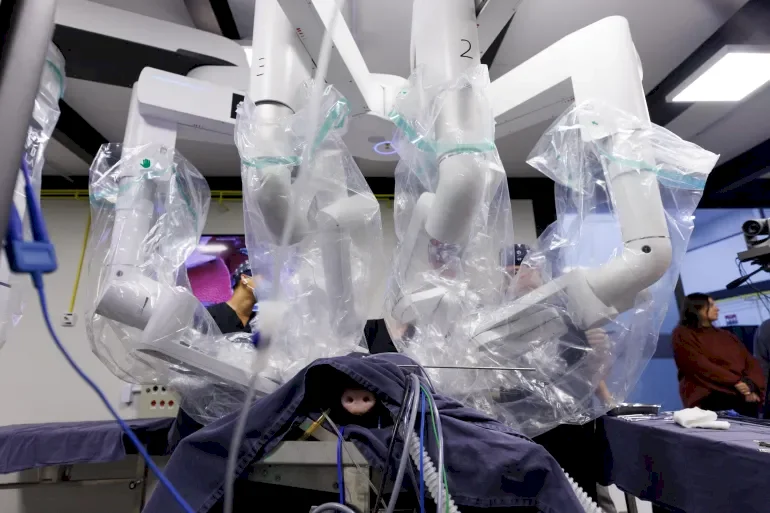
SadaNews - The field of remote robotic surgery has witnessed significant development recently, as the concept has moved from testing laboratories and is now ready for practical application in several countries around the world. A notable example is the prostate removal surgery performed by a doctor in London on a patient in Gibraltar, over 2,400 kilometers away, according to a report from the American tech site "Tech Radar".
The surgeon relied on a system of robotic surgical equipment known as "TUMAI," developed by the company "Shanghai MicroPort Medbot," which is one of the first Chinese companies to receive the necessary European approvals in the field of remote robotic surgery.
The robot consists of three main parts: the surgery platform, the patient table, and the vision table, which facilitates the surgeon's view of the surgical site and allows control of the robotic arm to perform the operation. The system enables surgeons to conduct operations on the pelvic area and abdomen.
British doctor Bruskhar Dasgupta performed the surgery on a 62-year-old patient named Paul Paxton, who expressed happiness about undergoing the operation and participating in making medical history, according to his statements.
Paxton's case is not the only one of its kind involving remote surgery. Doctor Sudhir Srivastava, a heart surgeon at Georgetown Public Hospital Corporation (GPHC) in Guyana, performed surgery on a patient in India, who was approximately 20,000 kilometers away from the hospital, according to a report from the American medical site "Cardiovascular Business".
The report describes this surgery as the longest remote surgical operation conducted using robotic surgery and ultra-fast communication networks, with the system used in this surgery having performed over 173 similar surgeries globally.
The spread of these robots and their initial use raises many technical and critical questions regarding their quality and ability to operate under different conditions.
Technical Obstacles That Could Endanger a Patient's Life
A report from "Live Hospital," specialized in experimental treatments and advanced medical technologies, points to several obstacles facing the widespread adoption of robotic surgery globally.
The cost of building robotic surgical systems and their annual maintenance costs are among the most prominent obstacles this sector faces, with some systems costing around one million dollars, including periodic maintenance costs that exceed 100,000 dollars.
It also highlights a significant obstacle related to the medical procedure itself, as many surgeons rely on tactile sensation during various surgical operations to ensure the patient's condition and the state of the surgical procedure itself, which is absent when using remote surgical robots. This could increase postoperative complications or lead to serious side effects.
The report confirms that technical obstacles, such as internet disconnection or the robot suddenly ceasing to function during the operation, represent some of the greatest risks associated with robotic surgeries.
In some cases, latency in communication could also make the difference between life and death. A delay, even of fractions of a second, between the surgeon's hand movement and the robot's response over the network is considered the most significant challenge, as any sudden interruption could pose severe risks.
Moreover, the use of remote robotic surgery requires complex and lengthy training that includes stringent accreditation conditions for medical teams, which many current medical training programs do not provide.
There are also legal and ethical considerations that raise questions about medical liability in the event of a technical failure in the robot during the operation, and who is responsible (the surgeon, the hosting hospital, or the manufacturer of the surgical robot).
Despite this, the technology holds hope for many patients residing in remote areas that lack adequate medical care.
 Follow the latest Sada News via Google News
Hollywood Enters the 'Microdrama' Race, Betting on Smartphone Audiences

6 Surprises Await You at Samsung's Upcoming Conference.. What Will the Company Reveal?

Combining the Flavor of Coffee with the Calm of Tea.. Can Hojicha Become a New Competitor...

What We Don't Know About Our Parents.. 9 Questions That Will Change Your Relationship With...

After Its Spread.. Will Remote Robotic Surgery Succeed in Critical Situations?

Holland the Last Victim.. How Did Morocco Become a "Nightmare" for Europe's Giants?

Morocco Qualifies for Round of 16 After Victory Over Netherlands in Penalties
