

How Smotrich is Redrawing the Geography of the West Bank to Undermine the Two-State Solution?
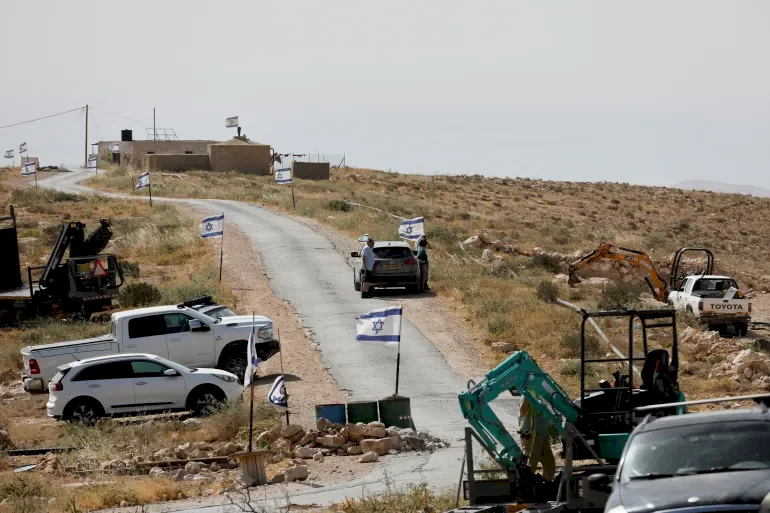
SadaNews - Israeli reports have revealed a noticeable acceleration in the pace of settlement expansion in the West Bank, as part of a strategy led by Israeli Finance Minister Bezalel Smotrich. According to his statements, the aim is to impose a geographical and political reality that prevents the establishment of a Palestinian state in the future, while human rights organizations and Israeli experts have warned that these policies represent a rapid transition towards the actual annexation of occupied Palestinian territories.
In an interview with the newspaper "Israel Hayom", Smotrich stated that the settlement project implemented by the current government has created a "revolution" in the West Bank, indicating the establishment of about 160 settlement outposts, the approval of more than 100 new settlements, and the resettlement in areas in the northern West Bank after the cancellation of parts of the disengagement law, in addition to investments worth billions of shekels in infrastructure projects.
Smotrich confirmed that the settlement outposts are no longer merely housing clusters but have become "the tool that allows for the creation of regional continuity," as he described it, explaining that the goal is to build geographical continuity between Israeli settlements, while dissecting the Palestinian geographical extension into separate areas.
He stated that this vision crystallized after studying the maps proposed as part of the "Trump Plan", which showed - according to him - that Palestinians have geographical continuity, while Israeli settlements appear as isolated islands. He added that the government is working to reverse this equation by creating a connected network of settlements and outposts.
He clarified that the government is racing against time to legalize the status of as many outposts and settlements as possible before any upcoming elections, aiming to grant them a legal status that makes their evacuation more difficult for any future government that might adopt a different political approach.
Smotrich also accused opposition leaders - including Naftali Bennett and Gadi Eisenkot - of making contacts with European officials to revive the political track, pointing out that any governmental change might halt the settlement project and return to political negotiations, including the evacuation of settlements and outposts.
He indicated that the events of October 7, 2023 changed public opinion inside Israel, adding that the debate about the West Bank is no longer ideological but has become linked to security, and that most Israelis - according to his estimation - no longer support the establishment of a Palestinian state.
In an extensive report, Haaretz evaluated that what is happening in the West Bank goes beyond mere settlement expansion and represents an organized project to redraw the political and geographical map of the region, undermining the possibility of implementing a two-state solution.
The report pointed out that Israel established 127 settlements from 1967 until the formation of the current government, and the current government alone has approved the establishment of 103 new settlements, in addition to more than 300 outposts being legalized, including about 140 outposts that are nearing the completion of their official recognition procedures, raising the number of settlement sites in the West Bank to more than 470 locations.
According to the report, this transformation came after restructuring the administration of West Bank affairs, as Smotrich was granted extensive powers within the Ministry of Defense to oversee planning, construction, land, and civil administration files in Area "C". Additionally, the powers of the Defense Minister in granting building permits have been reduced, leading to an unprecedented acceleration in the approval procedures for settlement projects.
Under the "Oslo II Agreement" signed in 1995, the West Bank is divided into three areas: "A", "B", and "C". Area "A" is under full Palestinian control, while Area "B" is under Palestinian civil control and Israeli security control, and Area "C" is under full Israeli control, comprising about 60% of the West Bank's area.
The report added that the government has approved, until the end of 2025, more than 40,000 housing units in settlements, later stating that Smotrich announced the number rose to 60,000 units, compared to only six settlements approved in the decade preceding the formation of the current government.
According to data from the United Nations Office for the Coordination of Humanitarian Affairs (OCHA), there are currently 925 military checkpoints in the West Bank, most of which are located at village entrances, and the roads connecting Palestinian areas are gradually deteriorating.
Transitioning from one group of villages to another has become a complex task, where checkpoints open and close without warning, and Palestinians' access to services and work outside the isolated areas they live in is restricted, as any movement to another area requires passing through Area "C".
Moreover, the density of settlements along the roads in these corridors confines Palestinians to increasingly smaller spaces, deepening the separation between isolated Palestinian areas.
The government has approved up to 60,000 housing units in settlements by the end of 2025 (Reuters)
The newspaper viewed that the ongoing expansion aims not only to increase the number of settlers but also to reshape Palestinian geography by establishing new settlements in strategic locations, along major roads, and among Palestinian clusters, leading to the fragmentation of Palestinian areas and preventing the establishment of a geographically connected Palestinian state.
The newspaper quoted Hagit Afrahn from the settlement monitoring team in the "Peace Now" movement, stating that the West Bank has witnessed a radical transformation over the past three years characterized by the establishment of new settlements, the injection of billions of shekels into infrastructure, the confiscation of vast areas of land, and the weakening of the Palestinian Authority, warning that these developments impose increasing security and political burdens on Israel.
The report also relied on estimates from the Institute for National Security Studies at Tel Aviv University, noting that the ongoing settlement expansion carries strategic risks, both in terms of increasing security burdens on the Israeli army and deepening Israel's political isolation, with diminishing opportunities for reaching a political settlement.
The report indicated that the government allocated at least 19.8 billion shekels for the development of settlements and the road networks and infrastructure associated with them, in addition to additional security expenses that may increase with the expansion of settlements.
It also discussed phenomena described as unprecedented, including the legalization of settlements within military firing zones and the approval of outposts established on private Palestinian land, as well as the construction of settlements near Palestinian clusters from which residents had been displaced in recent years, which human rights organizations view as part of a policy aimed at changing the demographic and geographical reality in the West Bank.
At the conclusion of the report, Israeli experts' estimates were divided regarding the future of these policies. While organizations such as "Peace Now" and "Kerem Navot" believe that the extent of settlement expansion makes reversing it more difficult over time, researcher Shaul Arieli stated that a large part of the new settlements is still in procedural phases, and that the possibility of reaching a political settlement has become politically and security costly the longer construction and legalization processes continue.
 Follow the latest Sada News via Google News
Al-Shara: Israel seeks to turn Syria into an unending chaos arena

How Smotrich is Redrawing the Geography of the West Bank to Undermine the Two-State Soluti...

Bezhkian: We Will Not Retreat in Negotiations with Washington Regarding Our Rights

Rights Activists Demand to Ban Ben Gvir from Entering America

Occupation Closes the Headquarters of the Solidarity Charitable Association in Nablus for...

"American Forces on the Ground".. Leaks About Washington's Role in the Lebanon Agreement

American and Iranian Delegations in Doha as Tehran Threatens to Disrupt Alternative Routes...
