

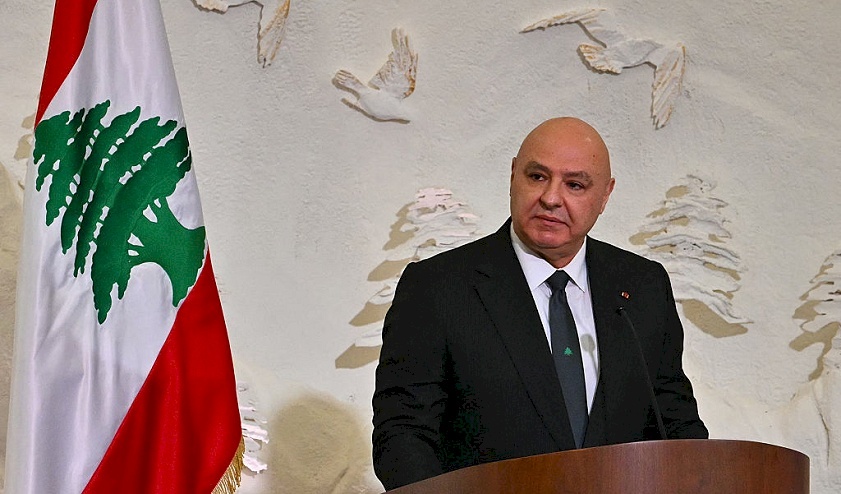
Aoun calls on those opposed to the "framework agreement" to present an alternative
SadaNews - On Wednesday, Lebanese President Joseph Aoun made statements defending the framework agreement signed in Washington, which he confirmed includes clauses related to the Israeli withdrawal, the return of displaced individuals and prisoners, and even the remains of Lebanese in Israel. He emphasized that it is not an agreement but a framework.
He noted that Lebanon's issue is with Israel, a sovereign state that has decided to negotiate for itself, and that it has not abandoned its principles legally, politically, or on the ground in the framework agreement, as some promote. He highlighted the role played by Speaker of the Parliament Nabih Berri, "who has set two main red lines considering that strife and harming the army are prohibited. We all agree on these two matters."
Aoun called on those opposing the negotiations and the framework agreement to present alternatives or share their opinions within institutions, reiterating that the right to disagree is sacred. "Let us discuss politics, but disagreements are prohibited. No one should go to the streets or distort the truth to convince their environment that what has happened is surrender and disgrace for them."
The President denied rumors about an intention to dismiss Army Commander General Rudolf Haikal or heads of security agencies, except for the Director General of General Security, praising their role and efforts and confirming that such rumors aim to undermine the army and security forces rather than enhance their role and presence.
The President addressed the concept of sovereign decisions, saying, "Let them explain to me the meaning of state sovereignty? Sovereignty lies in the independent decisions taken by the state based on conviction. Here lies the core of the problem, as we took an independent decision to negotiate for ourselves and did not allow anyone to negotiate on our behalf, which, unfortunately, upset many." He added: "I have repeated several times that between the options of war and negotiations, let us choose negotiations because we have already tried wars and they did not yield results, and it is better for both parties to sit, talk, and understand each other. We chose negotiations and worked on the framework agreement that they have interpreted, whether intentionally or otherwise, in a misleading way to distort it. If they do not want it, let them give us the alternative."
He continued: "For about a year, we have been asking to be given an alternative option, and when we started negotiations and faced opposition, we asked again, but there is no alternative. Well, they do not want the framework agreement? What do they want in return? To allow others to negotiate on our behalf? Why should this or that state negotiate for us? Are we not capable of negotiating for ourselves? Our problem is with Israel, and we negotiate for ourselves. If you are Lebanese, then the Lebanese state is the one negotiating, and everyone participates with us in negotiations and presents their opinions and remarks, but they do not want to participate; they want to criticize and distort."
Aoun responded to accusations of legitimizing the occupation, stating: "They said that we legitimized the Israeli occupation, while all the clauses stipulate the need for state authority to extend over all Lebanese territories and that the Israeli should be outside Lebanese territory. So where did we talk about legitimizing the occupation? We spoke about the return of displaced individuals and prisoners and the return of remains they have and about international support, and all of that was included in the framework agreement. Here I repeat that the framework is not ideal because every party wanted to gain as much as it could for its benefit, but it was the best possible within the Lebanese constants."
The President asked: "Had we not proceeded with negotiations, do you imagine what the situation would have been and what the price would have been?" He added: "They say it is a project of strife. Where is the project of strife mentioned? If they do not agree, they are free because Lebanon is a democratic country, and one can oppose politically. So if we do not agree on something, does that mean we are facing a project of strife?"
Aoun confirmed: "We will continue what we started; not to register positions but for the country. Today there is an opportunity for us, and we will not miss it. If there is an alternative, let them tell me. If they want war, let them show us what the field has achieved for them. In 2000, we retrieved the Lebanese village of Ghajar, and we returned and lost it in 2006, in 2023 we lost five points, and this year more than 66 towns have come under occupation."
 Follow the latest Sada News via Google News
Aoun calls on those opposed to the "framework agreement" to present an alternative

The Organization of Islamic Cooperation Welcomes the UN Report on Occupation Against Child...

Turkish Interior Minister in Damascus to Discuss Security Cooperation and Sign a Memorandu...

From New York.. The Head of Syrian Intelligence Defines Damascus's Security Priorities

Dozens of Drones Target Moscow as Zelensky Ridicules the "Donbas Complex"

Venezuela: Total or Partial Damage to More Than 58,000 Buildings Due to the Earthquakes

Palestine Participates in the Event Organized by the General Secretariat of the Organizati...
