

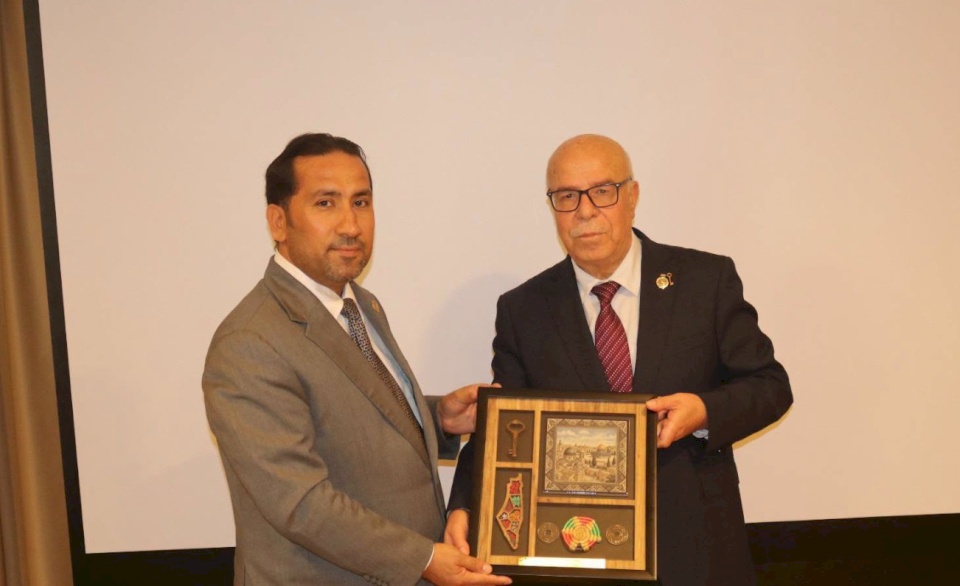
The President of the Supreme Judicial Council Calls for Arab Judicial Integration
SadaNews - The President of the Supreme Court/Court of Cassation, President of the Supreme Judicial Council, Judge Mohamed Abdul Ghani Oweih, participated in the dialogue session for the heads of judicial councils and supreme courts in the Arab world, organized by the Arab Center for Legal and Judicial Research affiliated with the Arab League, in Milan, Italy, on June 27 and 28, 2026. The event included the participation of heads of judicial councils and supreme courts along with several senior judges and experts from Arab countries, as part of the work program of the Council of Arab Ministers of Justice aimed at enhancing Arab judicial cooperation and exchanging experiences.
During the first session, titled "Arab Experiences in Developing Judicial Councils and Supreme Courts", Judge Oweih reviewed the Palestinian experience in developing the justice system, emphasizing that justice in Palestine represents one of the pillars of national resilience amidst the exceptional circumstances imposed by occupation and aggression.
He explained that the vision of the Supreme Judicial Council for developing the judiciary is based on five main axes, which include strengthening judicial independence, investing in the judicial and administrative cadre, achieving swift justice, accelerating digital transformation, and enhancing institutional building and sustainable planning, contributing to the development of judicial services and consolidating citizens' trust in the justice system.
He pointed out that the Palestinian judiciary continues to fulfill its mission despite the unprecedented challenges posed by the occupation and the widespread destruction resulting from the aggression on the Gaza Strip, affecting people, institutions, and infrastructure. He affirmed that the continued operation of the courts under these circumstances embodies the judiciary's commitment to protecting rights and upholding the rule of law.
The intervention also addressed the importance of keeping up with rapid legal and technological transformations by developing judicial tools to handle cybercrimes, artificial intelligence applications, information security, and personal data protection.
Judge Oweih called for transitioning from the concept of traditional judicial cooperation to the stage of Arab judicial integration, through building a sustainable institutional framework for exchanging experiences and judicial interpretations, and developing training programs and joint scientific research, enhancing the capacity of Arab judicial institutions to confront common challenges.
The President of the Supreme Judicial Council welcomed the Arab initiative for judicial communication that was proposed during the dialogue session, affirming its importance in enhancing institutional communication among Arab judicial authorities, supporting capacity building, exchanging experiences, and developing Arab judicial work to keep pace with modern legal and technical developments.
The dialogue session, organized by the Arab Center for Legal and Judicial Research at Villa Lacolina in Milan, is part of the implementation of its work program for 2026 approved by the Council of Arab Ministers of Justice, with support from the Konrad Adenauer Foundation and the participation of the German judiciary, aimed at enhancing cooperation between Arab supreme courts, exchanging experiences, and improving justice management, as well as discussing Arab initiatives in the areas of governance of using artificial intelligence in the judiciary and building judicial capacities, leading to recommendations that support the path of joint Arab judicial work.
 Follow the latest Sada News via Google News
The President of the Supreme Judicial Council Calls for Arab Judicial Integration

Two Palestinians Win Membership in the Inaugural Cohort of the Global "Azm" Fellowship for...

Mustafa Receives a Study on Judicial Independence and Efficiency and Affirms Government Su...

Sheikh Discusses with Japanese Assistant Foreign Minister for Aid to Gaza Reconstruction M...

Palestine Participates in the 66th Session of the Advisory Council of the International Ol...

Yasser Arafat Foundation Holds Seminar on Israeli Elections, Change Prospects, and Their R...

Sheikh Receives French Consul General and Swiss Confederation Representative in Farewell M...
