

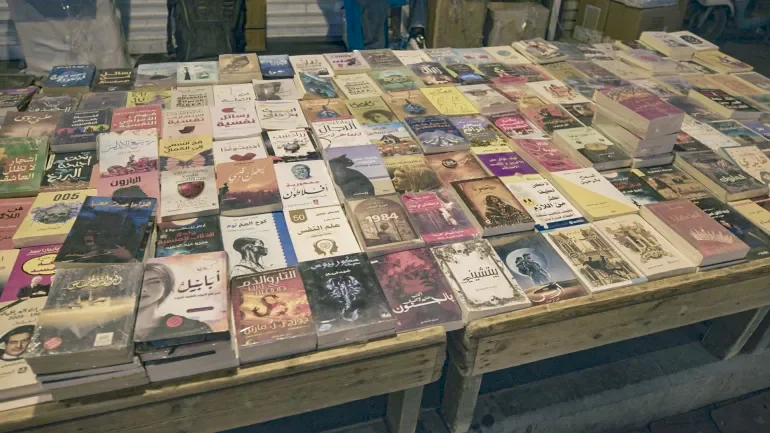
The Hidden Al-Mutanabbi: How Culture Creates a Parallel Market in Baghdad?
SadaNews - In a country whose economy is primarily based on oil as the almost sole resource for the state, the idea of a vibrant and active "cultural economy" at the heart of Baghdad seems like a paradox that goes unnoticed by many.
In the old alleys stretching from Rashid Street to the banks of the Tigris, Al-Mutanabbi Street functions every week as a complete economic hive that does not factor into the calculations of GDP, despite generating hundreds of professions and creating daily income for dozens of families.
Here, books are not the only item sold. Al-Mutanabbi resembles a small city functioning within a larger one, bustling from the early morning hours, with libraries and used book stalls opening up, gradually expanding to include cultural cafes, publishing houses, print shops, calligraphers, painters, photographers, and sellers of antiques and traditional crafts, along with restaurants, taxi drivers, and street vendors.
Although this activity operates almost outside the official economy, it represents a model for what experts term "the invisible cultural economy," which relies more on knowledge, heritage, and identity than on traditional capital.
A Street that Never Rests
On a Friday morning, Al-Mutanabbi begins welcoming its visitors just before noon.
The voices of the vendors intermingle with the scent of old paper and coffee, while queues of books line the sidewalks, suggesting that the entire street has transformed into an open exhibition.
Abu Ali, the owner of one of the old bookstores on the street, says that what happens inside Al-Mutanabbi is "much greater than what official institutions imagine," noting that the street does not just sell books but manages a complete economic cycle that dozens of families and cultural professions depend upon.
He adds during his conversation with "Al Jazeera" that many view Al-Mutanabbi as merely a historical or cultural space, adding, "But the truth is that there is a complete daily economy here that starts from the second-hand book seller, passing through publishing and printing houses, cafes, calligraphers, painters, and even street vendors."
He notes that some bookstores rely on specific cultural seasons that yield significant sales, while cultural cafes create a space that attracts visitors from various provinces, which in turn affects transportation, restaurants, and nearby markets.
According to bookstore owners, this activity does not fall under accurate statistics, but it generates a continuous financial movement, especially during weekends, cultural seasons, and book fairs.
An Economy Unseen by the State
For his part, the head of the Tourist Union in Iraq, Dr. Mohammed Awda Al-Obeidi, believes that what is happening in Al-Mutanabbi and the old city transcends the traditional cultural dimension, asserting that Baghdad has genuine potential to build a sustainable cultural and tourism economy.
Al-Obeidi tells Al Jazeera Net: "One of the most important issues raised today globally is cultural and heritage tourism, especially in Baghdad, a historic city that has been worn down by political and economic transformations but still retains its civilizational potential."
He adds that Al-Mutanabbi Street is not merely a book market but a living memory of Iraq with all its values, customs, and traditions, indicating that the cultural economy can transform into a genuine resource if invested properly within a comprehensive civilizational and tourism vision.
According to Al-Obeidi, every cultural activity within Al-Mutanabbi creates a wide array of intertwined economic activities extending to transportation, hotels, restaurants, and creative industries. He emphasizes that the main problem lies not in the lack of elements but in the "absence of urban and tourism planning capable of linking heritage with development."
Who Really Profits?
Within this unreported economy, profits seem to be distributed in a complex manner. The bookstore owner sells books, but cafes benefit from visitors, while printing houses are engaged in printing new releases, and professions related to bookbinding, Arabic calligraphy, and making traditional gifts flourish. Even street vendors find Fridays an opportunity to achieve a weekly income that may not be available to them elsewhere.
Hussein Ali, one of the workers in the printing field on Al-Mutanabbi Street, reveals that book release seasons or exhibitions "completely energize the market," clarifying that the demand includes not only printing but also design, packaging, transport, and distribution. However, this economy remains fragile as it is based on individual initiatives and is not supported by government plans or organized investment projects.
Paper Facing the Screen
Cultural researcher Yasser Al-Obeidi links the history of Al-Mutanabbi to the history of the "Wraqin Street," which represented a center for books and knowledge since the Ottoman era, pointing out that the street has been connected to bookbinding, stationery, and printing professions for decades.
He tells Al Jazeera Net that "the book in the past represented a great value, and those seeking knowledge would head to this street," but he indicates that digital transformations and social media have changed the nature of the relationship with reading. Al-Obeidi points out that part of Al-Mutanabbi's cultural identity has started to recede in favor of a commercial and entertainment character, stating that "commercial appearances such as restaurants and songs have begun to overshadow the cultural spirit of the place."
Despite this, the street still retains its symbolic allure as one of the last open spaces for culture in Baghdad.
From a Marginal Economy to a Tourism Lever
In many cities around the world, old cultural neighborhoods have become major sources of income through tourism and creative industries, but Baghdad still treats Al-Mutanabbi more as a symbolic space than as an economic resource.
Economic expert Haitham Al-Lami believes that the urban renaissance witnessed by Al-Mutanabbi Street and the old city as part of the (Heartbeat of Baghdad) initiative was not merely an aesthetic rehabilitation but contributed to revitalizing a silent local economy based on culture, tourism, and small crafts.
Al-Lami tells Al Jazeera Net that reviving the heritage facades and developing the sidewalks have reinvigorated the area and increased visitor movement, which has directly reflected on the bookstore and cafe owners and artisans, indicating that this space has become a model for a cultural economy capable of creating job opportunities and energizing markets away from traditional reliance on oil.
He concludes by affirming that the old city possesses significant components to transform into an organized tourism and cultural hub if properly invested in a clear economic vision that maintains the heritage identity and supports related activities.
Source: Al Jazeera
 Follow the latest Sada News via Google News
After Deschamps' Departure... Zinedine Zidane Tops the Candidates to Lead France

Mbappe Surpasses Messi and Becomes the All-Time Top Scorer in the World Cup

England Defeats France and Achieves Largest World Cup Achievement Since 1966

Messi Refused to Play for Spain and Missed 3 World Cups

Publishers Sue Google for Allegedly Using Books to Train Artificial Intelligence

Google Expands Capabilities of Google Search Console to Support Social Media Accounts

The Mediterranean Table... An Ancient Diet Revealing Its New Secrets for Health and Longev...
