

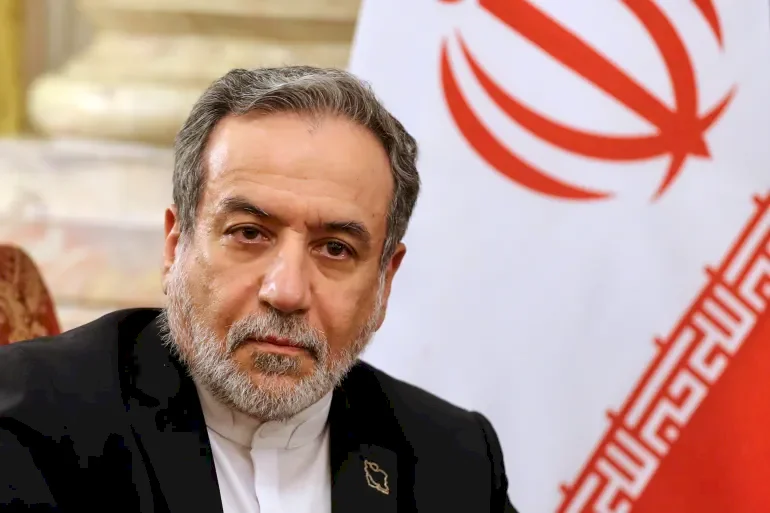
Iraqji Reveals Details of the Attack on the Iranian Supreme Leader's Headquarters
SadaNews - Iranian Foreign Minister Abbas Iraqji confirmed today, Sunday, that the targeting of the former Supreme Leader Ali Khamenei's headquarters during the recent war was the result of a "security breach" that still exists, considering that this breach was not limited to the security aspect but extended to influencing the decision-making process within the country.
Iraqji explained, in an interview with the program "The Story of War" aired by Iranian media, that "the bombing of the headquarters occurred through a security breach, and this breach still exists, and it also affects orientations and decision-making."
He revealed that he was present "at the Iranian leadership headquarters (former Supreme Leader Ali Khamenei's headquarters) at the moment the attack targeted several offices within the area," indicating that the atmosphere leading up to the attack "was warning of the outbreak of war," according to his expression.
Iraqji clarified that "since Friday, March 28, the general atmosphere had shifted towards war," adding that he "met with President (Masoud Beheshtian) at eight o'clock on Saturday (February 28), and informed him that the overall atmosphere was that of war."
He added that "he then met with cleric and senior official Ali Asghar Hojjati at nine o'clock to inform him of a report regarding the negotiations," explaining that "while I was speaking about the atmosphere of war, the attack occurred."
The Iranian Foreign Minister recounted the minutes before the attack, saying: "On that day, as we were leaving the headquarters, I asked Khamenei's office chief, Ali Asghar Hojjati, if the Supreme Leader was there, and he replied that he did not know." He explained that while he was presenting the negotiations report to Hojjati and discussing security tensions with him, the compound was attacked.
He added: "Hojjati was almost rescued from under the rubble, while his secretary was killed in a manner that left no trace of his body. Within seconds, the headquarters was subjected to three attacks."
Iraqji pointed out that "the Strategic Council for Foreign Relations was holding its weekly meeting at that time, while the late Supreme Leader Ali Khamenei was present in his office, and the Secretary of the Iranian Defense Council, Admiral Ali Shamkhani, called for a meeting of the Defense Council."
He considered that "the coincidence of those meetings was not unusual," but he said that "the information gap about these meetings regarding the knowledge of the United States and Israel was likely due to an existing intelligence breach."
He added that "the attack targeted several sites within the Supreme Leader's residence area, including a Defense Council meeting chaired by Shamkhani, the office of Mohammad Shirazi, Khamenei's military bureau chief since 1989, and Hojjati's office, in addition to the Supreme Leader's office," according to his statements.
In a related context, Iraqji clarified that he has not met Mojtaba Khamenei recently, pointing out that only a limited number of people have been able to meet him.
In response to a question about whether he expects Mojtaba Khamenei to assume the position of Supreme Leader, he replied: "He has always been mentioned as one of the candidates."
The Iranian Foreign Minister considered that "the appointment of Mojtaba Khamenei as Supreme Leader sent a message of strength to the United States," as he put it.
He also mentioned that the Iranian authorities had laid plans from the first day of the war to deal with various scenarios, affirming that "in the event of an attack on the Supreme Leader, it was planned to close the Strait of Hormuz."
He added that Tehran agreed to resume negotiations with the United States despite its conviction that war would break out again, explaining that the opportunity for negotiations should not be wasted, even if it were at 10%, as war has its costs, according to his statement.
Iraqji clarified that state institutions and the armed forces were confident that military confrontation would resume, and thus they did not suspend their preparations based on the results of the negotiations, noting that the Iranian military response began only two hours after the war erupted, when Khamenei died on February 28 during a meeting with several military officials, and several members of his family were killed in the initial strikes by the United States and Israel on the capital, Tehran.
In a related context, Iraqji disclosed that the session of the Supreme National Security Council that discussed the approval of the memorandum of understanding with the United States lasted from 9 PM to 3 AM, while the acceptance of the preliminary ceasefire took place in smaller meetings during which it was impossible to hold a session of the Supreme National Security Council, with the basis for any subsequent negotiations being adherence to the terms of the Iranian proposal consisting of ten items.
Iraqji affirmed that the decision to end the war is made collectively within the Supreme National Security Council and becomes effective after the leadership's ratification, considering that the cessation of the war that lasted 12 days was a "correct decision," as it allowed Iran to enhance its military capabilities in the following months.
He added that Iran made adjustments to its missile launch systems during the eight months separating the two wars, making its launch capabilities more sustainable.
 Follow the latest Sada News via Google News
High-level sources reveal to SadaNews: Washington seeks to hold a Gaza Reconstruction Conf...

Iraqji Reveals Details of the Attack on the Iranian Supreme Leader's Headquarters

صراع على إرث خامنئي وسط غياب مجتبى.. والمتشددون يتهمون قادة إيران بـ«الانقلاب»

Hebrew Channel: Kushner Pushing to Enhance Communication Between the United States and the...

SadaNews Report: Israeli Elections with a Settlement Flavor!

1.3 Billion Shekels to Expand Settlements in the West Bank.. A Secret Decision Concealed b...

New York Times: Trump Officially Notifies Congress of Resuming Fighting with Iran
