

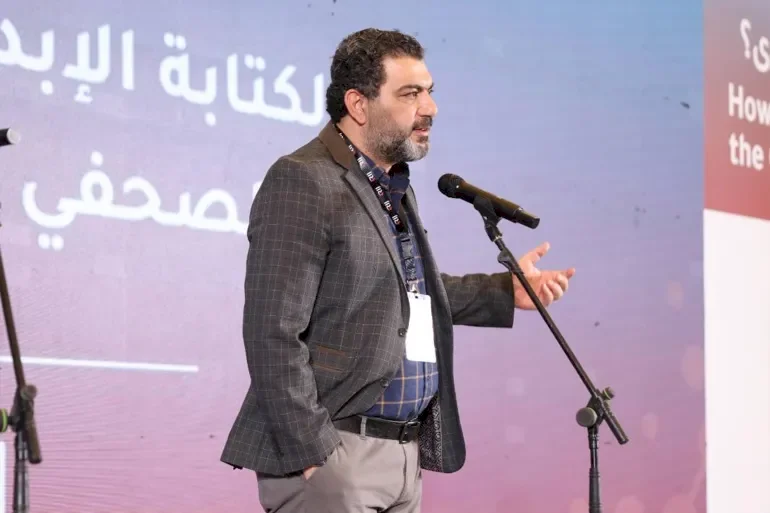
Deferred Crossing to Beyond the Lens.. Abdullah Maksour Writes His Day in the Shabak
SadaNews - In writing about Palestine, there is always that distance that a writer strives to maintain between himself and the experience: the distance of neutrality, the distance of an observer, the distance of a historian. However, Abdullah Maksour, the Syrian novelist and journalist, has chosen to eliminate all of this distance in his new book "Deferred Crossing.. A Day in the Shabak," recently published by the Egyptian-Lebanese Publishing House in Cairo.
His new book is a testimony written from inside the interrogation room itself, from the heart of the moment when time becomes a tool of pressure, and the questions become traps. In this text, Maksour enters the most closed area of Palestinian geography, where photography is absolutely prohibited, and the details are managed behind a dense layer of prohibition and censorship.
A Testimony from Within, Not an Expectation from Outside
From the very first pages, the writer places the reader in a position of participation, not mere reception. He clarifies that he has made alterations to some names and sensitive details to ensure the safety of their owners, while fully committing to the truth of the events. This early acknowledgment, which may seem marginal, is in fact an implicit contract between the writer and the reader, establishing the remaining text on trust.
The experience in the book does not start at the airport, nor at the checkpoint. It begins earlier, from the idea of crossing itself as a haunting concern that resides within the person before finding its way into reality. From here, crossing becomes a complex concept, intersecting the moral question with personal desire, and the right to access Palestine with the cost of this access. In this book, Palestine is not a backdrop for the story; it is the question from which the story arises.
The Shabak interrogation rooms, which Maksour describes with remarkable precision, are managed according to a precise logic, where time stretches until it becomes a punishment, and questions are crafted with professionalism to extract what is beyond their immediate responses by deconstructing the detained person’s personal narrative and testing it time and again. And since the writer does not settle for merely pointing from a distance, he linguistically enters the heart of this practice, reshaping it as a daily structure of the occupation authority, practiced quietly, without the need for exhibition.
For this place, under Israeli occupation, does not record moments as they are; rather, it condenses the entire experience into individual memory, through a narrative that bears the burden of conveying the unseen, leaving a deep impact on those who undergo it and on those who attempt to write about it.
Deconstructing the Daily Structure of the Occupation Authority
"Deferred Crossing.. A Day in the Shabak" presents a personal journey for the writer based on a precise reading of the structure of the occupation authority as manifested in the details. By observing what happens in small spaces, in procedures, in waiting, in the language used, and in the manner in which the Palestinian moment is managed at the Al-Lubban Bridge.
This observation grants the reader a deeper understanding of the nature of the experience in a cohesive and profound literary style, combining journalistic precision with high literary craftsmanship. The sentence is crafted with care, carrying a clear emotional density, and moves with a studied rhythm that aligns with the narrative’s nature. It does not merely convey the event; rather, it shapes it, reshapes it, and gives it an additional dimension. It transforms into an open reflective space, where the personal intersects with the public, and individual experience coincides with larger questions.
The book offers an accurate portrayal of the Palestinian life connected to the only land crossing that links them to the world. What stands out is its high ability to capture what happens outside the traditional image, outside the lens, and outside direct media discourse. The experience depicted is not narrowed down to a climactic moment; rather, it is shaped by a slow accumulation of similar brutal details, where daily subjugation is exercised quietly, without the need for display. This accumulation provides the text with its strength, allowing the reader to approach the experience as a daily lived reality that carries a great deal of exceptionalism.
Writing as the Architecture of Memory
This is not the first time Maksour (born in Syria 1983) has written about open wounds. His trilogy "Days in Baba Amro," "Returning to Aleppo," and "The Way of Sorrows" is considered among the first works to address the details of the Syrian war.
He also provided in his book "Children of the Sea" an excerpted biography of his experience in prison and his journey in search of a homeland. He has published seven novels, in addition to a theoretical book titled "Engineering Meaning" on the techniques of journalistic narrative.
In his previous dialogue with Al Jazeera Net, on the occasion of the release of his novel "2003" about the invasion of Iraq, Maksour spoke about his philosophy of writing in a way that illuminates "Deferred Crossing" today. He stated that literature "does not present history, but narrates the biography of those whom history does not write." He added that he writes about people he knows with all their contradictions and fates that "they did not have a hand in choosing." This same philosophy is manifested in his new book, where the Palestinian who crosses the checkpoint every day does not enter the official history, but rather enters the text as a living memory.
Maksour pointed out what he considers to be the greatest challenge in contemporary writing: "renewal in narrative," and "closeness to everyday language," and "overcoming reality that preceded imagination."
In "Deferred Crossing," it seems that he is putting this challenge into practice. The sentence is carefully crafted, carrying emotional density, and moves with a studied rhythm that harmonizes with the nature of the story. It combines journalistic precision with literary work, not only to convey the event, but to reshape it and grant it an additional dimension.
Source: Al Jazeera
 Follow the latest Sada News via Google News
Senegal and Congo as Examples: Why Do Teams Collapse in the Final Minutes?

Heat Waves: Why Do Some People Die While Others Survive?

How 'The Last Miracles' Was Born from Naguib Mahfouz's Story? The Film Director Reveals th...

Hollywood Enters the 'Microdrama' Race, Betting on Smartphone Audiences

6 Surprises Await You at Samsung's Upcoming Conference.. What Will the Company Reveal?

Combining the Flavor of Coffee with the Calm of Tea.. Can Hojicha Become a New Competitor...

What We Don't Know About Our Parents.. 9 Questions That Will Change Your Relationship With...
