

Senegal and Congo as Examples: Why Do Teams Collapse in the Final Minutes?
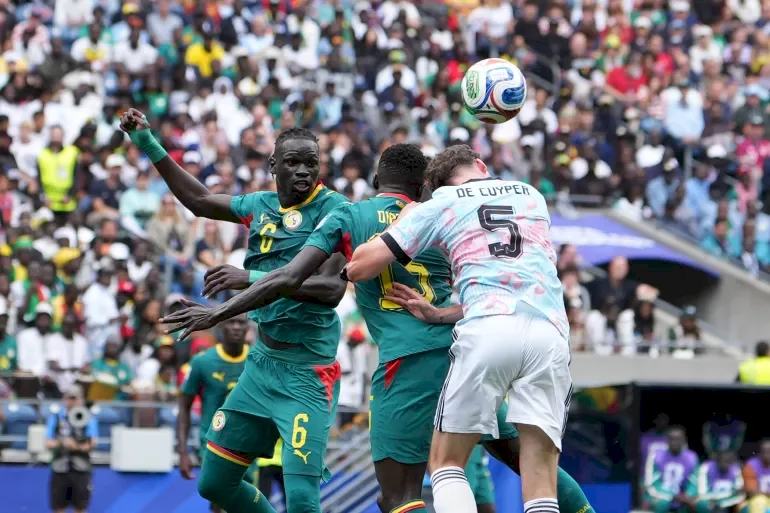
SadaNews - Senegal only needed to hold on for a few more minutes to secure a two-goal lead over Belgium and write a new chapter in its football history. However, this did not happen. Belgium's Romelu Lukaku scored to narrow the gap in the 86th minute, and then Youri Tielemans equalized just three minutes later, before a penalty settled the match in the dying moments of extra time, causing Senegal to lose after being on the verge of advancing to the Round of 16.
Hours before this football surprise, the Democratic Republic of Congo experienced a similar issue. They led England in the 7th minute and held firm for a long time, even appearing to be on the verge of one of the biggest World Cup surprises. However, Harry Kane equalized in the 75th minute, and then scored the winning goal just four minutes before the end, concluding the match with a score of 2-1 in favor of England.
We have here two different defeats in details, but similar in context: a team nearing something great only to retreat. At that moment, things get mixed up, as there are certainly factors related to skill, experience, technical quality, fitness, bench strength, coaching decisions, refereeing decisions, details of space, and even luck (like the penalty in the Senegal match, for example). However, they are not the only factors; there is an important psychological aspect that teaches us a lot about "last-minute goals" and what happens in a player’s mind when victory feels so close.
The Last Minutes Are Not Just an Extension of the Match
If you are a beginner in following football matches, devoted fans who have watched thousands of matches will tell you: "The match doesn’t end until the referee’s whistle." They have learned this through easy and hard ways. A study published in 2025 by American scientists analyzing over 3,400 matches across 21 leagues and tournaments supports this statement completely.
The study found that goals are not distributed evenly throughout the match. As the match progresses, the rate of goals tends to increase, while fewer goals are expected in the initial minutes of each half. This means that the match does not remain the "same match" over time; what happens in the last quarter of an hour does not just continue what happened in the previous quarter, but enters a different context where several factors change, such as players' energy, risk levels, tactical shape, and mental state.
The study did not only examine the timing of the first goal or each goal individually but also the time intervals between goals. The research team found that goals tend to cluster closer together in time, meaning a goal does not always come as a completely separate event but is part of a short wave within the match.
In this context, the team that scores may become more likely to score again shortly afterward, entering what the researchers call "momentum dynamics." When a late goal is scored against a leading team, it can psychologically and tactically open a new phase, where the returning team grows bolder and the leading team becomes anxious or defensive, creating minutes where the chances of the next goal are higher than what the score alone might suggest.
This is very important for understanding what happened in the Senegal-Belgium match, for instance. Belgium’s first goal was a psychological event that completely redefined the match, because before the 86th minute, Senegal was in the position of managing a victory, and afterward, they found themselves trying to prevent a collapse. The difference between these two states is enormous in terms of attention, coaching and player decisions, and even in factors like breathing rates, body movements, and overall mental state.
The study does not claim that the cause is solely psychological; it is ultimately a temporal analysis of goals and not a psychological experiment. However, it indicates that this pattern may reflect an interplay between various factors, including physical fatigue towards the end of the match, tactical changes, increased risk-taking by the trailing team, and possibly psychological momentum. The team that just scored becomes braver while the team that awaits a victory becomes more fearful.
Psychological Momentum
From this standpoint, when Belgium scored its first goal against Senegal, it created momentum. Psychological momentum is a concept studied by sports psychology, described as a change in players' perception of the match after a pivotal event, regardless of the nature of that event. For example, in a study on the impact of a late equalizing goal in knockout matches published in the journal "Science and Medicine in Football," researchers conducted an experiment on 86 players at various competitive levels in football, asking them to imagine a scenario where they were playing in an important final match.
The experiments unfolded as follows: some imagined their team was trailing by one goal (the score was 1-0 for the opposing team) and then equalized, while others imagined their team was leading (the score was 1-0 for their team) and then conceded an equalizer. In both cases, the equalizer occurred either in the 61st minute or the 92nd minute. Afterward, the researchers measured the players' feelings of psychological momentum through various questions, such as which team seemed closer to winning, which was more confident, which felt more frustrated, which was more excited, and which was dominating the game.
The result was the same across all scenarios (1-1), but the players' feelings were never the same. If the player’s team scored the equalizer, their sense of momentum increased; however, if the opponent scored, this sense decreased, according to the psychological surveys in the study.
Most importantly, the timing of the goal amplified the effect. When the player’s team equalized in the 92nd minute, the psychological momentum was significantly higher than if it had happened in the 61st minute. Conversely, when their team conceded the equalizer in the 92nd minute, the psychological momentum was much worse than if it had happened in the 61st minute. Quantitatively, the average momentum when the player’s team equalized in the 92nd minute was 6.00 compared to 4.47 when scoring in the 61st minute, whereas it dropped to 2.53 when the opponent equalized in the 92nd minute compared to 3.50 when it happened in the 61st minute.
This explains why a team scoring late seems to have suddenly evolved, as its players begin to run more, demand the ball more, and tackle with greater confidence. Conversely, the team that conceded the goal appears to lose its capabilities not necessarily because they have lost fitness but because they lose some interpretation of the match, going from thinking, "We are succeeding, we are getting closer," to thinking, "Perhaps what we feared is about to happen."
Approach Mentality vs. Avoidance Mentality
The last statement might be the start of a collapse, as the situation is more complex than it may seem at first glance. In sports psychology, there is a crucial difference between approach mindset and avoidance mindset. A player with an approach mindset asks themselves how to create the opportunity, how to receive, how to progress with the ball, and how to shatter the opposing team’s hopes with a third goal. Meanwhile, a player with an avoidance mindset asks questions like: What if I make a mistake? What if I am the reason my team is eliminated from the World Cup? What if everything falls apart now and we lose?
This kind of inner dialogue influences everything, and this idea is evident in studies of penalty shootouts. In a famous study by Geir Jordet from the Norwegian School of Sports Sciences and Esther Hartman from the University of Groningen in the Netherlands, the researchers analyzed 36 penalty shootout series in the World Cup, European Championship, and Champions League, totaling 359 penalties, and studied the relationship between situational pressure, avoidance behavior, and performance.
Geir and Esther did not settle for just saying that some players get tense in penalty shootouts; they attempted to measure the type of pressure preceding each penalty. The fundamental result was that players scored at a higher rate when the penalty provided their team with a chance to win, but performance clearly declined when the penalty was only necessary to keep the team alive, i.e., to avoid elimination. Of course, we are talking about statistical averages, as no player is the same, and not every team is alike; however, researchers are typically interested in observing any statistical tendency in results and interpreting it.
These results demonstrate that the message inside a player’s head may differ, affecting the outcome. When the thought is, "I will secure the win," the pressure is towards approaching a reward; however, when the message becomes, "If I miss, we will be out," the pressure shifts to a fear of disaster, which raises the likelihood of choking under pressure.
In the final minutes of knockout matches, the entire match can resemble an extended penalty shootout. Every misplaced pass may become a headline in tomorrow’s news, and every defensive error may remain in the national memory for years. Here, the player does not only face the opponent but also a terrifying possibility: being the one who squandered the dream, especially if it’s a dream that has been long awaited, compounding that pressure, and perhaps making the player lose their spontaneity.
The professional player performs most of their skills automatically; they do not think about the movement of every muscle when passing the ball to a teammate or what angle to play the ball as they receive it. Their skills have become almost automatic through years of training. However, there is only one thing that can break all of that: intense pressure that can pull the player back into "conscious monitoring." They begin to think about their foot, their body position, the crowd, the clock, and everything.
This is what sports psychology refers to as "choking under pressure." Scientific studies in this area indicate two primary models that can lead to disaster. The first is the "distraction model," where anxiety consumes part of the player's attention and working memory in any sport, not just football. The second is the "self-focusing model," where the player overly monitors their movements, disrupting a skill they had been executing smoothly.
The Team on the Verge
In this tense psychological context, another aspect arises that should not be underestimated in its effect on players, particularly during critical minutes: the prolonged repetition of certain outcomes or, more clearly, experiences of repeated failure in a specific context, such as confrontations with a particular team or a specific stage in a tournament.
Ultimately, a player or team does not enter a critical match with a completely blank memory; previous defeats are imprinted in their mind, and missed penalties still linger in the back of their thoughts. All of this may evolve over time into an "anticipated pattern," where the athlete may view the new situation as a return to an old scene they experienced the end of previously. Sometimes, this can escalate further, according to a study published in 2000 in the journal "Research Quarterly for Exercise and Sport."
The study tested the role of repeated failure and feelings of lack of control in a motor and cognitive task akin to sports performance. The experiments were designed so that the participants encountered situations where their performance was actually linked to what they did (in half the cases), or where the outcome seemed uncontrollable (in the other half). The results concluded that the combination of failure with a sense that effort does not change the outcome can lead to patterns of performance helplessness.
The danger of this effect increases when a player or team interprets failure as an inherent trait rather than a correctable mistake. If a team gets close to unprecedented achievement again, the past may rear its head again, shifting the player into an avoidance philosophy and perhaps leading them to avoid a bold pass, or to unnecessarily shy away from opportunities, or to retreat their midfield too much, playing as a whole to avoid losing instead of continuing their path to winning.
We see this in all types of matches, not just the World Cup. When any team suffers consecutive defeats from a familiar opponent, it becomes more challenging to recover in subsequent encounters. Unfortunately, while it remains possible, it requires a greater alignment of factors than usual. Besides training and planning factors, there is a psychological barrier players must break to continue performing their duties as needed.
Just One Player
That barrier is not inevitable and can be overcome by precise training scenarios simulating the final minutes against a strong team. The team can practice conceding a late goal without collapsing and have clear routines to follow after every goal, knowing who takes the ball, who passes, and how the plan works, which many teams already do. Scientific studies on dealing with choking under pressure indicate that training does indeed reduce distractions and refocus attention, so developing pre-performance routines and training under pressure conditions resembling competition improves performance in the toughest circumstances.
This type of training is very crucial because it prevents the player, especially the less experienced one, from beginning to self-sabotage, turning fear of losing the win into pressure, which leads to stress, resulting in decision-making breakdown that can cause the victory to slip away in critical moments.
Note that football is ultimately a team sport, and the decline in performance of even one player in the final minutes, for any of the reasons above, may affect the entire line they are playing in and perhaps the entire team. For example, opponents may become closer to the goal if there are multiple poor passes in dangerous areas or if a striker does not press hard enough.
Here, small decisions can turn into a wave of major impact; if this happens while playing against top teams and world-class players—even if those teams have witnessed significant declines during the match—they have the ability to seize a very narrow window of error to turn it into a "comeback in the match" and then into a major victory.
Finally, it is not easy to pinpoint the underlying cause of a team’s decline in the final minutes of a match; it is a highly complex matter. What scientists do is build general probabilities that may help teams improve and enhance our understanding of human behavior under pressure. The cause may relate to fitness, or the coach’s strategy, or the skills of substitutes from both teams. It may also be psychological, related to pressure and its effects on the coach or players. Small fragments from all of these causes might accumulate, combined with even natural luck.
However, what matters in this context is for each team to try to deal with previous losses, no matter how harsh or how often they have repeated, as laboratories for study to evolve in the future, rather than seeing them as an inevitable reality that will continue to repeat over time.
Source: Al Jazeera
 Follow the latest Sada News via Google News
Senegal and Congo as Examples: Why Do Teams Collapse in the Final Minutes?

Heat Waves: Why Do Some People Die While Others Survive?

How 'The Last Miracles' Was Born from Naguib Mahfouz's Story? The Film Director Reveals th...

Hollywood Enters the 'Microdrama' Race, Betting on Smartphone Audiences

6 Surprises Await You at Samsung's Upcoming Conference.. What Will the Company Reveal?

Combining the Flavor of Coffee with the Calm of Tea.. Can Hojicha Become a New Competitor...

What We Don't Know About Our Parents.. 9 Questions That Will Change Your Relationship With...
