

From Cruelty Comes Creativity: Discovery of Advanced Stone Tools from the Heart of the Ice Age
SadaNews - A new scientific study has announced that humans who lived in central China around 146,000 years ago developed complex techniques for making stone tools during a harsh glacial period, a discovery that challenges the common notion that human innovation flourished only in warm and stable periods.
The study, published on May 7 in the "Journal of Human Evolution," relied on re-dating a significant archaeological site known as "Lingjing" in central China, where researchers had previously found advanced stone tools alongside animal bones indicating that ancient humans were slaughtering or processing them on site. However, the novelty of this study was not only the tools themselves but also the time period in which they were made.
An Ancient Bone Changes the Timing of the Story
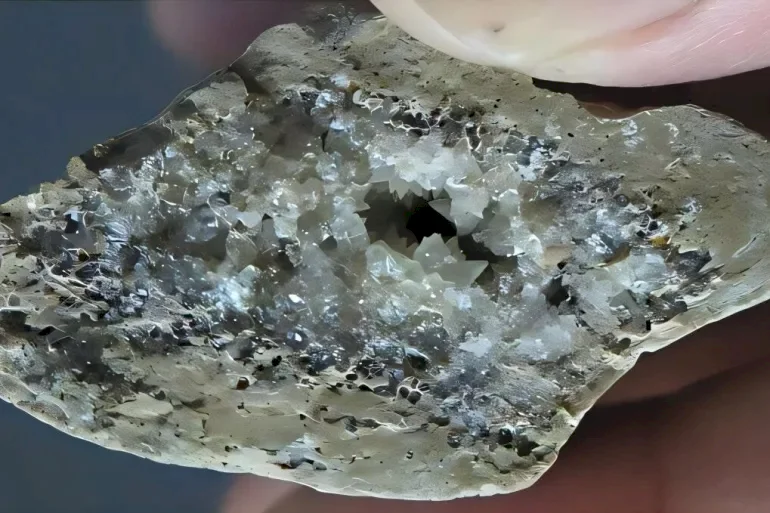
Researchers used fine crystals of the mineral calcite that formed within a rib of an ancient deer-like animal buried at the site. These crystals contain very small amounts of uranium, an element that decays very slowly into another element known as thorium.
By measuring the ratio of these two elements, scientists can estimate the age of the crystals, and thus determine the minimum age of the archaeological layer in which they were found.
The lead author of the study, Changyang Li, a professor of vertebrate paleontology at Shandong University in China, explained that the results indicated the site dates back to about 146,000 years, which is approximately 20,000 years older than previously thought.
Li added that this difference may seem limited, but it significantly altered scientists' interpretation of the site. Instead of these tools having been made during a relatively warm period, as previously believed, they actually belong to a cold and harsh phase of the Pleistocene epoch, which featured recurring ice ages.
The researcher stated, "Here lies the importance of the discovery, as these advanced tools did not emerge in a time of climatic abundance, but in challenging environmental conditions, raising an important question about the relationship between climate and human creativity."
Creativity Under Pressure
The researchers believe that these findings suggest harsh conditions may not have been a barrier to innovation but could have driven ancient humans to develop new skills and techniques to survive. Instead of viewing creativity as a product of comfort and stability alone, the study implies that environmental pressures, like cold and resource scarcity, may be a strong motivator for thinking in new ways.
Li noted that people often imagine creativity as something that flourishes in times of prosperity, but finding these tools during a harsh glacial period presents a different picture; difficult times may drive human beings to adapt and innovate.
The stone tools discovered at Lingjing were not just randomly broken rocks; analysis showed that their makers used organized methods to produce sharp flakes from stones by controlling the striking angles and the shape of the surface struck.
In some cases, the stone core was carefully prepared so that one side was used for striking while another side was designated for producing blades or sharp flakes.
This type of manufacturing requires planning ability, understanding of how stone responds to impact, and a three-dimensional vision of the tool's shape before producing it. These are advanced cognitive skills, which scientists have often associated with human groups in Europe and Africa during that period, rather than with East Asia to the same extent.
According to the researcher, these results do not mean that these ancient humans were exactly like modern humans, but they indicate that they possessed more complex technical and behavioral capabilities than previously thought. It also opens the door to the possibility that East Asia was more diverse and innovative in ancient human history than the traditional narrative reflects.
The study was conducted with support from the Natural Science Foundation of Shandong Province, the National Social Science Fund of China, and the National Natural Science Foundation of China.
Source: Al Jazeera
 Follow the latest Sada News via Google News
Senegal and Congo as Examples: Why Do Teams Collapse in the Final Minutes?

Heat Waves: Why Do Some People Die While Others Survive?

How 'The Last Miracles' Was Born from Naguib Mahfouz's Story? The Film Director Reveals th...

Hollywood Enters the 'Microdrama' Race, Betting on Smartphone Audiences

6 Surprises Await You at Samsung's Upcoming Conference.. What Will the Company Reveal?

Combining the Flavor of Coffee with the Calm of Tea.. Can Hojicha Become a New Competitor...

What We Don't Know About Our Parents.. 9 Questions That Will Change Your Relationship With...
