

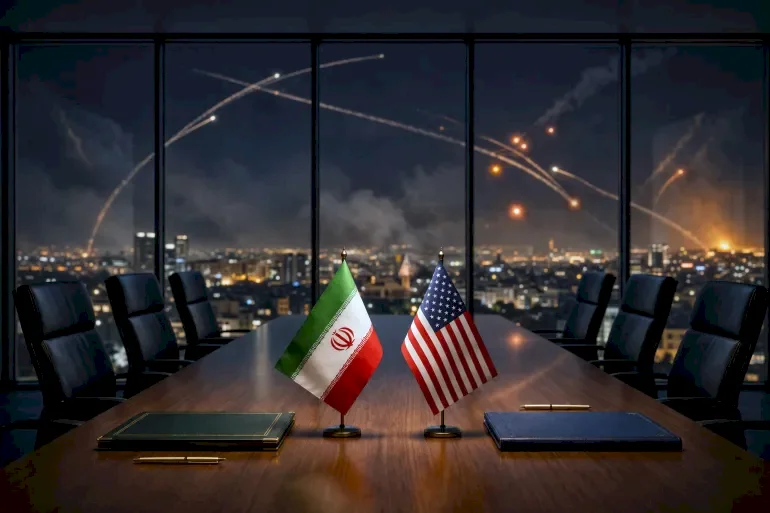
US-Iran Negotiations: 5 Questions to Understand What’s Going On
SadaNews - As US forces advance and the deadline set by Washington for Tehran to reopen the Strait of Hormuz approaches this Friday, behind-the-scenes diplomatic communications are taking place that could determine the fate of the entire region.
The administration of US President Donald Trump has proposed a 15-point plan to end the war, which was met with an Iranian response in the form of a different 5-point plan, raising concerns among observers about achieving tangible progress to spare the region from the threat of a land war.
While the two countries exchange demands, Israel is anxiously monitoring developments for fear that the conflict might end before achieving its own objectives.
Here are 5 important questions answered by the American newspaper The New York Times and the American website The Hill, summarizing the key details of the negotiations.
1- What are the details of the 15-point US plan?
The full details of the plan remain unclear, but the newspaper reported that officials familiar with the points indicated that the US initiative focuses on three main issues:
The Iranian ballistic missile program
The nuclear weapons program, including uranium enrichment
The Strait of Hormuz
Through this plan, Washington aims to end the war in exchange for imposing strict limitations on Iran's military capabilities, while ensuring the smooth flow of shipping in the strategic waterway through which about one-fifth of the world's oil supplies pass.
2- What was Iran's response?
Tehran rejected Trump's assertion that the United States is negotiating to end the war, while the Iranian Khatam al-Anbiya headquarters stated that "America is negotiating with itself."
However, Iranian officials revealed to The New York Times that Tehran is ready to meet with US negotiators in Pakistan next week, provided the discussions do not involve talks about a temporary ceasefire, for fear that the US and Israel could exploit it to strengthen their forces.
The Hill published an Iranian peace plan, based on statements from a senior Iranian official who was not named to the Iranian channel "Press TV." Here are the details of the five conditions:
A full stop to "US and Israeli aggression"
Guaranteeing that war does not recur in the future
Payment of compensation for damages
Ending the war on all fronts, including Iran-backed resistance groups (like Hezbollah in Lebanon)
Acknowledgment of full Iranian sovereignty over the Strait of Hormuz
The website also cited a statement from the Iranian consulate in Mumbai published on the platform X, stating: "Iran will end the war at a time of its choosing, and only if the conditions it has set are met. It will not allow Trump to determine the end date of the war."
3- Who is negotiating for both sides?
In Washington, the matter is led by both Secretary of State Marco Rubio and Vice President Mike Pence, according to the newspaper.
The report noted Trump's confirmation of the participation of his son-in-law Jared Kushner and his Middle East envoy Steve Wittekoff, both experienced in Ukraine and Gaza issues, in the negotiations.
However, The Hill pointed out that Tehran requested the participation of Pence after rejecting negotiations with Wittekoff and Kushner, whom they accused of "backstabbing" during previous rounds of negotiations.
In Tehran, there remains some ambiguity over who will lead the negotiations following the assassination of former Supreme Leader Ali Khamenei and the injury of his successor and son Mojtaba, according to The New York Times.
The newspaper believes Iran may face challenges in responding quickly to the US side, as senior Iranian officials struggle to communicate internally, fearing they could be bombed by Israel if they gather and meet in person.
According to the report, Pakistani mediators, specifically Chief of Army Staff General Asim Munir, are talking with Iranian Parliament Speaker Mohammad Baqir Qalibaf, but the actual leadership in Iran remains unclear.
Pakistan plays the main mediating role, benefiting from its relations with both sides, along with the potential involvement of Egypt and Turkey, according to the newspaper.
4- What is Israel's stance?
The newspaper confirmed that Israel is anxiously monitoring the negotiations, while Israeli Prime Minister Benjamin Netanyahu stated that his country will protect its interests at all costs, no matter the price.
At the same time that discussions are taking place regarding a ceasefire, Israel has widened its attacks in Tehran and against Hezbollah in Lebanon, fearing that the war might end before eliminating the Iranian missile and nuclear threat.
Interestingly, The New York Times is skeptical that a US-Iran agreement would rein in Israeli attacks.
5- Is an agreement possible?
The newspaper emphasized that the main difficulty lies in the widening gap between the two sides. On one hand, Iran refuses to halt uranium enrichment -something the US insists on- and insists on retaining control over navigation in the Strait of Hormuz.
Nevertheless, according to the report, the Trump administration seems to be searching for a quick political "exit" as midterm elections approach and public anger over fuel prices rises.
Notably, polls indicate that the majority of Americans oppose the war against Iran, seeing no national interests served by it.
Thus, both sides face a tough equation: either painful concessions now or a lengthy war of attrition that threatens to drag the region into a fierce conflict.
 Follow the latest Sada News via Google News
Trump: We will make great progress with Beirut.. Aoun: It is time for Lebanon to be stable

The Lebanese Army Deploys in the South and Comes Under Gunfire; Israel Clarifies

Bezhkian: Directives from the Leader to End the State of No War, No Peace

Meeting Between Aoun and Trump Expected Alongside 'Experimental Areas'

Saudi Arabia condemns the Houthi threats to navigation and pledges to protect its ships

Trump: Iran Will Pay the Price for Killing American Soldiers

Global Warning to Americans Due to Rising Tensions in the Middle East
